“The reason it’s so difficult for existing companies to take advantage of innovation is that their processes and business models, which make them effective in their existing businesses, actually make them uncompetitive in addressing change.”
Clayton Christensen
—
What if your greatest success was the beginning of the end?
Did you know that the companies that are best at executing their strategy are often the worst at changing it?
Not for lack of vision, but for excess of competence .
Success is not just measured by how much you win, but by how quickly you can change the rules of the game.
The paradox of success
The processes, incentives, and business models that make you successful today are the same ones that will make you vulnerable tomorrow.
Success creates a powerful but dangerous logic: what works tends to repeat itself, and what repeats itself becomes habit.
Every company thus ends up building an invisible cage of habits : procedures that guarantee quality but slow down decision-making, KPIs that optimize costs but minimize experimentation, a culture that rewards perfection and stifles risk.
At a certain point, the organization stops responding to the market and begins to answer only to itself.
This is where success becomes a closed system: efficient, coherent, and irremediably fragile .
Do we have a strategy? Seriously…
There is a precise, almost imperceptible moment when a company stops making strategy and simply starts defending its surrogate .
When things are going well, they says:
“We already have a strategy, we don’t need to work on it.”
Yet he fails to explain why that strategy actually works.
When things go wrong, they says:
“We have no time for strategy, we have to survive.”
And so everything becomes urgent, but nothing is more important.
Both positions are, simply, stupid .
One is blind with trust, the other is blind with fear.
In both cases, the company stops thinking strategically: either it deludes itself into thinking it doesn’t need it, or it convinces itself it can’t afford it.
The strategic illusion of success
In a growing and “pushing” market, even a mediocre strategy can seem brilliant.
When the tide comes in, all boats float, even the poorly built ones.
A company that grows in a favorable environment tends to confuse luck with strategy.
It interprets market growth as proof of the validity of its choices, consolidating processes, metrics, and incentives born in a cycle that will end sooner or later.
When the tide goes out, however, it is discovered who was simply floating, without having moved from the port.
The danger is the illusion of being right, not of being wrong.
The mistake forces you to correct your course.
Illusion pushes you to strengthen the wrong direction.
And the better you are at executing, the faster you get away from the sweet spot.
Rethinking the playing field
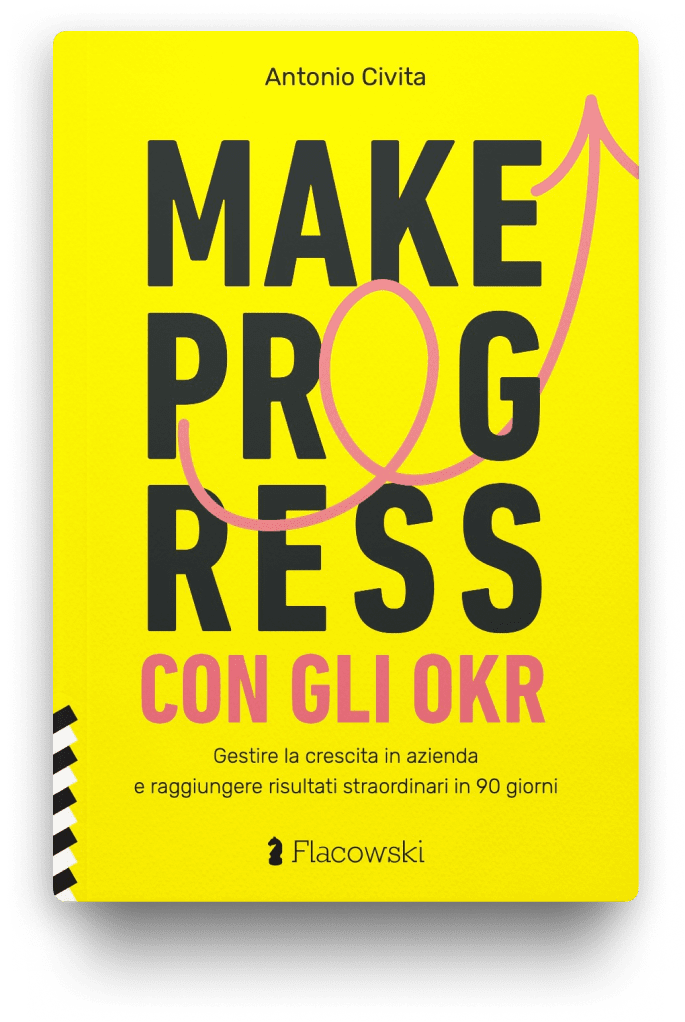
MAKE PROGRESS® doesn’t ask you to “innovate more.”
It invites you to answer two questions that every business leader should ask themselves.
Question 1
Are we still playing on the most fertile ground? Do you have any numbers to back this up?
Question 2
What new fields could we explore, and what habits would we have to abandon to actually do so?
Progress is not an act of creativity, but of clarity: recognizing that the soil that nourished you may no longer be fertile.
This is why MAKE PROGRESS® is not a planning method, but a way to learn to change fields before the market forces you to do so .
Moving to a new field without changing behavior is useless.
Long meetings, rigid annual budgets, and the tendency to manage people rather than processes—these are the real barriers to change.
Focus vs. Myopia
It’s not enough to know what we do well, we need to recognize why we stop growing.
Many companies remain trapped in the soil that made them successful, even when it no longer produces value. They continue to irrigate it with the same metrics, the same incentives, the same rituals.
When, in an attempt to “focus,” we look too closely, for too long, only at our own business (its products, processes, numbers), we lose depth of field. We become strategically shortsighted .
Strategic myopia occurs when leaders see only what is close, familiar, and controllable.
It is the tendency to interpret the future as a version of the past (“it will be the same, only bigger”) or as something totally alien (“it’s another game, it doesn’t concern us”).
Both views are cognitive shortcuts that reduce complexity rather than understanding it.
In both cases, the result is the same: the organization becomes blind to the real changes in where and how it plays. It mistakes operational continuity for strategic stability and stops questioning the underlying logic that makes it successful.
The most effective way to shift focus is to update incentives
Every incentive system is a strategic lens: it lets you see only what rewards you .
If you incentivize efficiency, you will have more control.
If you encourage exploration, you will get more learning.
But beware: optimizing for efficiency is not the same as optimizing for exploration.
Efficiency improves what already works.
Exploration, on the other hand, accepts that many things won’t work at all .
Organizations prize not only operational efficiency, but also cognitive efficiency: they prefer to be right quickly rather than learn slowly.
When an organization optimizes for exploration, the incentive mechanism changes nature:
- Success is not in the result , but in the discovery .
- Failure is not a loss , but a cost of learning .
- Speed does not measure how much you produce , but how much you understand in less time .
And this requires leadership capable of protecting those who experiment , not just rewarding those who perform best.
Alignment vs. Control
If focus identifies the field that is still worth playing on, alignment ensures that the entire system (incentives, language, behaviors) moves in the same direction.
One without the other is useless:
- Focus without alignment is vision without traction .
- Alignment without focus is efficiency without meaning .
It’s not enough to update metrics: we need to redefine what it means to do good work . As long as “good work” equates to “zero errors,” there will be no progress.
When “good work” means “we understood something we didn’t know yesterday,” exploration becomes an integral part of the strategic game.
What to bring to the office
- Habit lock-in: Ask yourself which organizational habits generate results today but could become constraints tomorrow. Every procedure that optimizes efficiency should be tested to determine whether it limits adaptation.
- Strategic myopia: Don’t just focus on what’s close by. Spend time looking outside and beyond your business (emerging customers, alternative models, weak signals). Strategic distance is a muscle to be trained.
- Illusion of success: When the numbers are rising, ask yourself if you’re winning on merit or context. Don’t confuse market strength with the soundness of your strategy.
- Incentives for exploration: Measure progress in terms of learning, not output. Develop metrics that reward intelligent experiments, not just predictable performance.
- Focus and Alignment: Choose a fertile playing field and ensure the entire system (language, incentives, behaviors) moves in the same direction. Vision without alignment is theory; alignment without vision is inertia.
3 questions to reflect on
Progress does not come from improving what we already know how to do,
but from questioning what we think we know.
Ask yourself, and ask your team:
- What part of our winning today will make us unable to win tomorrow?
- What are we really rewarding: the result or the discovery?
- Are we defending what we know how to do or are we learning to create a real strategy?
ALWAYS MAKE PROGRESS ●↑
Antonio