| ✱ Growth Machine Workshop. 90 minutes to build your company’s growth machine. Get your pass. |
“Don’t tell me what you think, tell me what’s in your portfolio.”
Nassim Nicholas Taleb, from the book Skin in the Game
—
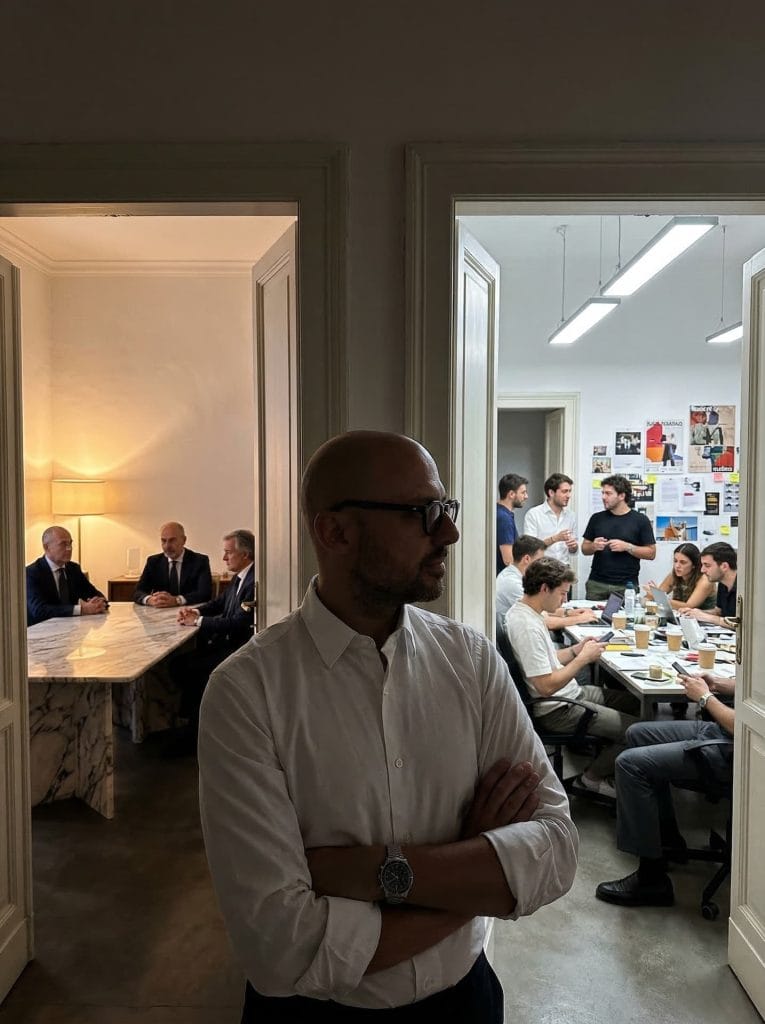
There’s a question I always ask at the beginning of a project.
This isn’t a technical question. It’s not about numbers, KPIs, or organizational structure.
“Who is responsible for strategy in this company?”
The response often comes in less than three seconds, depending on who is missing from the call.
“The CEO,” “the executives,” “the management team.”
An incomplete answer that costs dearly.
Because that answer describes the organizational chart, not who can actually influence decisions.
And the difference between the two, in my experience, is exactly where many implementations fail.
The first step that almost everyone skips
When a company decides to implement MAKE PROGRESS®, the first step is not building OKRs, it is not defining KPIs, it is not even doing a competitive analysis.
The first step is to build the STRTGY team .
The STRTGY team is the group of people who will actually work on the strategy, not just those higher up in the hierarchy.
Most organizations don’t know who to include, and when they try to respond, they make one of two classic mistakes .
The first: it puts only those who decide, that is, those with formal power, in the room. The result is a strategy that no one actually executes, because those who should execute it didn’t participate in its construction.
The second: it broadens the scope too much, including everyone who “should know.” The result is a room where no one decides anything, because every voice carries equal weight even when the responsibilities aren’t.
In both cases, the strategy goes nowhere.
Not everyone in the room is at the same risk
| ✱ Do you really have a strategy? Find out in 3 minutes and get personalized feedback on where to act first. Take the assessment. |
There is a distinction that has become increasingly clear to me over the years.
Not everyone enters the strategy room with the same attitude.
There are those who make decisions by risking their own capital, reputation, assets, identity, and years of life invested in the business.
And there are those who participate in the same discussion, risking above all their role, salary, professional career, or internal reputation.
These are not trivial differences.
They change the way we look at priorities, risk, timeframes, investments, and even the meaning of the word “strategy.” Those who take greater risks aren’t automatically right: they’re looking at the problem with different stakes. That difference, if no one organizes it into a process, produces distortions in both directions.
Without a common process, the strategy ends up in one of two equally poor extremes.
In the first case, whoever has more power decides. The founder, CEO, owner, or whoever is recognized as leading the organization sets a direction. Others execute, perhaps intelligently, perhaps with discipline, but without truly feeling part of the strategic construction. At that point, collaboration declines; people don’t stop working, but they stop actively contributing.
In the second case, the opposite happens. Strategy is delegated, explicitly or in practice, to those furthest removed from entrepreneurial risk. The result isn’t necessarily incompetence. Indeed, managers are often capable, serious, well-organized, even excellent at their craft. But without a real connection to the risk the company is willing to assume, strategy tends to become cautious, fragmented, and incrementalist. Not out of ill will, but out of consistency with incentives and role.
Thus, the entrepreneur finds himself in an uncomfortable and familiar position: he doesn’t know whether he should micromanage everything, delegate, correct after the fact, or intervene only after the damage has already been done.
You need someone who can say no
Here, however, it is worth making a clarification that I don’t make often but which is necessary.
Personal risk alone is no guarantee of good strategy.
WeWork had a founder with all the assets at stake and almost absolute control. The result was a $47 billion valuation followed by Chapter 11 bankruptcy. Theranos had a founder with all the equity and no real counterweight on the board. The result was a fraud conviction. In both cases, there was personal risk. What was missing was someone who could say no with authority and the right information to do so.
This changes the question to ask.
It’s not enough to ask who is risking enough to make courageous decisions. We must also ask who, in the room, has the legitimacy and information to challenge a wrong direction.
If everyone agrees, maybe there’s a bigger problem to solve.
Berkshire, Inditex, and Southwest share a specific characteristic: in addition to those risking capital, there was always someone capable of challenging management, with the right skills and the legitimacy to do so. Berkshire does this through a culture of disclosure and letters to shareholders that force transparency. Southwest does it through profit sharing, which turns every employee into a direct economic stakeholder. Inditex achieved this through a clear separation between owner and operational CEO, where Pablo Isla had the real authority to dissent.
In the cases that failed, the problem wasn’t a lack of vision or courage. It was a lack of counterbalances.
WeWork and Theranos had founders with super-voting shares and boards that lacked both the technical expertise and the independence needed to block bad decisions. Enron and Wells Fargo had compensation committees that tolerated clearly distorted incentive schemes, without ever asking the right question: does this system reward the behavior we want or the behavior we’re willing to ignore?
This is what, in my experience, separates a STRTGY functional team from a meeting where decisions are made before entering.
It’s not enough to know who carries the risk. You need to know who has the right and the ability to say that the direction is wrong. And that person must have the information to do so with arguments, not just with the authority of their role or personal courage.
When the goals are there but the company remains stationary
This, however, is not yet the complete diagnosis.
In many companies there is no lack of will to improve, no lack of goals, and no lack of capable managers.
There’s no shared X-ray across the company. And when there’s no shared X-ray, everyone talks about the same patient, but everyone only looks at their own medical history.
The sales director sees the commercial priorities.
The CFO sees economic-financial control.
The operations manager sees efficiency and continuity.
Marketing sees the brand, the positioning and the pipeline.
The entrepreneur sees the overall risk, the direction, the invested capital and often even something that others don’t yet see.
Everyone can be right, from their own point of view.
The problem is that these points of view, if they are not organized within the same framework, instead of adding up, they overlap.
This is where many companies get into what I call patchy goal management .
Everyone has goals. Everyone knows them. Everyone can defend them. Everyone has KPIs, milestones, dashboards, periodic reviews, operational plans, maybe even OKRs.
On the surface, the company is tidy.
But upon closer inspection, we discover that those objectives are often disconnected. Not because they’re poorly written. Not because they’re unprofessional. Not because the managers aren’t up to the task.
They are disconnected because too often they only represent a numerical description of the respective job descriptions.
Sales has its numbers. Operations has its numbers. Finance has its numbers. Marketing has its numbers. Human resources has its numbers.
Everyone is competent in their own area. Everyone recognizes their own priorities. But the whole doesn’t automatically generate strategy. It generates, at best, good local execution. At worst, a sum of functional optimizations that hinder each other.
This is why even good managers can be ineffective. Not because they lack intelligence or discipline, but because they operate poorly within a logic that hasn’t been harmonized.
The combination that works is not the one you expect
There is a pattern that emerges quite consistently from the most studied business cases.
The founder who does everything alone doesn’t win. Professional management that manages without ownership doesn’t win. A combination of the two wins, when roles are clear and don’t overlap.
Google, in its most productive years, had Larry Page and Sergey Brin as controlling shareholders with supervoting rights, and Eric Schmidt as operating CEO, explicitly described by the press as the company’s “adult oversight.” The founders’ task: to maintain the company’s long-term strategic direction. Schmidt’s task: to translate that vision into a scalable business model. The result: one of the most profitable advertising systems in the history of the digital economy.
Inditex worked the same way. Amancio Ortega as the reference shareholder with a very strong ownership concentration. Pablo Isla as CEO with real operational authority and the right to dissent. In 17 years, the market value increased from approximately €15 billion to €85 billion. Not by magic, but because the two roles were separate and respected.
Microsoft under Satya Nadella follows the same logic: a board with the founders’ legacy and a professional CEO with compensation tied to long-term results, not quarterly. The cloud-first pivot and the partnership with OpenAI were possible because the structure allowed for multi-year risk-taking.
In contrast, Nokia and Kodak are cases where management was technically competent but structurally detached from proprietary risk. Nokia’s managers were good. They understood the industry. But no one in the room was risking enough to truly want the transformation, even at the cost of cannibalizing the existing business. Symbian was protected not by strategic conviction, but by consistency with the incentives of those who had to defend it.
The mix works not because it’s more democratic. It works because it combines the patience of those who risk their own capital with the operational expertise of those who know how to execute. These are two different things. They are rarely found in the same person. They are almost always found in different people who must work together with clear roles. A Bain & Company study of over 1,700 public companies found that companies with strong ownership alignment grew revenues at about three times higher than similar companies without them.
Do you have a Power Couple?
| ✱ The Operational Manual. All the tools to build a STRTGY team and translate strategy into OKRs and measurable growth. Order your copy. |
In MAKE PROGRESS® this combination has a precise name: Power Couple .
It’s not a romantic metaphor. It’s a functional structure. The Power Couple is the strategic pairing that every organization needs to intentionally build: one who brings the proprietary risk and long-term vision, and the other who brings the operational expertise and ability to translate that vision into systems and measurable results.
In the examples you read above, the power couple was Larry and Schmidt, Ortega and Isla, the Microsoft board and Nadella. In each case, the two roles were separate, respected, and clear. Neither tried to do the other’s work. Each brought what the other lacked.
In smaller companies, where the founder often finds himself doing both, the Power Couple is constructed differently: you identify who on the team possesses the characteristics of the second role and give them the legitimacy to exercise it. It’s not a question of the organizational chart. It’s a question of clarity about who does what and why.
The Power Couple neither eliminates nor reinforces hierarchy: it only makes grounding more effective. Those who decide remain those who decide. But now they decide with someone who can truly contribute, not just execute.
When I build strategic teams with business leaders, the first thing I ask each person is to identify their own power couple. Not their organizational chart, not their department, not their direct reports. Their own power couple.
The answer to this question says more than any organizational assessment. Those who find it immediately have already worked on this dynamic, even without naming it. Those who struggle to answer are usually still trapped in one of two extremes: either they do everything themselves, or they’ve delegated without building the necessary relationships to do it well.
Building a STRTGY team means first understanding who makes up the Power Couple in your organization. Everything else comes afterward.
The incentives that align (or misalign) everything else
There is one final element that almost everyone addresses last, but which actually influences everything: the incentive system.
I’m not talking about annual bonuses or performance bonuses. I’m talking about something more structural: the mechanism that determines what is best for everyone in the room, over what time horizon, and with what personal consequences .
Charlie Munger said it with his trademark clarity: Show me the incentive system, and I’ll show you the behavior.
The most common problem I observe in strategy teams isn’t a lack of expertise. It’s that skilled people are incentivized to optimize in the short term, even when the strategy requires long-term decisions. This isn’t out of bad faith, but rather out of rational consistency with their own evaluation system.
Southwest Airlines is the most cited example because it works the opposite way: profit sharing turns every employee into a direct stakeholder in the company’s annual results. The result is that even those who aren’t on the board have a concrete economic reason to focus on overall profitability, not just their own function.
Under Nadella, Microsoft shifted top management compensation to multi-year time horizons: tied to cloud performance, not quarterly. This is one of the factors that made the pivot possible, as it removed the incentive to protect the legacy business.
The question I invite you to ask yourself is not “how do you motivate people?” but “does this system reward the behavior we want to engender, or only the behavior we’re willing to tolerate?”
In the STRTGY team, this question translates into a specific check: before building OKRs, we verify that the incentives for those who must achieve them are consistent with the strategy’s time horizon. If they aren’t, OKRs become a style exercise.
Why I created MAKE PROGRESS®
That’s why I created MAKE PROGRESS® —the operational method that helps entrepreneurs and managers build and manage strategy collaboratively, with precise tools and a replicable process. Not a theoretical framework: a working system for translating direction into OKRs, KPIs, and measurable growth.
Not because I believe strategy can be transformed into a mechanical formula. Nor because I think judgment, interpretation, or the distinction between roles can be completely eliminated.
For me, there is only one point: to create a system that allows the organization to see the same company.
A shared understanding of real needs. A concrete basis for discussing shared priorities, trade-offs, investments, and operational implications.
When I say this, I don’t mean a generic cultural alignment. I mean specific tools that make the picture clear: the STRTGY Focus One Pager , the Growth Machine , a coherent system of KPIs and OKRs . Different tools, but with a common function: to prevent everyone from interpreting the strategy based on a different view of the company.
This does not eliminate judgment, it disciplines it into a method.
It doesn’t make everyone the same, it makes everyone focused on the same reality.
And this is where the difference between entrepreneur and manager becomes a resource rather than an obstacle.
Centralize decisions, decentralize execution
In a good strategic system, it’s not necessary for everyone to have the same role in the final decision. In fact, it wouldn’t even be fair.
Ultimately, those who make decisions are those with the greatest interests in the organization, especially those who risk their own capital and are recognized as the company’s leaders. This shouldn’t be hidden to appear more democratic; rather, it should be made clear.
I have encountered many boards where democracy and delegation were merely interjections in the conversation.
But clarifying who decides does not mean accepting that strategy must remain opaque, intuitive, or charismatic.
It means making a more mature distinction and embracing the fundamental principle of strategic execution: centralized decisions, decentralized execution .
This distinction also resolves a potential misunderstanding of what I’ve said so far. The STRTGY team isn’t an extended committee that makes decisions together. It’s the group that builds the strategy, analyzes it, tests it, and makes it executable. Those who decide remain those who decide. The STRTGY team’s job is to ensure that that decision is made with the right information, the right perspectives, and the right balance of factors.
And I want to say this, regardless of the organizational model adopted.
The choices that define direction, priorities, trade-offs, and risk-taking must remain centralized where they belong: close to those who bear the risk and have ultimate responsibility for the course.
Execution, on the other hand, must be decentralized. It must be able to operate within the organization more flexibly, more quickly, more responsibly, and less dependent on the constant presence of top management.
If you centralize everything, you suffocate the company. If you decentralize even the very things that define the strategy, you disperse it.
MAKE PROGRESS® was created to avoid both traps.
On the one hand, it reduces micromanagement, because the entrepreneur no longer has to intervene in everything for fear that, if he or she relinquishes control, the organization will collapse. If the overview is shared and priorities are made explicit, it becomes easier to understand when to intervene, where to intervene, and, above all, where it is no longer necessary.
On the other hand, it prevents managers from simply executing without understanding, because they aren’t simply given objectives to achieve. They are empowered to understand the strategic rationale behind those objectives, the trade-offs they express, and why some numbers matter more than others.
This changes the quality of collaboration.
The right answer to the initial question
So I go back to the original question.
“Who is responsible for the strategy?”
The right answer isn’t the CEO or executives. Not as a category.
The right answer is: the right people, in the right role, with the right responsibility, within a shared process.
It’s called STRTGY team.
And building it well is the first step to everything else.
To learn more
Founder and ownership structure
- Founder-Led Companies Outperform the Rest — Here’s Why — HBR/Bain: S&P 500 companies still led by their founders generate 31% more patents and bolder investments than their founder-less peers.
- Founder-led companies sustain superior performance — Bain & Company: Analysis of 1,700+ publicly traded companies, revenue growth rate approximately 3x that of companies without ownership alignment.
The founder/manager mix in successful cases
- Eric Schmidt departs, and Alphabet’s era of adult supervision is over — Fast Company: Schmidt’s role as Google’s “adult overseer” and the logic of the strategic duo.
- Pablo Isla: A conversation with the Inditex CEO for 17 years — Peter Fisk: How Ortega and Isla separated vision and execution at Inditex for 17 years.
- Owner’s Manual — Berkshire Hathaway — Buffett’s Guiding Principles: The document that defines what it means to make decisions as an owner.
Governance and checks and balances
- The Strategic Decisions That Caused Nokia’s Failure — INSEAD: An analysis of the strategic decisions that led to Nokia’s collapse, focusing on management’s detachment from proprietary risk.
- What exactly happened to WeWork? — Corporate Governance Institute: How a Voting Structure and Lack of Balance Turned a Startup into a Case of Failed Governance.
Long-term incentives
- Paying It Forward: The Southwest Profit Sharing Plan — Southwest Airlines: the history of the profit-sharing plan since 1971 and how it turned employees into owners.
- The Long-Term Payoff of Employee Ownership — FCLTGlobal: Empirical Evidence on the Benefits of Employee Ownership on Retention, Engagement, and Long-Term Performance.
Antonio Civita is the founder of STRTGY , an anti-consulting firm that works with entrepreneurs and leadership teams on strategy, growth, and operational systems. He developed MAKE PROGRESS®, the method that helps organizations translate strategy into shared systems, OKRs, and measurable growth.