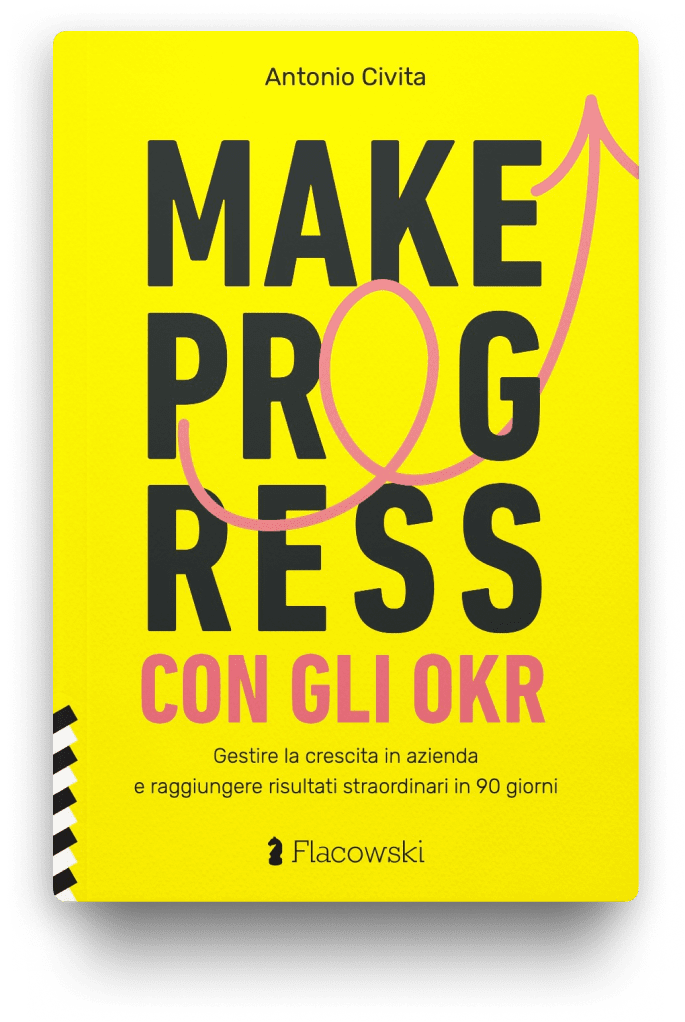
| IN VERY BRIEF ✱ Trends Library 2026. Update coming soon, get LIFETIME access to all trends with 17% off with code “trends2026” ✱ Growth Machine Workshop. 90 minutes to build your company’s growth machine. New dates . ✱ MAKE PROGRESS. Discounted for a limited number of copies . |
——
“If everyone agrees with your decision, then you haven’t added any value, because they would have made it even without you.”
Ben Horowitz, The Hard Thing About Hard Things
●↑
In 2002, two brothers from Texas entered the market with a terrible strategy .
Selling a portable refrigerator for $300.
Not a special refrigerator. Not a refrigerator with artificial intelligence.
A portable refrigerator. The kind you find at the supermarket for $29.99.
The market looked at them as it looks at those who have lost touch with reality.
YETI now has annual revenues of nearly $1.9 billion.
Other terrible strategies
Liquid Death sells canned water with skulls and a name that sounds like a metal band. Valuation: $1.4 billion.
Airbnb asked people to let strangers sleep in their beds. At its stock market launch, it was worth more than Hilton, Marriott, and Hyatt combined. Today, it has a market capitalization of over $75 billion.
Red Bull has convinced people to pay more for a smaller can and a drink that tastes like cough syrup.
Southwest has eliminated business passengers from its model.
Each of these companies built their competitive advantage on a strategy that any sane person would consider wrong .
Even in Italy we have terrible strategies that work
Mario Moretti Polegato’s strategy for Geox : perforate the soles of shoes to let feet breathe. All the manufacturers he proposed the patent to said no. Today: 60 patents, revenue in the hundreds of millions.
Leonardo Del Vecchio’s strategy for Luxottica : to become a subcontractor with a major brand, starting with an eyeglass components workshop in Agordo, a town of 5,000 in the Dolomites. Net worth at death: over $27 billion.
Oscar Farinetti’s strategy for Eataly : create a supermarket where everything costs more because the food is Italian. Today, it has 40 locations worldwide, from Turin to Dubai.
Ernesto Illy’s strategy for Illycaffè : industrialize single-serve coffee in 1974 with paper pods when everyone had a moka pot. He invented an entire category that is now worth billions.
Pietro Ferrero’s strategy for Ferrero : dilute cocoa with Piedmontese hazelnuts because it was too expensive. This is how he invented Nutella, the world’s best-selling spread.
Enrico Piaggio’s strategy for Vespa : in an Italy that dreamed of automobiles, convert an aircraft factory destroyed by the war into a factory that produced a small, strange scooter.
Massimo Banzi’s strategy for Arduino : open-source hardware from a design school in Ivrea, freely distributed designs, and a seemingly nonexistent business model. Acquired by Qualcomm in 2025.
Miuccia Prada’s strategy for Prada : using parachute fabric to make luxury bags instead of leather. Her nylon bags are now iconic.
Marco Porcaro’s strategy for Cortilia : sell fruit and vegetables online. “Ugly but good” products delivered to your home.
Each of these Italian companies built its competitive advantage on a strategy that seemed absurd .
What does the market “think”?
Over the years, I’ve worked with hundreds of entrepreneurs and management teams. I’ve seen strategies discarded before they’ve been tested .
Not because they were weak. Because they sounded too weird to “work.”
The pattern is always the same. You have a hunch. It feels right. Then you filter it by “what would the market say?” and throw it away.
Your company has no shortage of good strategies. But every time you ask yourself, “Does this make sense?”, you’ll throw away the only ones that can create a competitive advantage that will protect you over time.
Everything that makes sense, everyone is already doing.
How to understand if it might work
Does your strategy solve a problem people want to solve, in a way that no one is considering because it seems wrong?
If the answer is yes, you’ve got something.
Now ask yourself: is it so bad that no competitor would copy it because it “doesn’t make sense to them”?
You’ve just found what we at MAKE PROGRESS® call “sustainable superiority”: something that sets you apart and that others can’t replicate, precisely because they can’t or won’t.
That space between “no one would do that” and “it might work for us” is where low competition and high margins arise.
Not what you were looking for?
3-minute exercise
Take a sheet of paper.
- Write down the 3 strategies you’ve discarded in the last year because “the market wouldn’t understand them.”
- Which ones solve a real problem?
- Which ones are so terrible, that they might work?
- Which one excites you the most?
- Which one can you bring into contact with a small number of customers in the most economical way possible?
If you feel that not doing it will cost you more than doing it wrong, give yourself a plan:
- Build a test: “if we choose X, we expect Y by Z.”
- Assign a budget, not too small that it fails due to lack of resources, not too large that it becomes a problem if it fails.
- Select a handful of metrics to monitor, I wrote a book about this (which is now on sale too)
- Set a deadline to figure out whether it makes sense to continue or not.
Having everyone agree is not a good strategy
The next time someone tells you, “This strategy will never work,” stop for a second.
Not because I’m wrong.
But that’s exactly what they told Mario Moretti Polegato of Geox, Leonardo Del Vecchio of Luxottica, Enrico Piaggio of Vespa, Miuccia Prada, and Pietro Ferrero of Nutella.
What’s the strategy you have in your drawer that you keep discarding because it “makes no sense”?
Reply to any emails you receive from me. I’m curious.
ALWAYS MAKE PROGRESS ●↑
Antonio