| IN VERY BRIEF Stop procrastinating alone. Work on your strategy with MAKE PROGRESS®. See the Growth Machine in action. Geely 2030, deconstructed Strategic Debt Explained in Full. Get the book . |
“Plans are just good intentions unless they immediately degenerate into hard work.”
Peter Drucker, the man who invented management according to BusinessWeek
Every week I meet dozens of professionals and executives who readily recognize the importance of working on their company’s strategy …
Such important work that no one has even started doing it yet!
The ancient Egyptians had two words for this: one meant laziness, the other meant waiting for the right moment . The problem is that those who procrastinate on strategy think they’re doing the latter, but are actually doing the former.
The Greeks called it akrasia , that is, acting against one’s better judgment .
You call it “I didn’t have time.”
Everyone calls it “procrastination.”
Over the past 5 years, I’ve facilitated strategy work with hundreds of professionals and businesses using the MAKE PROGRESS® method, and the pattern I see most often is always the same.
The founder of a 20+ person agency told me, “We know how to develop strategies for clients, but we’ve never written one for ourselves.” In two years, they’d gone from 10 to 21 people, but management was still the same as when they were 10. He couldn’t separate client work from business work. Every time he tried to stop, an emergency arose. The first email in the morning set the tone for his day. He started with a 3-minute exercise: identifying the bottleneck in his Growth Machine. That single starting point unlocked the rest.
I’m about to show you the exact mechanism and a 3-minute exercise to nip strategic procrastination in the bud .
Now, don’t say you’ll read this newsletter later, okay? Finish what you just started…
Because your brain always chooses… something else.
Your brain has a simple rule: do the things that yield immediate results first. Update project KPIs? It can wait. Make a call? Do that now. The strategy works the same way: it always loses to anything that gives you immediate satisfaction.
In 2006, researchers Piers Steel and Cornelius König demonstrated this with a model called Temporal Motivation Theory (TMT) and explained it with this formula:
Motivation = (Expectation x Value) / (Impulsivity x Delay)
Where,
- Expectation: How much do you think you can do? (If you don’t know if it will work, this number collapses.)
- Value: How much does it matter to you? (Really, how important is it to you?)
- Impulsiveness: How distractible are you? (Does a notification suffice, or can you stay in the flow?)
- Delay: How long will it take to see results?
Among these variables, the one that really matters for those who run a company is Delay .
Distractions have near-zero delay: they are instant gratification.
The strategy? Not only does the return take months to arrive, but you don’t even know where to start!
For your brain, a task without a clear action is a task to be avoided.
There are 3 more hidden variables for those who procrastinate on business strategy work.
TMT explains the general mechanism, but there is a more specific level that concerns only those who are responsible for deciding the direction.
1. Uncertainty
Strategy requires making decisions with incomplete information. Your brain interprets uncertainty as risk, and risk as something to avoid. The result: you procrastinate until you have “all the data.” But all the data never arrives.
2. Commitment
Writing a strategy means committing yourself. Every direction chosen is an alternative direction eliminated. For those accustomed to keeping options open, commitment is a high cognitive cost.
3. Reputational cost
If the strategy turns out to be wrong, your name is at the top of the document. Procrastination protects your reputation because if you don’t decide, you can’t go wrong.
Every week that passes without a clear strategy accumulates what I call strategic debt . It’s like technical debt in software: you don’t see it right away, but at some point the system slows down, people become misaligned, and opportunities disappear.
A manager decides, he doesn’t let the calendar decide.
Growth Machine Anti-Procrastination Recipe (3 min)
You don’t need a day offsite to work on strategy.
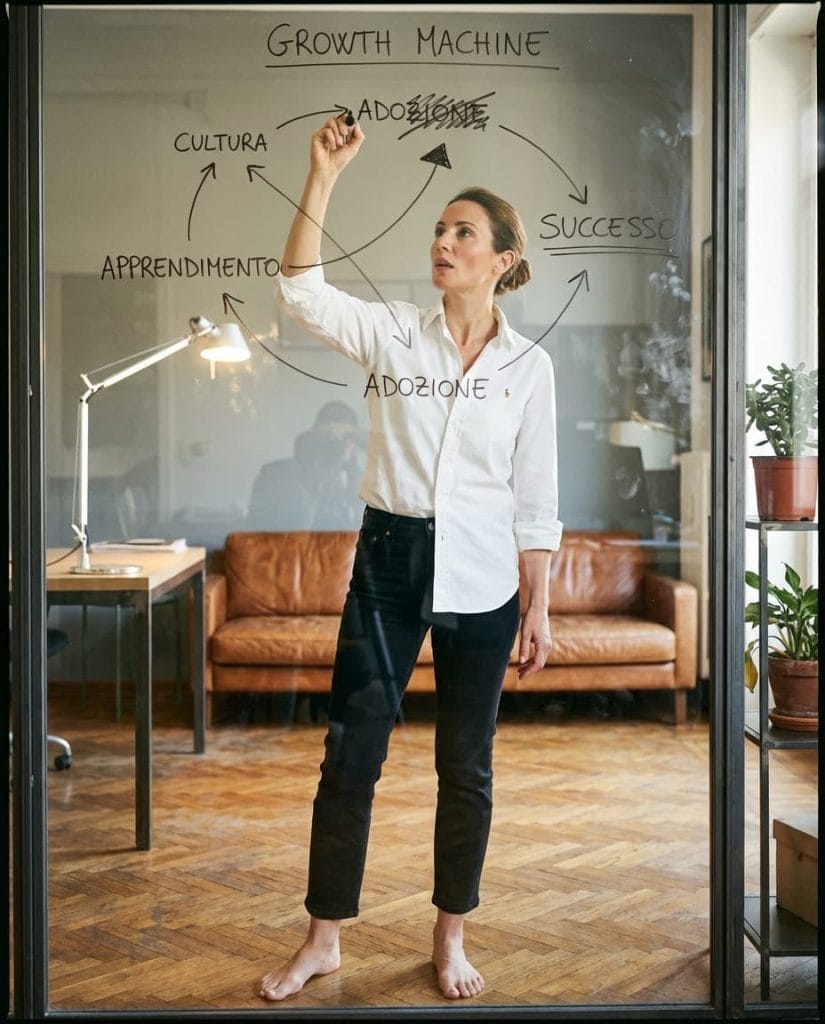
In the MAKE PROGRESS® method, we use a tool called the Growth Machine (I discussed it in detail in the Geely strategy newsletter ): a cycle of mutually reinforcing effects that keep your company growing. When one gear slows down, the whole system slows down.
Try this, now, before you close this email:
Minute 1: Write down the 4-5 effects that drive your company’s growth, like a cycle. A generates B, B generates C, C generates D, and D reinforces A. (e.g., “Service quality → satisfied customers → referrals → new customers → higher margin → investment in quality.”)
Minute 2: Circle the slowest-turning gear. The one that, if you unlocked it, would make all the others speed up.
Minute 3: Write a sentence that answers this question: “What needs to change about the way we work to make this gear turn faster?”
Three minutes. A bottleneck identified.
If you did, you’ve just discovered where your strategy lies: not in a document, but in the mechanics of your growth . And you’ve seen that the block wasn’t intellectual. It was focus.
My point
It’s not laziness, nor even talent, but procrastinating on strategy means accumulating strategic debt . It’s normal. It’s human. But with each passing week, this hidden cost grows, people become misaligned, and the best opportunities go to those who made decisions before you.
The question isn’t if you’ll work on the strategy. It’s when . And “when” comes at a cost.
Reply to this newsletter or email me: how long have you been putting off working on your strategy?
ALWAYS MAKE PROGRESS ●↑ Antonio, Founder
PS. There’s an exercise that turns 3 minutes of procrastination into 90 minutes of immediately actionable strategy. The person who did it at the last workshop came in with a complicated strategy and left having explained it in 60 seconds.
Join us at the Growth Machine Workshop on Tuesday, February 24th, at 2:00 PM.
Find out if there is space and collect your ticket
ALWAYS MAKE PROGRESS ●↑
Antonio