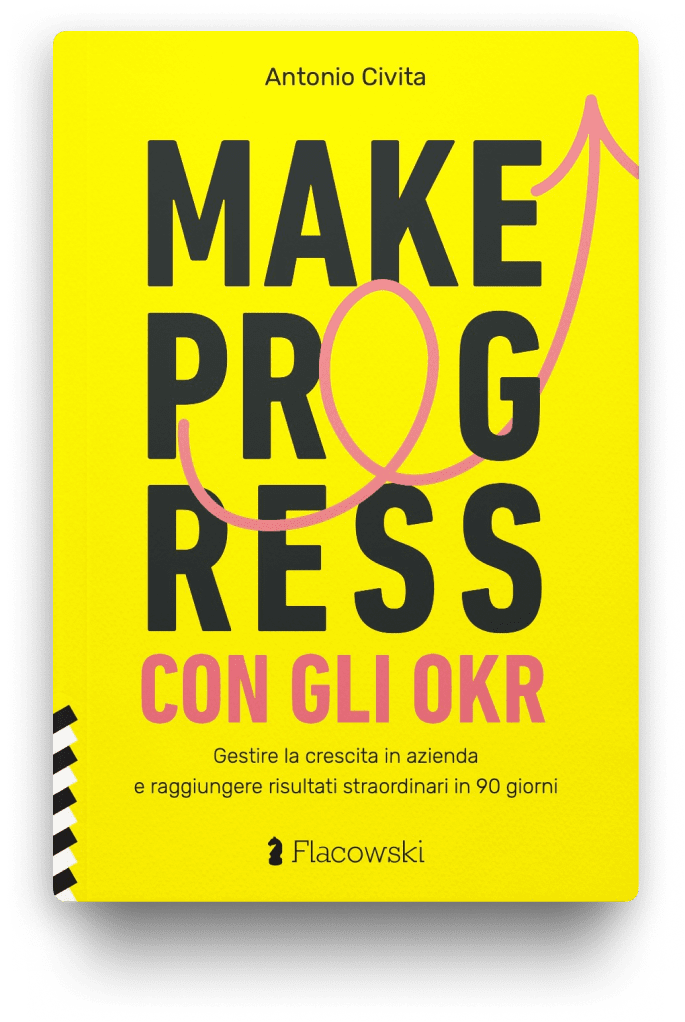
| IN VERY BRIEF One-page strategy. Download the Strategy Focus One-pager. For businesses. Get a personalized roadmap. The MAKE PROGRESS® book. Order your copy. |

“The sooner we link overtime and multitasking to poor skill and negligence, the better it will be for everyone.”
Margaret Heffernan, Beyond Measure
Happy Monday!
For the first time in history, automation will hit managers first, then operations teams.
Every previous technological revolution first changed how we used our muscles, then our brains. This one is different.
Automation isn’t coming to the factory floor, it’s coming to your agenda .
If your team is faster today but not growing, it’s not a problem with tools. It’s a problem with priorities.
In this edition:
- The work that AI can’t do yet
- AI copilot, speed without results
- Growth, trust, measurable promises
- Who benefits from a 200-slide strategy?
The work that matters most is the work that AI can’t do yet.
Every previous technological revolution has automated from the bottom up: first the muscles, then the cognitive routine, then coordination. AI reverses the sequence and starts at the level where questions are decided, not where answers are provided.
Where does the value shift? Those who ask the tough questions, not because they require complex calculations, but because they require clarity on what’s truly important. Where is the company headed? What’s driving growth? How do we measure progress?
The chain of command: the human defines the intent, the AI generates the options, the human validates the steps, the AI executes the activity. Whoever controls that first layer, the strategic formulation , controls the entire flow. The rest is automated, accelerated, delegated.
- The value isn’t concentrated in the execution layer, it’s concentrated in the layer that’s hardest to replicate.
Who’s not talking about it: the most exposed level isn’t the execution team. It’s middle management with years of experience who transform strategy into operational priorities, tasks, and alignment meetings. That translation work is the prime candidate for automation. No one says it because it’s the level that currently signs contracts, manages budgets, and hires and fires.
Redesign in progress: Companies that redesign roles around strategy before automation get a head start. I see this every week with the companies we support at STRTGY.
The right tool: In MAKE PROGRESS®, the Strategy Focus One-pager has never been an execution tool. It’s a formulation tool: it defines the questions that matter, not the answers. Start using it today—it’s free with the book .
Teams with AI copilots move faster, but their business results don’t improve as well.
We need to examine our conscience: speed has never been the bottleneck, or am I wrong?
Optimizing execution speed when priorities are wrong is a huge waste of resources.
Goldratt had already written it in The Goal : optimizing the wrong point does not improve the system, it only creates delay while waiting to do the right thing.
How it works in the Growth Machine : GM only produces results when fueled with the right strategic inputs. Speeding up execution without first clarifying the direction is like pushing the accelerator to idle. The engine revs higher, fuel consumption increases, but the distance traveled remains the same.
- It’s not how fast you can build it but knowing what’s worth building.
- In STRTGY it took me 3 years to understand how all the gears worked.
Buying a tool is a simple decision. Rethinking priorities requires admitting that speed was never the issue. Few teams are willing to do that. It’s easier to measure delivery cycles than the quality of decisions.
The question I invite you to ask yourself is: are you using AI to produce more, or think better?
Growth has become a matter of trust.
Most companies measure what’s easy to count: traffic, leads, published content. Today, a single prompt is enough to flood a channel with noise. These are measures of activity, not results achieved.
Trust works differently: it comes before any purchase, it doesn’t appear on any dashboard, and those who don’t learn to measure it build growth they don’t understand and can’t replicate.
How to build a benefit: When AI makes all messages interchangeable, generic promises stop working. The only positioning that holds up is based on measurable promises , what we at MAKE PROGRESS® call Measurable Benefits: specific, verifiable, and difficult-to-copy statements.
They’re not just a sales tool: buyers can check them at any time, and sellers can use them to realign the entire organization.
The problem no one solves: Building a promise that competitors can’t replicate with a prompt requires clarity about what makes your offering truly unique. Most companies don’t have that. I see it in every program: it’s always the last piece to arrive, and the first to change everything.
The starting point: redesign the gap between what you offer and what anyone can copy. It’s not a question of marketing, but of strategy.
| Build your Growth Machine, live, together. 90 minutes of intense, guided work to ground the mechanics of your growth. It’s not a webinar. You work. At the end, you’ll have your Growth Machine built, with real-time feedback. – Those who have already participated have left with: – Clear goals and priorities – Simplified activities – Team aligned on the metrics that matter – OKRs written 10x faster Space is limited to 10 people per session, and once this number is filled, there are no exceptions. Check available dates and secure your spot here: 👉 Choose the date and join the workshop |
We need to go back to doing what Bruce Henderson did, writing his strategy on a page.
A few weeks ago, I rediscovered Bruce Henderson’s Perspectives . They are one-page essays written by Henderson after he founded BCG in 1963: a single strategic idea per page, no slides. Richard Rumelt cited them as an example of how strategy was written when strategy actually mattered to decision makers .
What struck me: reading one takes five minutes. You understand everything, and there’s nothing to interpret, nothing to translate. Today, the average strategic presentation lasts two hours, filled with numbers, consulting jargon, and slogans, and leaves everyone with the same questions as before. Is everything okay with the stakeholders?
Today’s consultants use 200 slides: more pages means more billable hours. Complexity hasn’t grown because the problems have become more difficult. It’s grown because it benefits those who produce the communication, not those who must use it.
Why it worked: Henderson wrote for a small group that shared the same context. That premise no longer holds up today. Think about how many colleagues you’d involve in redesigning the strategy… that’s exactly it. It’s time to start over with you.
ALWAYS MAKE PROGRESS ●↑
Antonio
—