«Always invite AI to the table.»
Ethan Mollick, Co-Intelligence, Living and Working with AI (2024)
●↑
For a month, this newsletter has been silent, by choice. In these lines, I’ll tell you what happened, why it was important to pause, the people I met over the nearly 10,000 kilometers between Turin, Cesena, Bologna, Rome, and Naples, and the two tools that are reshaping MAKE PROGRESS® as you read this. There are also some invitations I don’t want you to miss.
Like a spring
For about a month, this newsletter was on hold. Not because there was nothing to say, but for the opposite reason: too much was happening, too fast, too close to the heart of the work. At a certain point, I had to choose whether to report everything as it happened, or to pause, absorb, understand what was really emerging, and return in a more useful form.
A spring doesn’t go far because you stretch it endlessly. It goes far because, for an instant, it lets itself be compressed. At a certain point, you stop pushing forward, gather energy within the systems, and only then do you start again, stronger.
This month has been like this: less visible output, more accumulated energy. I’m not sorry that time has passed. In fact, I’m glad it did. Because when the work becomes profound enough to require you to remain silent, it usually means you’re entering a new phase.
Can you afford to evolve?
One of the most dangerous things I see in entrepreneurs is the confusion between acceleration and strategy. Moving a lot feels good. Filling your calendar feels like work. Launching, responding, producing, publishing, participating: all this generates background noise and is often mistaken for progress. But going fast doesn’t mean going in the right direction. Sometimes it just means expending more energy to get to a place we shouldn’t have chosen sooner. Stopping also helps: looking at the trajectory, not just the speed. May reminded me that strategy doesn’t exist in the moments when you push hardest. It exists in the moments when you have enough clarity to ask yourself if you’re still pushing for the right thing.
I feel privileged when I manage to take these spaces, but I don’t see it as a stroke of luck that happened to me; on the contrary, it’s the result of systems built much earlier, the same ones I see those who use MAKE PROGRESS building.
Putting your business on autopilot for a moment, keeping everything running, and using that space to design your next version. This, for me, is one of the most concrete forms of strategy.
The bank, APIs and the sense of numbers
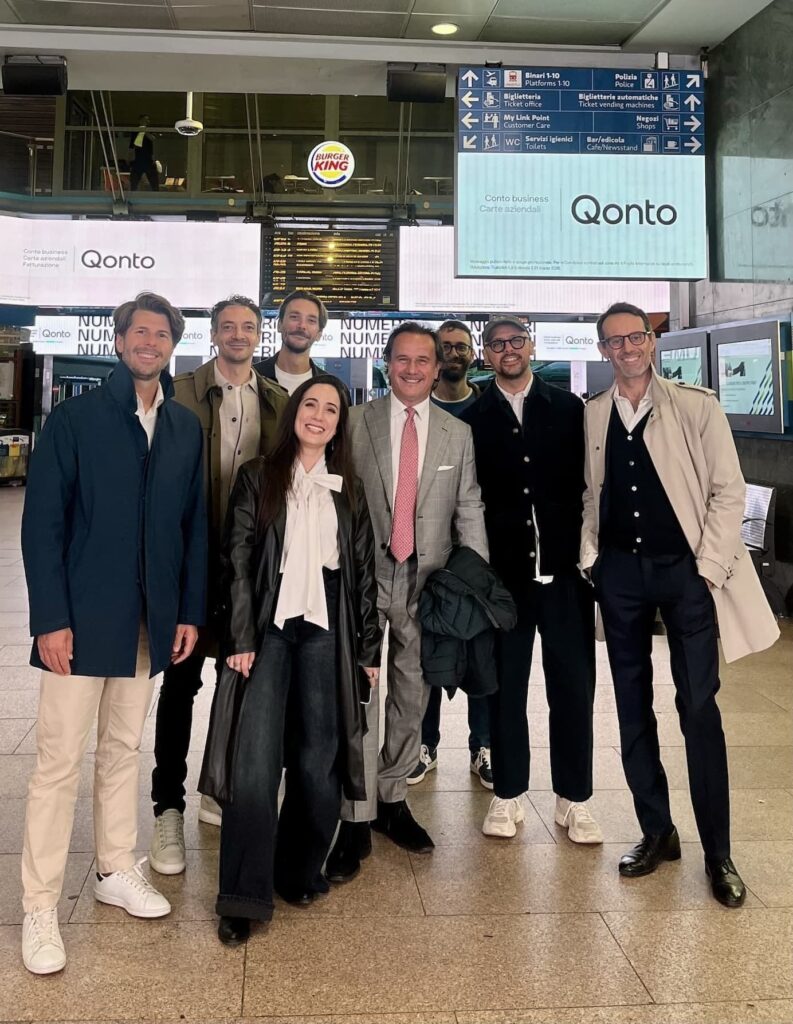
Some news I hadn’t told you yet: STRTGY has become a Qonto ambassador and will be an active member of its community.
When I founded STRTGY I chose it for a specific reason: I can manage everything via API.
And APIs today aren’t just a technical detail, but a key to having a bank that works with you, not against you. They’re the agents’ natural language.
It’s about being able to manage the financial side of things with the same logic I use to manage the rest of the company today: accessible data, clearer processes, interconnectable tools, information available when needed.
But the reason why I’m happy to be an ambassador is another: to be able to share the process with you.
If you want to build a more autonomous company, you can’t have important information locked away in tools you don’t want to open because you feel like you’re back in the 21st century.
Young Compus, how hard is it to grow up today?
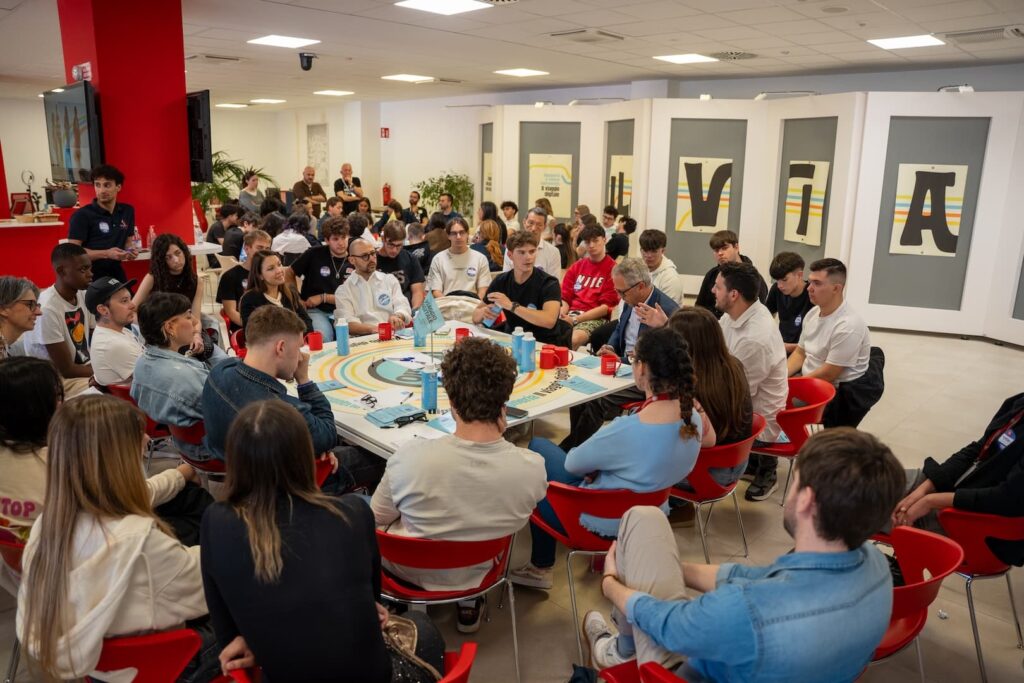
In Cesena, I met high school and university students during an event co-designed with DISI and the University of Bologna.
The theme was journey: digital, internal, spatial, professional. I left with one thing in mind: being a student today is more difficult than we imagine. For the first time, a generation is growing up with an exobrain that’s always on, a second brain outside the body, accessible to all. They use it, their competitors use it, companies, institutions, and markets will use it. What it means to be good is changing. Imagination or ability is no longer enough. We must learn to nurture this second brain, to train it, to question it, to avoid being overwhelmed by it but to manage it to our advantage. This is a huge educational frontier. And we can’t leave it solely to entertainment algorithms.
We should teach young people three families of languages with the same seriousness we take math or grammar.
- The language of emotions and human psychology, because without that you can’t read yourself or others.
- The language of people, therefore Italian, English, languages that open up worlds, opportunities, and precision of thought.
- The language of machines to understand how artificial systems think, how to question them, how to delegate work without losing judgment, and how to build with them without being overwhelmed by them.
If we don’t guide this transition, many young people will learn, above all, the language of constant entertainment: scrolling, comparison, pointless desires, synthetic lives, generated content that seems real but often isn’t. That of cheap dopamine. Seeing it up close hurt, but it clarified an ethical priority: using AI to improve the future of those growing up, not to replicate the mistakes of those who came before.
Young Forum Destination Tomorrow
AI Day Turin: A New Paradigm for Corporate Leadership
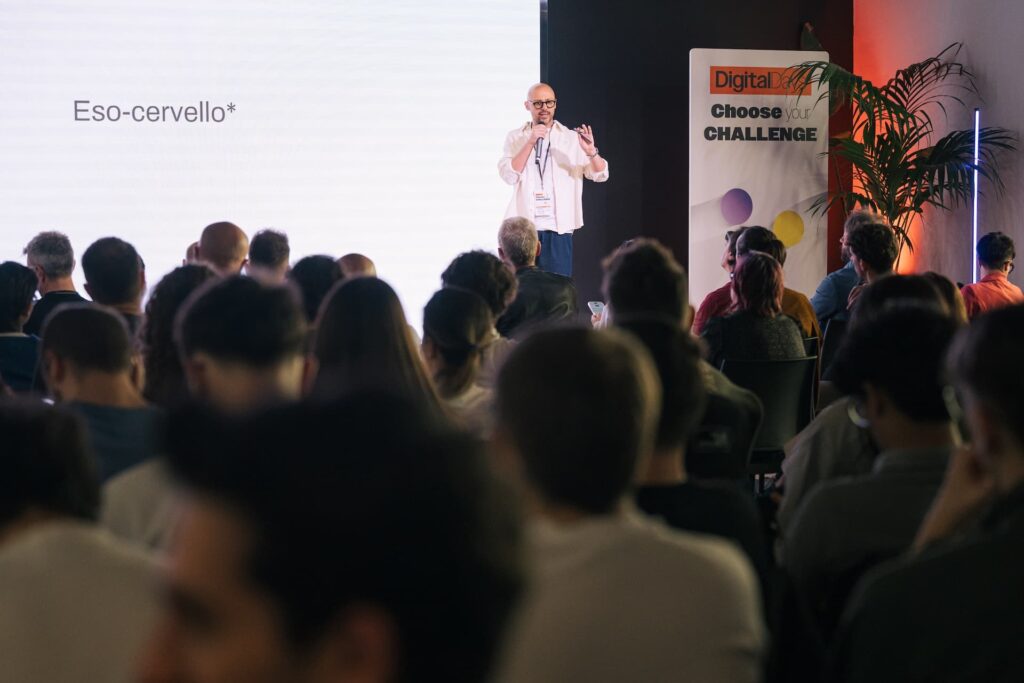
At AI Day in Turin, I met professionals who are bringing AI into organizations from very different entry points: automation, legal, creativity, design, ethics, and processes. What I saw is that we’re no longer in the “let’s try a tool” phase. We’re already in the next phase: redesigning the way work is coordinated.
AI used well requires a change in organizational architecture. If part of the operational, analytical, and documentation work is delegated to intelligent systems, then the role of people changes, the role of leadership changes, and the way strategy is formulated, measured, executed, and adapted changes.
I coined the term Augmented Leadership because I believe it is the future of what we are already experiencing, and those who don’t intercept it in time risk being left out.
STRTGY sponsors Digital Days events throughout the year, and PMI Day will be held in October. Dates aren’t available yet, but if you stay subscribed to the newsletter, you’ll be the first to receive exclusive access.
TEDx Bassano and the end of performance culture

On Saturday, June 6th, I’ll be taking the stage at TEDx Bassano del Grappa, with the topic ctrl+alt+Me, at the Teatro al Castello Tito Gobbi. If you’re in the area next week, you’re invited.
I’ll talk about one of the foundations of MAKE PROGRESS, and how it was built to transcend performance culture.
We’ve been taught that happiness is a place to be reached, hidden behind a target, a threshold, an objective. This isn’t the case.
In this talk, I demonstrate that happiness shouldn’t remain a rare and random event, and that today we have more tools than ever to understand it on a deeper level and engineer that sense of progress that drives us forward.
Performance culture is showing its limits now that machines are surpassing us. What’s left for us to do is use them wisely, to outsource boredom and drudgery, and focus on what makes us truly human: that energizing sense of progress that moves the world.
It’s a question of strategy
In a world where producing a presentation takes ten minutes, reporting risks exploding. We’ll have more slides, more summaries, more documents, more recaps, more dashboards. But not necessarily more clarity.
This is one of the insights that’s guiding my work on Progress OS. The problem for organizations is no longer generating more artifacts, but having a strategy and executing it long enough to see if it works.
A strategy is almost never abandoned because it’s poorly written. It dies because it’s separated from execution, because it’s not updated with emerging trends, because decisions get scattered across a thousand channels and after a few weeks, no one knows what the original hypothesis was. Progress OS was created to address this exact point: coordinate, crystallize, update, and recirculate.
The webinar, and the opening of the seventh cohort

For me, this is an important event, because it marks a turning point for MAKE PROGRESS. The method has reached a level of maturity that requires a thorough update to remain effective in a world where companies are not just made up of people, but of an increasingly integrated interaction between people and machines.
During the same webinar, I will open registration for the seventh cohort to become a qualified MAKE PROGRESS® coach, the most advanced program for using the method independently, within your own organization and with your clients.
After six editions I redesigned it from scratch, now it is structured in two phases.
If what you see matches the future you’re already starting to live, you won’t want to get your hands on it after your competitors, or even after the best talent.
Some previews…
MAKE PROGRESS within the tools you already use
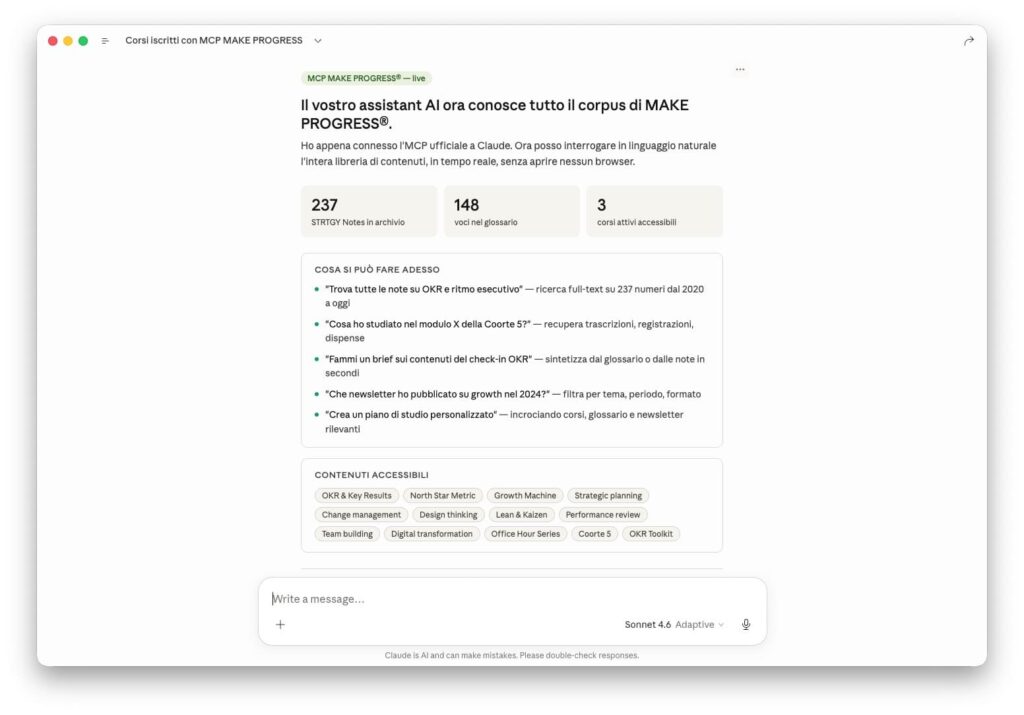
The deeper reason for my silence is this: MAKE PROGRESS® is entering a new phase. After years of work, cases, cohorts, tools, and conversations with founders and teams, the method is becoming more accessible, more integrated, and more operational.
I don’t want it to remain a set of concepts to remember. I want it to become a system to work with.
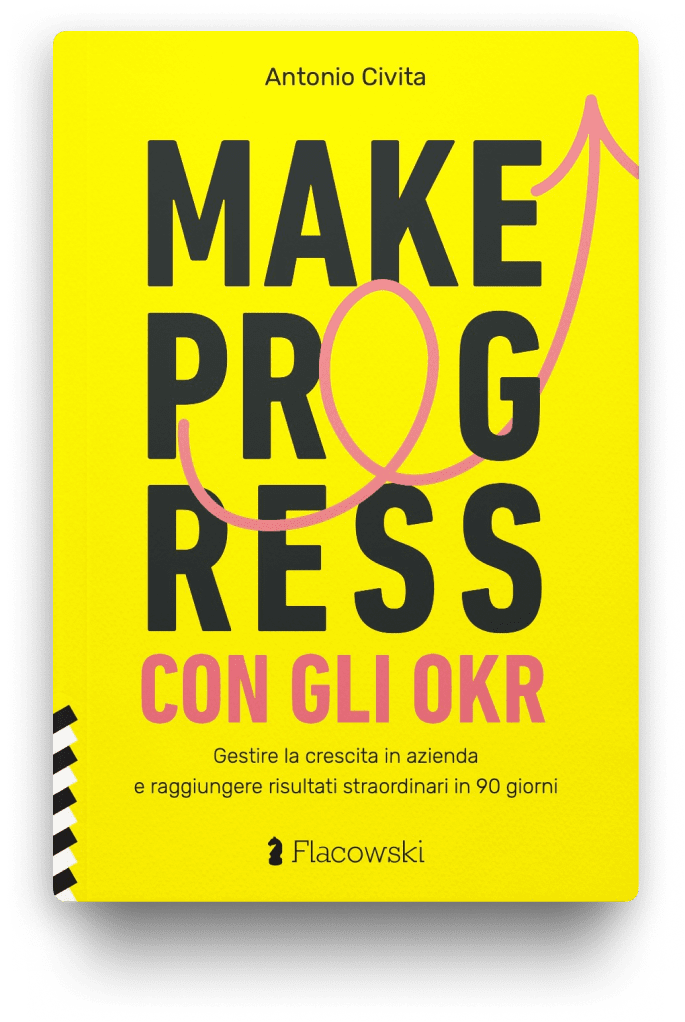
If you ask ChatGPT or Claude today how MAKE PROGRESS® works, you risk a banal and probably wrong answer. From now on, anyone who participates in a program receives access via MCP to the method and real case studies.
In practice, you stop re-explaining everything to a generalist model and work with a specialized coach who understands your company’s methodology and context. You ask them how to calculate a metric, then ask them to calculate it based on your numbers.
There are those who will continue to settle for generic prompts like “help me write my strategy,” and those who will be able to work on MAKE PROGRESS within the tools they already use, and will need to use in the future.
Progress OS, the C-suite operating system
And then comes the biggest news: the entire toolkit is flowing into a new application, ProgressOS.
In an age where producing a slide takes ten minutes, reporting has exploded, often useless, reports that are perfect on the surface and that neither the writer nor the recipient actually reads.
ProgressOS was born with a clear target, the C-suite, a product category where usability standards are among the worst in corporate software.
ProgressOS is a coordination system that brings out strategy, even emerging strategy, crystallizes it in constantly updated documents, and keeps the organization aligned on strategic priorities.
Its guidelines have been public since Chapter 6 of my book, written before AI changed everything, and they describe with astonishing precision how a company will function in the coming years.
The tools are already in beta for MAKE PROGRESS practitioners. A first demo will be available on the day of the webinar.
External access is limited and I evaluate it on a case-by-case basis.
Before saying goodbye
I still have a lot to tell you, and I realize that the newsletter may not be the right tool for the quality of interaction I want with you. That’s why, starting this week, we’re starting to write to each other again and work together.
In the meantime, thank you for still being here, among these lines. I’ll leave you with the question I’ve been asking myself during this month of silence: does your business really have a strategy?
If you want an answer, with numbers, click here , I will reply to you personally within 24 hours.
ALWAYS MAKE PROGRESS ●↑
PS: We can also stay connected on LinkedIn , that’s where I tell you about the future of STRTGY that is about to arrive.