“Well-intentioned goals don’t work. You have to be obsessed with the system that helps you achieve them.”
Lane Shackleton , Head of Coda
●↑
Concentration is not a gift that appears like a miracle when you lock yourself in a quiet room or download the right app for binaural beats.
I can assure you that those who have focus didn’t find it by chance, but build it every day with intention . Here’s how you can do it too.
To do this, however, I don’t recommend starting from a prompt to find the latest productivity hack or the coolest brand of adaptogenic mushrooms.
I advise you to start with yourself. And to do that, you have to know yourself, and to know yourself, you have to measure yourself. It’s the same principle behind MAKE PROGRESS® : first you understand objective reality, then you redesign it.
Why starting a timer isn’t enough
The Pomodoro technique is one of the best-known and most effective for increasing productivity, yet it is among the most abandoned after a few days of initial enthusiasm.
It works like this: you set a timer for 25 minutes, work uninterrupted until it’s up, then take a 5-minute break. After 4 cycles, take a long break of 20-30 minutes. The idea is simple: short, frequent focus blocks to maintain concentration without burning out.
But there’s more than one good reason why most people abandon it: simply setting a timer isn’t enough to get work done. The timer measures the time that passes, not the work you do.
The 25-minute rule has no scientific basis. Context switching research suggests that after each interruption, it takes over 23 minutes (according to research by Gloria Mark, UC Irvine ) to regain deep concentration. With 25-minute blocks, you have 2 minutes of real work left before the next break. It’s impossible to delve deeply into any task.
The timer starts, the focus does not. Starting the timer doesn’t mean you’re focused. We often justify ourselves by saying, “I’m working because the timer is on.” Pomodoro time passes, but productive work doesn’t. When you actually count the Pomodoros in which you’ve accomplished something, you discover you’ve worked much less than you imagined. The Pomodoro ignores everything that happens between one moment of focus and the next: those minutes when you should be working but your mind wanders, you check your phone, you look for a quick reward. It’s not rest. It’s not a break. It’s time when your mental energy is consumed without producing anything. And it can be surprisingly long.
It does not take into account the biological rhythm. Some people are sharp in the morning for creative work and slump in the afternoon. Others do the opposite. Pomodoro works if you also timebox, if you organize your schedule by selecting the right sequence of tasks. It’s not enough to do it in order.
It is incompatible with real life if adopted rigidly. It requires tasks of adequate complexity for the available slots, respected slots, and zero unforeseen events. Adopting it suddenly and completely is unrealistic. Colleagues, family members, unexpected events, and external interruptions don’t disappear just because you set a timer.
I’ve been using Pomodoro for years, and at first it didn’t work for me either. The 25-minute blocks were too short, and as soon as I started to get into the flow, the pause would sound. I spent more time restarting than staying focused.
Then I extended the blocks to 50 minutes, then 90. I discovered that my best pace wasn’t the “textbook” one, it was my own. I had to figure out which hours of the day I could do creative work and which I was only good for emails.
I had to accept that some days the focus just wouldn’t come, and that forcing it meant wasting energy without results.
It was a long journey. Months of trial and error. But in the end, my productivity increased significantly.
Here’s what I learned: the technique works, but only if you can adapt it to yourself. And to personalize it, you must first understand how you actually work. Not how you think you work, not how you want to work.
How you really work, with data in hand.
It’s not enough to count flight time

A few weeks ago, I was on a small plane. Sitting near the cockpit, I could watch the pilot at work.
One of the instruments that struck me was a sort of timer that activated as soon as we started the engines to simultaneously calculate the time on the runway and the time in the air.
It’s called a Hobbs meter . It’s a counter that measures every hour the engine is running. Not just flight hours. In aviation, the question of time is very precise: there’s flight time , wheels off the ground, the actual flight. And there’s block time , the total time with the engines running, from the departure gate to the arrival gate, including waiting times, taxis, and delays.
The Hobbs Meter counts everything. It’s the instrument that tells the truth about how much the plane was actually used.
Why aviation can’t afford to just count flight hours
In aviation, block time is calculated, meaning the time the plane is on the ground. It’s a matter of both safety and economics.
Each aircraft component has a useful life calculated not by flight hours, but by total engine operating hours. The engine wears out even when the plane is on the ground waiting for takeoff. Turbine blades degrade, oil wears out, bearings accumulate stress…
If an airline only tracked flight time , it would underestimate the actual wear and tear and consequently the maintenance.
Block time is also used to calculate real operating costs: fuel burned on the ground during taxis and waiting, crew salaries paid from departure gate to arrival gate (not from takeoff to landing), scheduling, punctuality.
A flight that lands in 2 hours but takes 3 hours of block time due to delays and congestion is a flight that costs 50% more than it seems.
The difference between operating time and productive time is the most important metric for maintenance, safety, and profitability.
Your motivation runs out even when you’re not working: the hidden cost of staying on standby
Your Pomodoro only counts flight time : it only counts the minutes “in the air.” But your block time , the total time you’re “on fire” at work, is much greater.
Even if you’re just waiting for focus to arrive, sitting in front of the screen with the timer on, your motivation is draining. Every minute of idle time isn’t a zero-cost minute. It’s a minute that burns mental fuel: attention slack, decision fatigue, frustration, self-doubt.
Your brain in standby consumes motivation without producing anything.
Motivation is a finite resource. If you burn it waiting for focus to come naturally, when you finally get down to work, you won’t have enough. The day is over. The block is gone. And you convince yourself you “don’t have time,” when in reality you’ve been burning through your time with your engines running, not flying.
Focus Ratio: How to Measure Your True Focus
Each work block has two components:
- the time when you are actually producing something,
- the time you’re sitting there with the engines running and not flying.
The ratio between the two is called the focus ratio .
Focus ratio = focus time ÷ total work time.
It works like this: Take a 60-minute block. If you worked with real focus for 40 of those minutes, your focus ratio is 0.67. You flew for 40 minutes. You burned the remaining 20 minutes on the ground.
From my experience and that of the professionals I work with, a focus ratio above 0.7 is good; it means you’re using more than two-thirds of your operating time for real work. Below 0.5, you have a problem: you’re spending more time in standby than focusing. You’re not working too little because you’re short on time. You’re working too little because you’re burning through the time you have before you use it.
But reading numbers without context is a sterile exercise.
What matters is the pattern. After a week of tracking, the data starts to speak for itself: when you crash, what distracts you, what tasks paralyze you.
You can create a complete behavioral profile. Discover your best cognitive windows, your weaknesses, what work to protect during peaks and what to shift during lows.
I want to invite you to do what psychological research calls the Experience Sampling Method ( Csikszentmihalyi & Larson, 1987 ): a real-time sampling of your emotions, motivations and perceptions.
I’m not asking you to journal, which many find boring. I invite you to start a structured data collection process on your work. The same technique used in the research that inspired MAKE PROGRESS® .
STRTGY Focus Timer
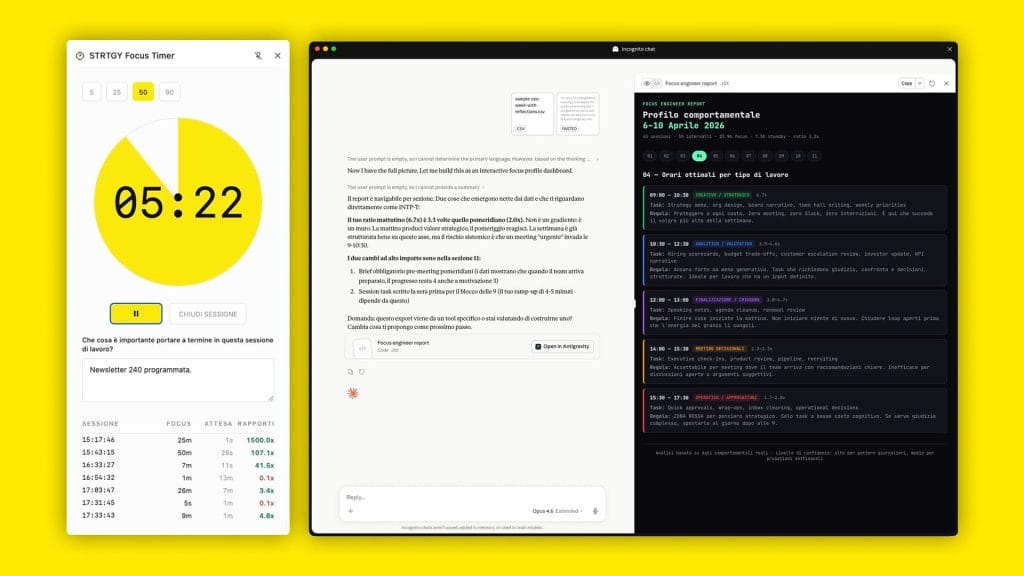
The STRTGY Focus Timer is a Chrome extension. At first glance, it looks like a timer. But inside, it does three things a regular timer doesn’t.
Track your work sessions.
Within each session, distinguish moments of real focus from those of stand-by.
At the end of the block, he asks you questions to understand the context: what happened, what blocked you, how you felt.
All data remains local. No information leaves your computer.
After 1-2 weeks of consistent use, export the CSV and upload it to an LLM with the prompt I’ve specially designed. You’ll receive 11 sections of personalized analysis: from your concentration profile to the best hours for each type of work, from break planning to a daily optimization plan.
It costs less than lunch out. I did it on purpose because free stuff stays in your downloads folder. What you pay for, you install, open, and use.
After at least a week of use, you get a profile of your working style that is worth more than most productivity courses I’ve seen.
What happens after a week?
After at least a week of consistent use, export a CSV file from the timer and upload it to an LLM along with the prompt I wrote for the occasion (it’s included in the usage instructions) to get a customized report that will tell you:
- When you are lucid and when you collapse , not when you think you are productive, but when the data says you are.
- How many hours to dedicate to creative work and which to other work , based on your patterns, not a Harvard Business Review article
- How long does your concentration last , not 25 minutes because the Pomodoro says so, but your span with the ideal duration of the blocks calibrated to how you work
- How to structure breaks : when to stop, how much to stop, when to stop pushing and change the type of activity
- A daily optimization plan : which tasks to do at different times of the day based on your mental energy.
There are 11 sections in all, a complete profile of how you work.
And the best part: you retake the test every two weeks. With each cycle, the profile becomes more accurate. After 3-4 iterations, you have a working system built around you.
It’s your system. Designed by you, for you, with your data.
Start using the Focus Timer today
Before you say “I don’t have time,” measure how you use it.
You might discover that there is time. You’re just burning it with your engines running, not flying.
ALWAYS MAKE PROGRESS ●↑
Antonio
Antonio Civita is the founder of STRTGY, where he helps entrepreneurs and leadership teams design operational systems for growth. He is the author of the MAKE PROGRESS® method.