“We were inspired by the prospect of building the company as if it were our product, of building an institution.”
Luca Ferrari , CEO of Bending Spoons
●↑
This is episode 1 of 6 in the series where we reverse engineer the Bending Spoons strategy using the MAKE PROGRESS® tools.
In each episode, we reconstruct a block of the Strategy Focus One-pager (SFO), understand the strategic mechanisms, and help you do the same in your company, drawing inspiration from those who have already achieved results.
Series Index
- 1. The operating model: because the first product of every company is the company itself.
- 2. The destination: how Values, Vision and Mission guide decisions.
- 3. The metrics: how to choose the North Star and the numbers to monitor.
- 4. The Growth Machine: How to connect the effects that make growth repeatable.
- 5. The enablers: what capabilities allow the model to work.
- 6. Priorities: How to Turn Strategy into Action.
To follow each step and apply it immediately to your company, you can use the official implementation manual or download the OKR Toolkit .
On September 10, 2026, Bending Spoons signed a definitive agreement to acquire Miro, valuing its operating business at $1.355 billion. Closing is expected in the fourth quarter. Until then, the two companies will continue to operate separately, as specified in the announcement filed with the SEC .
It seems like a huge amount, but it all becomes a bit smaller when you consider that as recently as January 2022, investors had given Miro a post-money valuation of $17.5 billion . Investors in the round also included Frank Slootman, then chairman and CEO of Snowflake, Dan Springer, then CEO of DocuSign, and Howie Liu and Andrew Ofstad, co-founders of Airtable. An interesting coincidence: Bending Spoons announced the Airtable deal on August 4th and the Miro deal on September 10th. Just 37 days apart.
I started using Miro when it was still called RealtimeBoard, before the 2019 name change. With Miro, I designed workshops with companies, strategy sessions, and many of the tools that are now accessible to the STRTGY community. During Covid, it allowed me to continue working with people in different cities and countries without leaving home.
As long as Bending Spoons was buying apps I wasn’t using, I observed their acquisitions with detachment. But with Miro, it’s different.
In recent years, the group has acquired Airtable, Vimeo, AOL, Tractive, Eventbrite, Evernote, and other products with vastly different technologies, customers, and business models. Miro’s price tag is therefore only part of the story.
I know some readers have strong opinions about Bending Spoons’ strategy. Articles and LinkedIn posts often summarize it easily: leverage debt, reduce staff, and raise prices.
If we ended the analysis here, however, one question would remain: how did the same team finance a sequence of billion-dollar acquisitions, integrate very different products, and repeat the process on an ever-increasing scale?
This is the question I try to answer by reconstructing the business mechanics and the choices that shape their strategy. Understanding the model doesn’t mean sharing every decision. It means distinguishing facts from interpretations and understanding what we can learn from outsized results like these.
The first answer appears in the IPO prospectus. Luca Ferrari and management call the system with which the team integrates and manages acquired companies Operating Machine . This first article aims to understand where it comes from, how it works, and why management considers it the group’s most important product.
The Strategy Focus Onepager by Bending Spoons
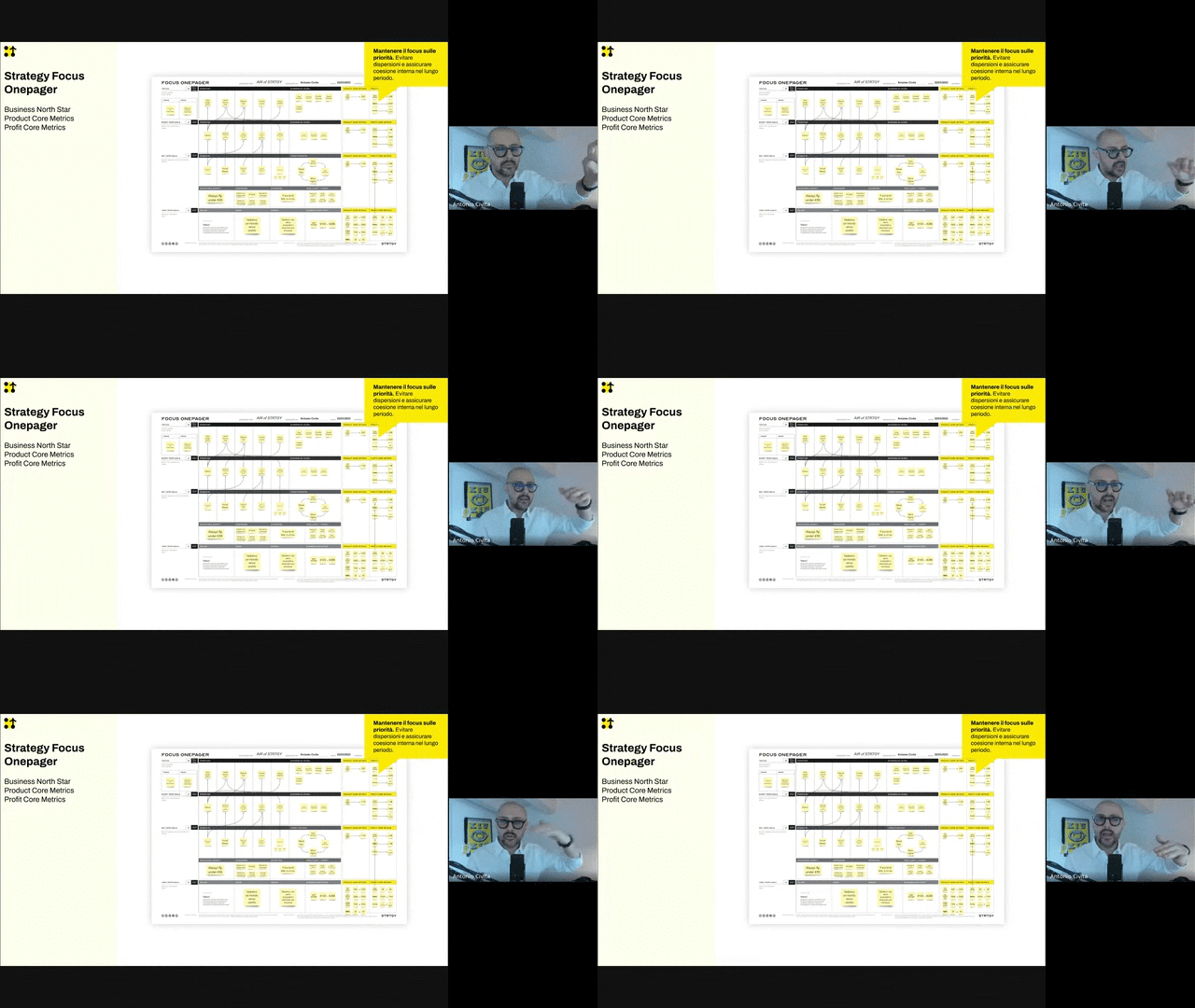
To reconstruct the Bending Spoons strategy, I will use the Strategy Focus Onepager (SFO), the MAKE PROGRESS® tool that collects the essential strategic choices on a single page.
The SFO connects four strategic levels:
- the long-term destination
- the metrics
- the mechanics of growth
- strategic priorities
In this reverse engineering exercise, I will use the company’s IPO prospectus filed with the SEC, financial results, acquisition announcements, and interviews with Luca Ferrari.
If you want to follow the series with the tools at hand, you can pick up the manual with the toolkit or access the toolkit in standalone mode.
The first product of every company is the company itself.
Many entrepreneurs spend months designing the product they will sell and very little time designing the company that will build it.
They oversee every step of the customer experience, choose the software, redesign the website, add features, and automate the service. Inside the company, meanwhile, all decisions continue to pass through the founder. Priorities shift during meetings. People solve the same problem in different ways. Every mistake produces a new rule, and every new rule slows down the work.
One of the pillars of MAKE PROGRESS® is that the first product of every company is the company itself.
Before the software, service, or product you sell, there’s an organization that must make decisions. It must understand which customers to serve, choose where to invest, distribute responsibilities, learn from results, and correct mistakes. That system is the company’s operating model.
If you don’t plan it, it will form anyway. It will be shaped by the habits of the most influential people, the pressing needs of the moment, and the solutions introduced to solve the latest problem. Initially, the founder will be able to know everything and control almost every decision. As customers, products, and people increase, the very centralization will slow down the work.
The cost of a layered operating model is evident in the time spent clarifying who should make decisions, in projects that start without replacing others, in the data that each team calculates differently, and in the bureaucracy that builds up every week.
This is what I call strategic debt.
Strategic debt grows when leadership postpones the decisions needed to give everyone direction. Information remains concentrated at the top and creates dependency on the founder. People lack the context to independently make the most effective decisions.
When clarity is lacking, each team tries to fill the gap with local processes and priorities. Even mistakes are filled with new rules. This is how bureaucracy builds up and further slows down work.
Designing a company means making its operations clearly visible. People must be able to see the same situation, use common criteria, and make good decisions without waiting for the founder every time.
The story of Bending Spoons was born from a failure
…like any true success story.
In the IPO prospectus filed with the SEC , the founders describe Evertale as a smartphone app that used artificial intelligence to automatically create a diary of the user’s life. They raised around $1 million in capital, built a team of ten, launched the product, and attempted to scale it.
By 2013, they were almost out of cash and generating very little revenue. Product-market fit, which the prospectus calls Evertale’s Achilles heel, never materialized. The team liquidated the company and used the remaining €40,000 to start Bending Spoons.
With that sum, they could have tried to invent another product and once again rely on the possibility of finding a market. But that wasn’t the case…
Recounting that experience in interviews such as The Neon Show and Invest Like the Best , Luca Ferrari explains two lessons that guided his subsequent work. The first is that luck plays a role that’s difficult to control when finding product-market fit. The second is that the team can work with better results if it stays focused on the quality of its people, technology, data, and decisions.
From that moment on, they focused their work on building a system capable of improving products that had already found a market.
Management then began looking for products with a solid product-market fit and a business model they deemed inefficient or declining. After each acquisition, the Spooners, the people who work for Bending Spoons, can influence the organization, technology, product, marketing, pricing, and costs to make the system more efficient.
To make this work replicable, the team built the Operating Machine .
What is the Operating Machine?
Form 424B4 contains a description of the economic model, results, risks, and operation of the Operating Machine.
Ferrari describes it as a combination of two parts: Platform and Playbook.
The Platform includes Spooners, data, and shared technologies. In an interview with David Senra , Ferrari discusses over fifty internal tools for managing payments, A/B experiments, user value estimations, recruiting, authorizations, data collection, and AI models.
The Playbook describes how teams use these resources to integrate a new product and improve its business model. It captures decisions and processes related to organizational structure, technology, product, marketing, monetization, and costs.
The Operating Machine is therefore the operating system with which the team integrates products across the group, connects them to the corporate strategy, shares common processes and achieves economies of scale.
A photo enhancement app, a notes service, a video platform, and an animal tracking device don’t all have the same customer or technology. However, the teams must make similar decisions: managing a subscription, measuring retention, evaluating an experiment, assigning permissions, hiring people, and estimating a user’s economic value.
The Platform allows these problems to be solved through common tools. If a product team improves a central tool, the others can use the same improvement.
In the same interview , Ferrari explains that each integrated product brings new data, new problems, and new solutions. A broader base allows the team to learn faster and update tools and playbooks across the entire portfolio.
An operating model that is less and less dependent on the founder
During the interview with Senra , Ferrari explains his desire to reduce the symbolic weight of founders. He wants each person’s contribution and the journey they can still make to count more than the date they joined the company.
A group that integrates dozens of products cannot entrust every decision to the intuition of the founders.
Procedures help people approach familiar situations. A shared strategy allows them to approach new situations using the same criteria.
The SFO crystallizes the most important decisions in a shared page. It outlines how the company can grow, what capabilities it needs to build, and what priorities it needs to set. With this information, multiple people can contribute without waiting for new instructions each time.
In the next episode: setting the destination
Every great journey begins with a destination. In the next episode, we’ll use official documents to reconstruct the vision of the company that Ferrari and his team want to create, through their Values, Vision, and Mission.
These elements will provide context for interpreting the decisions we’ll encounter throughout the rest of the reverse engineering process. You’ll be able to follow each step and use the same questions about your company.
How to apply these concepts to your strategy
Have you ever described your company’s operating model?
Many organizations assume people can glean this information from their job descriptions or assigned tasks. When shared criteria are lacking, teams must invent a different answer every time they encounter a previously solved problem.
When leadership retains strategic information and delegates only tasks, teams generate work to fill the gaps. That work absorbs time, talent, and money, leaving the company no closer to its goal. Mistakes breed more bureaucracy, and dependence on the founder increases.
When the operating model is clear, teams can stop adding activities that don’t move the strategy forward and refocus on what really matters.
Ask yourself:
- Which parts of your company’s operation are named and understood by everyone?
- In what areas can teams make decisions without waiting for the founder?
- What information is missing to allow people to make the most effective decision possible?
- How much work is created because no one knows the strategy?
If everyone could recognize and describe the operating model, your organization would be less dependent on just one person.
ALWAYS MAKE PROGRESS ●↑
Antonio Civita is the founder of STRTGY and author of MAKE PROGRESS® with OKRs. He helps founders and teams transform strategy into execution with the MAKE PROGRESS® method. To connect with me, reply directly to any email you receive from STRTGY.