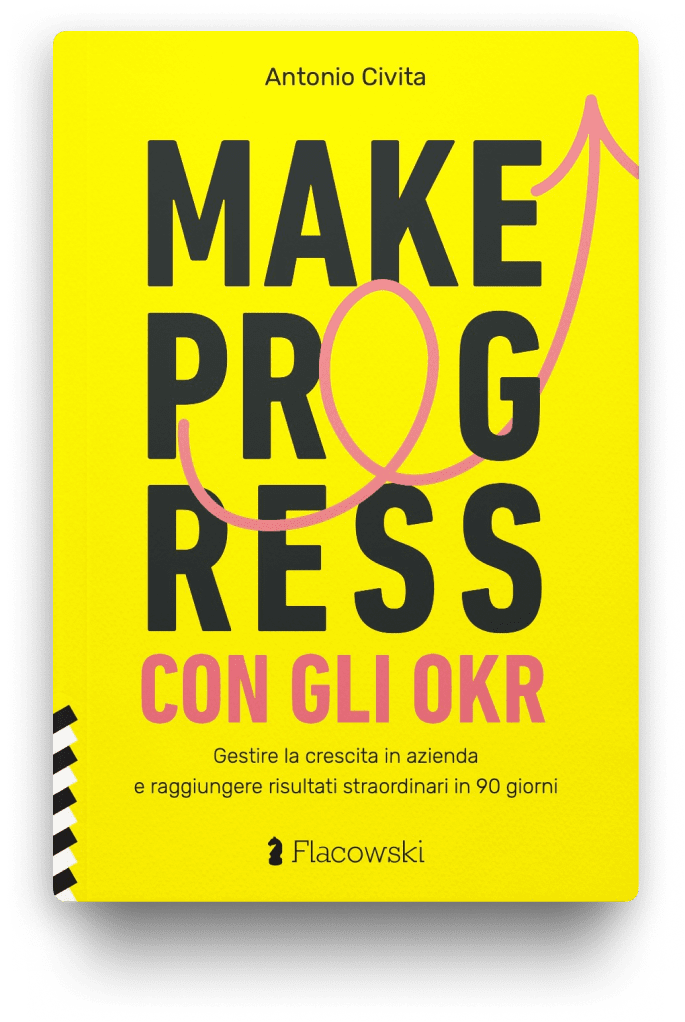
| IN VERY BRIEF ✱ Growth Machine Workshop. New dates throughout March. 90 minutes to build your company’s growth machine, the same one we discuss in this newsletter. Get your pass. ✱ The Operational Manual. All 10 tools mentioned in this newsletter are from the MAKE PROGRESS® with OKRs manual. Order your copy. |
People don’t lack the desire to do things, they lack the system to do things well.
Antonio Civita, from the book MAKE PROGRESS®
Have you noticed that even the slowest companies have one thing in common? Haste.
The rush to close, decide, approve, plan. And so we go fast where we should slow down, slow where we should speed up.
Augustus governed Rome with the motto festina lente because caution could prove disastrous, but excessive hesitation was equally harmful.
Two thousand years later, Cosimo I de’ Medici had a turtle with a sail on its back painted on the walls of the Palazzo Vecchio, symbolizing caution and urgency, in the same image.
Aldus Manutius, the Venetian who invented paperback books, stamped his trademark, a dolphin wrapped around an anchor to symbolize speed and steadfastness, on every volume that left his workshop.
In this note I want to show you how speed comes from stopping and working on strategy.
The false speed
Many organizations call “speed” what it actually is:
- compression of decision-making times;
- reduction of space for thinking;
- anticipating irreversible choices before having understood enough.
The result? Rigidity, rework, illusions of clarity. The opposite of speed.
It happens when the action plan disguises itself as a strategy. Strategy and planning are not the same thing. Planning means choosing projects, timeframes, and responsibilities to get somewhere. But to plan, you must first choose where to take your organization, and why it’s important to get there.
Doing good strategy and planning requires a different pace than companies allow themselves.
There’s no point where “strategy ends” and “execution begins.” At every level of the organization, someone is making decisions under uncertainty. Speed isn’t just about the top. It’s about how the entire company distributes decisions and responsibilities.
| 3-Minute Assessment Are you sure you have a strategy? Find out in 3 minutes and get personalized feedback. Take the assessment. |
More results, slowing down strategically
Strategic competence lies in managing two rhythms:
- quick to learn, slow to make irreversible choices;
- quick to act, slow to build processes;
- quick to correct, slow to build knowledge.
Five tensions run through this dual speed. Here’s how to address them with MAKE PROGRESS®.
1. Run the business / Change the business
Be quick to identify the model that works and extract as much profit as possible from what you do well, in the market you know well. You have consolidated expertise, customers who choose you for specific reasons, and processes that generate value. Run. Protect those margins, strengthen that machine. Those who hesitate on the run lose ground that cannot be recovered.
Be slow to change direction. Equip yourself with a system to filter high-risk opportunities and shape them to fit your long-term strategy. Change isn’t about reacting to the market. It’s about choosing with discipline where to invest scarce resources in uncertain territory. And haste is the enemy here: forcing change without a structured process produces errors that cost more time than the haste was intended to save.
In practice: explicitly separate budget, governance, and metrics between what you maintain (run) and what you explore (change). Different teams, different decision-making processes, different indicators. Strong companies don’t choose one pace, they govern two.
With MAKE PROGRESS®
Quick Tool: KPI
KPIs are your company’s dashboard. Every week, you update the numbers that describe the health of your existing model: North Star, Product, and Profit Core Metrics. If a KPI falls below the critical threshold, you see it immediately and take action. You don’t need meetings to understand if the process is working: real-time numbers are enough. Build a dashboard with the essential KPIs for each cog in the Growth Machine and make it accessible to everyone. When the dashboard is green, you can look ahead. When it blinks, you know where to intervene.
Slow Tool: OKR
OKRs are the navigator. While KPIs tell you if the car is working, OKRs tell you where you’re going and if the course is correct. Every quarter, set ambitious goals for change, with measurable key results that represent the distance between where you are and where you want to be. OKRs are negotiated, updated weekly, and recalculated like a GPS when the road is blocked. The power of OKRs lies in the fact that they measure not the activity but the transformation. Not how many things you’ve done, but how much the business has changed in the right direction.
2. Optimization / Innovation
Be quick to improve what already exists. Don’t wait for permission to optimize a process or an interaction between colleagues or customers. Problems only arise for those who can solve them, so do it! Reduce waste, improve quality, increase operational efficiency. If every time you do something you could improve it by 1%, you’d be unbeatable. This 1% thing really does exist.
Slow to innovate. Unfortunately, companies and their products change more slowly than people in the market. Innovation is anticipating needs before people even know they exist. This requires dedicated structures, different metrics, and longer horizons. If the logic of immediate optimization also governs exploration, new ideas are stifled before they can even be born.
In practice: keep the two flows separate. Optimization thrives within operational teams with short cycles. Innovation thrives in protected spaces with long cycles. When you mix the two, the urgency of daily life always wins.
With MAKE PROGRESS®
Quick tool: OMTM (One Metric That Matters)
Every optimization project needs a single number that justifies the investment. The OMTM is the metric that matters for that individual project, directly linked to the company’s North Star Metric. If you’re optimizing the sales funnel, your OMTM might be the conversion rate of a specific step. If the OMTM isn’t moving, you don’t change the metric: you change the tactics. This turns every initiative into a measurable investment decision. It prevents you from wasting energy on improvements that don’t move the needle.
Slow Tool: Project Alignment
Project Alignment is a census of all team initiatives. Each project is mapped with its status, cost, accountable person, and level of contribution to the strategy. Those with full contribution continue. Those with partial contribution are corrected. Those with no contribution are eliminated. This pruning exercise frees up resources for innovation that would otherwise be stifled by operational overhead. You update it every quarter and each time you discover projects that are coasting along without any real impact on growth.
3. Fire / Hire
Quick to eliminate what doesn’t work. Useless tools, superfluous processes, and even people who don’t contribute to strategic direction. In organizational transformation case studies, turning points almost always coincide with leadership changes and the rapid removal of those who block change. Every week of delay in eliminating a roadblock costs more than a single miscalculation.
Be slow in choosing what and who to bring in. Don’t rush to fill organizational boxes. Invest time in selecting change sponsors and key figures aligned with the new direction. Ensure those joining have understood the values, vision, and long-term strategy. Those who join quickly without understanding the direction become a hidden cost that slows everyone down.
In practice: apply deliberate asymmetry. To remove, facts suffice. To insert, at least three conversations about strategic direction are needed before any onboarding.
With MAKE PROGRESS®
Quick Tool: Weekly Check-in
The Weekly Check-in is the 45-60 minute weekly meeting in which each accountable person updates their OKRs using the What/So What/Now What technique: what happened, what it means, what you will do. The numbers speak for themselves. If someone isn’t contributing, it’s clear from the data, not their opinions. This meeting eliminates ambiguous conversations and makes it clear who is generating impact and who is slowing down the system. There’s no need to point fingers: the facts, transparently presented each week, are enough.
Slow Tool: Now & Next
The Now & Next framework codifies, for each team, the shift in pace between how they work today and how they will need to work tomorrow to support the strategy. For each cog in the Growth Machine, describe the current behavior (Now) and the expected behavior (Next). This tool allows you to understand which skills are needed, which roles need to be rethought, and which key figures to bring in. Don’t fill in boxes: first define the strategic shift each team must make, then look for the people who can lead it. The addition becomes a consequence of the strategy, not a reaction to urgency.
4. Action / System
Be quick to execute. Don’t wait for the perfect moment. Use SOPs, checklists, and clear decision-making rules to eliminate unnecessary bureaucracy and distribute decision-making power to those closest to the problem.
Slow in planning work. Spend time building the system before demanding speed from people. Otherwise, you’ll be reinventing the wheel every time, and the outcome will depend solely on motivation and talent, two resources that don’t scale.
In practice: for every process that repeats more than three times, ask yourself: is there a checklist, a standard, an error-prevention mechanism? If the answer is no, you’re gambling on luck. If you improve by 1% each time, you become unbeatable.
With MAKE PROGRESS®
Quick Tool: KPI Book
The KPI Book is the centralized database that collects all company metrics with a consistent nomenclature. Each KPI has a unique name, description, accountable person, data source, baseline, and target. When all teams use the same language to describe numbers, operational decisions become faster. You don’t waste time arguing over how to calculate a metric: it’s already defined. The KPI Book is the system that allows you to decentralize decisions without losing control. Those closest to the problem have the numbers to decide.
Slow Tool: Growth Machine
The Growth Machine is the map of your organization’s growth mechanics. Each cog generates a positive impact on the next: more customers generate more referrals, more referrals lower the cost of acquisition, higher margins fund innovation. When you design the Growth Machine, you understand where to invest to generate the greatest ripple effect. This tool protects you from the temptation to build systems disconnected from the strategy. Every process, every SOP, every checklist must strengthen a specific cog. If it doesn’t, it’s bureaucracy.
5. Impulsiveness / Sequentiality
Quick to gather inspiration, ideas, and opportunities. Energy must be captured, never repressed. But enthusiasm is never a sign of priority. We tend to prefer small, immediate rewards to great long-term results. And so days, weeks, and quarters are filled with activities that give the feeling of having accomplished a lot, without having done the things that needed to be done.
Be slow to sequence. Understand the domino effect in outcomes: what needs to be done first to unlock the next level. Don’t react to contextual pressures. Integrate each stimulus into a structured evaluation and prioritization process. Adopt a system that allows you to sequence projects and investments in order of real impact.
In practice: before adding any initiative to the quarter, ask yourself: will this unlock anything else? If the answer is no, it can probably wait. Too many initiatives launched without sequence lead to change fatigue : saturation, cynicism, and little impact. Doing a lot isn’t enough. You have to do what unlocks the rest first.
With MAKE PROGRESS®
Quick Tool: Focus Zone
The Focus Zone is the tool each team uses to publicly declare their weekly priorities. In the left column, you’ll find the OKRs; on the right, the focus of the week. This document protects people’s time from context switching and requests coming from all directions. If someone asks you to work on something outside the Focus Zone, the answer is simple: not this week. Energy is captured but not wasted. Moving from work-in-progress to work-in-process means choosing one thing at a time and getting it done.
Slow Tool: Now & Next
The Now & Next tool is also the basis for quarterly priorities. For each team, you define current and expected behavior, measuring the gap with Impact Mapping. The Strategy Gap Score tells you how far you are from the future version of the organization. Priorities arise from this: not from what seems urgent, but from what has the greatest impact on bridging the strategic gap. This allows you to sequence projects and investments in order of real impact, rather than reacting to momentary stimuli. The right sequence produces a domino effect in results.
The best companies don’t do everything faster. They do the things that generate learning faster, and they dedicate time to building their future.
How much is it costing you in rework, questioned decisions, and missed opportunities to continue applying the same speed to everything for the next 12 months?
Answer me, I’m reading you.
ALWAYS MAKE PROGRESS ●↑
Antonio Civita, Founder & Head of OKR Coaches, STRTGY
To learn more
STRTGY Resources
- MAKE PROGRESS® with OKRs The complete system for managing strategy, execution, and measurement with OKRs and KPIs.
- Free chapter of MAKE PROGRESS® Start here if you want to understand how the method works.
- Enterprise Growth System The implementation program for teams and organizations.
- STRTGY Notes Archive All previous newsletters on strategy, OKRs, and growth.
External sources and insights
- Ambidextrous Organization Harvard Business School Online. How companies balance exploitation and exploration.
- Organizational Ambidexterity in Action HBS Faculty Research. Academic paper on two-speed management in organizations.
- Organizational Ambidexterity London Business School. Analysis of how to manage innovation and optimization in parallel.
- The Determinants of Organizational Change Management Success SAGE Journals. A study of success factors in change management.
- Ambidextrous Organization Wikipedia. Overview of ambidextrous organizations.