Hey happy Monday !
Today’s note is the result of a conversation that took place within the May Cohort of the Make Progress Implementation Program with OKRs where entrepreneurs are working together to launch their first round of OKRs.
If you are a CEO, Founder, Executive and would like to adopt a goal-based way of working and strengthen the connection between strategy and execution, consider taking part in the June Cohort. Choose from this link a time to meet with us and evaluate the benefits of this collaboration together.
⤴⤴⤴
Today Monday, May 29 from 12:00 to 1:30 p.m. The Growth Machine Workshop will be held.
The 90-minute hands-on workshop in which we will work together to build your growth mechanics. There are still places available. Will you join us?
→Getyour Pass and participate online.
⤴⤴⤴
Product Led (PL) vs. Sales Driven (SD): what LinkedIn posts don’t say
A few days ago Robert Kaminski of Fletch published this very interesting post in which he illustrates how different the characteristics of a company’s website are depending on the growth model it has chosen to adopt.
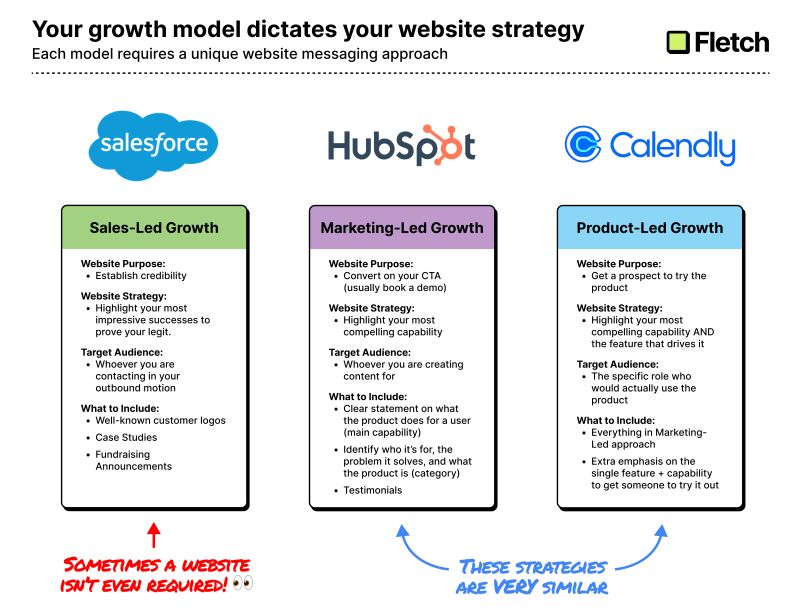
Being PL or SD does not mean siding with the good guys or the bad guys.
It means being deliberately clear about your organizational model.
Both models are profitable when well implemented and have advantages and disadvantages that must also be weighed against the stage of growth the organization is experiencing.
I have seen firsthand how these patterns, in addition to being misunderstood, are even instrumentalized. It is common, for example, for the tech team to live in a PL bubble when in fact the behaviors of all the other teams is blatantly SD company-like.
It is done-among other things-because a PL company attracts talent more easily, but this always brings strong friction between teams, especially with the sales department, which disproportionately influences the product roadmap depending on the size of customers and their demands.
The two growth models differ profoundly
- In the organization of teams
- In value creation processes
- In innovation management
- In the metrics that measure its performance
- In the cost structure
They are very very different!
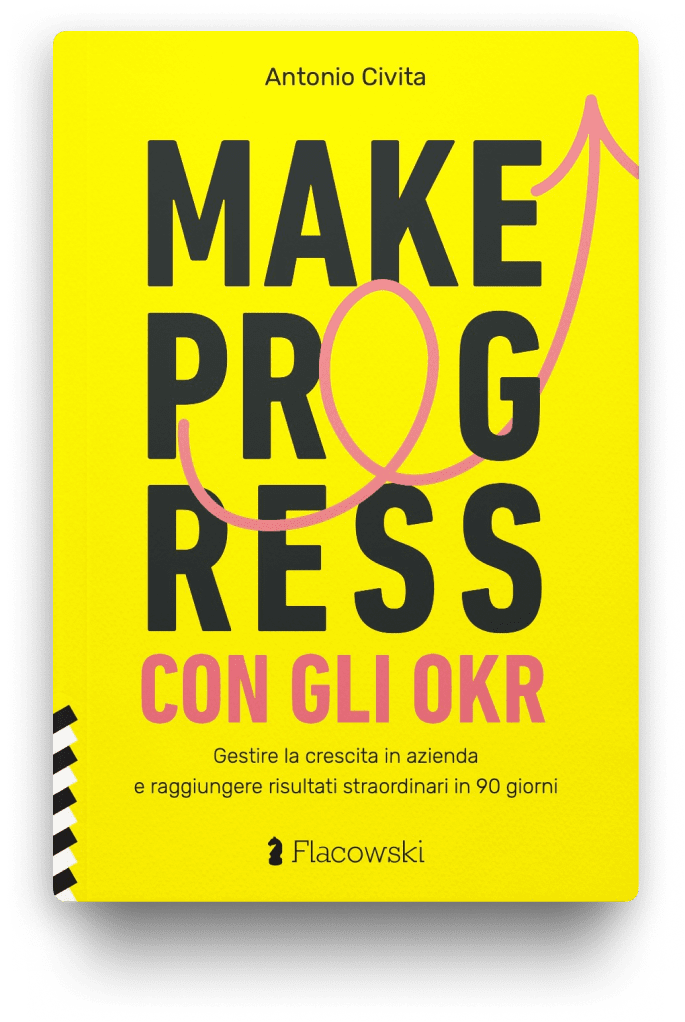
In MAKE PROGRESS with the OKRs, I devoted an entire chapter to help the reader in this disambiguation especially at the critical stage of choosing the North Star Metric.
Now I feel the need to add 3 shades that will make it even easier, and even more useful, to identify the correct pattern.
1 / Marginal cost for new customers
For a PL company, acquiring a new customer means incurring near-zero structure costs in addition, of course, to marketing costs. Think of Spotify or Netflix: for them, acquiring 10 or 10,000 customers on their platforms is operationally irrelevant.
An SD company, on the other hand, must contend with its ability to meet demands. For example, classic SD companies are agencies that have limited execution capacity. In addition, as the number of clients increases, there is generally less attention paid to them and consequently less quality of service. Proper supply & demand management in SD companies is crucial.
These unique characteristics imply that customer acquisition tactics are radically different. The former play on large volumes. The latter on precision in qualifying opportunities. Now Kaminski’s pattern will surely be clearer.
2 / Proximity to the Decision Maker.
Products in SaaS, especially those dedicated to B2B, are designed for the end user who may not coincide with the final purchase decision maker. Try to remember for a moment to the way products like Miro, Notion, Slack or Zoom entered your company. Probably a small group of people started using them experimentally until it became very difficult to do without them in their daily work. At that time it was inevitable to pass the purchase decision to the next level.
SD organizations build strong relationships with those who, on the other hand, evaluate firsthand the decision to buy the product or not. This is why it is important to adopt prospecting and lead generation techniques that allow the organization chart to be navigated down to the most useful level. This shortens the time to close opportunities and at the same time expands their size.
3 / Self Service vs. Human Relations.
This last point is related to the previous one. PL companies build self-service interaction modes with their users. They activate trials themselves, complete set-up independently, pay and download invoices with virtually no one in the company involved. Have you ever talked to anyone from Miro? Here.
SD companies, on the other hand, need to develop a strong ability to relate to their clients’ teams and make the interactions efficient. From the sales department to the administrative department via the technicians usually begins a dance of email exchanges, calls, documents to be signed and transfers.
You can tell from the first human interactions what it will be like to work with a new vendor. Building robust workflows becomes most important.
Three emerging opportunities
In recent years, at STRTGY, we have helped several entrepreneurs get the best of both worlds.
Sales Driven with Produced Services
We have seen excellent results when the company focuses on a small number of services, at best just one, that are managed exactly like a product. This allows sales teams to close a steady stream of opportunities while managing growth in a predictable manner. In addition, by treating the service as a product, it is possible to have accurate metrics that allow it to evolve accurately making it more profitable.
At STRTGY we have a specific coaching program. If you are considering this approach I would be happy to tell you how we did it and what are the things we learned. Choose when.
From Sales Driven to Product Led and vice versa
Needs may arise for which a decision may be made to transition from one model to the other. For example, an SD company is immediately more efficient from a cash perspective, while a PL is only more efficient in the long run. But this is not the only distinction.
Changing operating models is one of the most challenging strategic choices. And should you be looking to have a hybrid approach to Produced Services or adopt a more efficient growth model there are two tools that always work with surgical precision:
- The Growth Machine. Those who adopt a product mindset abandon the idea of linear growth and instead embrace the idea of growth loops-that is, engineering a series of effects in growth that have a compounding effect over time.
- The OKRs. While KPIs are more than enough to manage the business-as-usual, OKRs, measurable goals connected to the strategy, serve to transform it.
⤴⤴⤴
Let me know whether or not you found this note useful and if you have ideas you would like to explore further or questions that need to be answered. Just reply to this email.
Have a great week,
ALWAYS MAKE PROGRESS ⤴
-Antonio
How to get the most out of STRTGY
1 / Adopt OKRs with STRTGY. Work with me and my team to adopt OKRs by following the Make Progress Method. Here I show you how, step-by-step.
2 / Attend the The Growth Machine Workshop. Get in 90 work intended: clarity on goals and priorities, streamlining activities, focus and alignment of teams, building OKRs 10× faster.
3 / Buy Make Progress with OKRs. The most pragmatic book ever written on management by objectives technique. Includes the effective 12-week implementation program and all immediately usable templates. Click here.
4 / Download the OKR Toolkit. If you know OKRs well and just want to speed up their implementation, or solve specific problems with more effective tools, then get hold of all the templates. Click here
5 / Leave a review on Amazon. Even if you bought the book MAKE PROGRESS with OKRs, at any store, and spent at least €50 with your Amazon account, you can leave a review on any product. Click here to rate my book, the community will be grateful.