Hey, you’re back from vacation and back to work.
You thought you were more rested and motivated to face the rhythms of winter. But as soon as you sit down at the computer, all your energy and motivation vanishes. That’s what happened, isn’t it?
Triggered
Everything that represents work is like a switch that brings to mind the bad behaviors accumulated before leaving. Worries, challenges, difficulties and fatigue immediately materialize because the work environment recalls those bad habits. The environment is often the first factor to be changed to regain new energy and stimulation.
Changing the environment can make a difference. Try sorting your desk, move to another corner of the office or home if you work remotely. This is also one reason why it is best to get out of the office to work on something new. Strategic workshops and moments of innovation are most effective off-site, in spaces that don’t evoke the feeling of the office.
In a new place, there are no switches to bring back obstacles, only new horizons to explore.
Triggers > Habits > Culture
As human beings, we tend to be repetitive, performing more or less the same activities. We find comfort in routines and receive signals from our reality that anticipate certain outcomes. For example, we see notifications, receive emails from clients or hear sounds and see particular images. All of this reactivates behaviors that we constantly replicate. The more triggers we receive, the more our behaviors confirm expected outcomes and the more habits are reinforced.
The set of repeated behaviors, thus habits, contributes to culture. This is the simplest way to understand how culture works within organizations. People continue to behave the same way because of constant repetition.
This is an obviously necessary simplification for the space of this newsletter, but not an imperfect one. Based on this, we might think that just starting to change triggers would be enough to change habits and, consequently, culture.
However, there is another important level to consider: that of roles within a group of people. This issue is often underestimated, as we take it for granted that the organization functions in a certain way without anyone ever teaching us or questioning it.
The Stanford experiment that ended badly, like all change management projects
It is 1971 and Prof Philip Zimbardo of Stanford University, intended to demonstrate with an experiment how social role and environment could influence human behavior.
The experiment, which was supposed to last 15 days, was terminated after only 6 days because of the excessive violence and psychological suffering inflicted on the participants. The results were so alarming that Zimbardo felt compelled to publicly apologize to the volunteers for the negative consequences they suffered.
Twenty-four college students were selected and randomly assigned to the roles of guards or prisoners in a simulated prison set up inside the university.
Before long, participants began to behave in ways consistent with their roles, despite the fact that it was only a simulation. The guards adopted oppressive and harassing attitudes toward the prisoners, going so far as to exhibit sadistic and violent behavior. Prisoners, on the other hand, became increasingly submissive and dependent.
The Stanford experiment demonstrated how ordinary people with no special predisposition could engage in cruel and antisocial behavior simply based on their assigned role and context.
This phenomenon, known as the “Lucifer effect,” highlights the importance of social influence and the fundamental attribution error, which leads to explaining others’ behavior based only on personality traits, neglecting the impact of context.
The Stanford experiment has had a major impact on social psychology, demonstrating how role and environment are determining factors in shaping human behavior, even in contrast to one’s personal nature.
This explains, for example, some behaviors typical of the father-son role in companies where ownership is in charge and has established leadership. In these settings, the front line often consists of people who have been there from day one.
Or explain why your colleague, after promotion, went from great friend to perfect asshole! Those who have recently changed roles have also changed the way they see reality because they are subjected to new incentives, new environments, and new triggers, thus developing other behaviors that have been consolidated into new habits.
Business structure and strategy execution
This brief journey into the behavioral sciences was necessary to introduce an important relationship between organizational structure and strategy execution. In my career, I have seen many strategies that were unexecutable because of inadequate corporate structure.
I have also observed the emergence of numerous organizational patterns in which leaders often ask what the corporate hierarchy should look like. Should it be pyramidal, flat or hub-and-spoke?
If we want a good answer to the question of what is the best organizational structure, it must then be asked differently: what is the best organizational strategy, for what purpose?
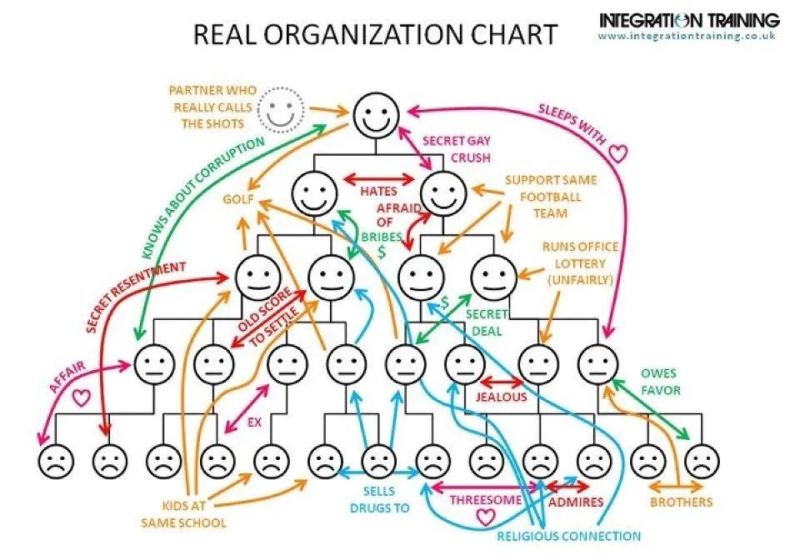
In a recent LinkedIn post at which I spoke, Pim de Morree shared this infographic that perfectly represents business dynamics.
Pim de Morree is one of the founders of Corporate Rebels, an organization dedicated to proving that even the most boring and traditional workplaces can be transformed into inspiring and motivating environments. Together with his colleague Joost Minnaar, de Morree wrote the book “Corporate Rebels: 8 Ways to Radically Transform Work,” where they share case studies of corporate transformation pioneers: here in Italian.
But back to the infographic. Many of us in the company have an organizational chart similar to this one. What it actually shows is the relationships between the various roles . Obviously this is a very funny description, but in some places it is realistic enough to question the validity of the architecture itself.
And this behavioral pattern is increasingly true as size increases. The larger they are, the more politics and personal goals slip between their meshes. It is not hard to imagine how a large enterprise actually behaves like a small town. In such a setting, there is the mayor, the sheriff, and the police. Budgets and resources are released based on personal agendas, protection of the status quo and benefits rather than overall improvement of the situation.
Strategy > Form > Results
In my career, I have found that work never follows the lines of organizational charts, but moves according to them. Because of this, organizations often turn out to be inadequate and lack processes to update them. Where should one start, then?
Many companies did not choose to be the way they are today; they became that way by inertia. They have adopted established models where everyone can have their position, with already known rules. It is easy to replace missing positions because they all have a well-defined label in the labor market. It is a very comfortable structure, but let’s try to imagine something different.
The organizational structure must align with business goals and be designed with intentionality. It should not just follow a conventional model, but be a natural extension of the working method.
The starting point is, of course, strategy. As you know well from following this newsletter, it is not made up of budgets or budgets, but by the building of shared decision-making principles within the organization. These principles guide how the company extracts value from the market and satisfies its customers and puts itself in the best position to do so for as long as possible.
The second step is to eliminate executive ambiguity, that is, to ensure a clear and precise understanding of the goals to be achieved on different timelines, both qualitatively and quantitatively. Using techniques such as OKRs or other lightweight ways of setting goals helps achieve coordination through collaboration, avoiding stringent policies and internal bureaucracy.
To do this, at STRTGY we use a crucial tool that charts the behavioral evolution of teams in strategic execution: it is called Now & Next and is part of the MAKE PROGRESS® Method. If you want to see it in action, you can do three things: read the book, download the toolkit, or request a hands-on demonstration.
Once you understand these three variables-strategy, goals, and people behaviors-you are ready to shape the organization to achieve consistent results.
The key word is consistent: not an exploit of a particular moment, but a stable way to generate results and constantly optimize the system.
Working with dozens of organizations in Italy and abroad that use MAKE PROGRESS, we have identified two effective ways.
Organization by systems
The first is to look at the company from a systems perspective. This means understanding value stream creation, how the company creates value in the marketplace, and how customers move within it. Then, build multidisciplinary teams that work on each system.
A system is the set of people, processes, tools, metrics and projects that enable certain results to be achieved. Systems foster cross-functional collaborations because they involve multiple teams. You have to imagine systems as blocks of sequential results to be achieved and teams as groups of people with particular skills or expertise. When this difference is clear, how to organize systems also becomes apparent. I refer you to this article to understand what the main systems are, how to organize them, and what KPIs to use to measure their effectiveness.
The power of Business Systems to grow more efficiently (plus 10 KPIs to measure now)
Gear organization
Another way of business organization that I have seen work can be to follow the mechanics of growth, which is described a MAKE PROGRESS® tool called the Growth Machine. The Growth Machine represents a series of effects that the company must generate in the marketplace, creating a flywheel that is reinforced over time. These effects, as they repeat, build a composite interest of organizational improvements.
The Growth Machine usually consists of 4-6 gears that represent key outcomes to be achieved. These outcomes must have clear accountability in the execution processes. For this reason, a lean way of organizing can be to identify the responsible people within each gear and the people who must execute them. Thus, the corporate structure becomes more efficient, mapped onto strategic execution and with a direct correspondence between results and form.
What to bring to the office
- Change the work environment: Reduce negative triggers to rekindle motivation and energy.
- Understand the link between behaviors and organizational culture: Identify and change the signals that trigger repetitive behaviors to transform corporate culture in a positive way.
- Recognize the importance of role and environment: Consider how roles and context influence behaviors, inspired by the Stanford experiment to prevent negative office dynamics.
- Align organizational structure with strategy: Assess whether your corporate structure really supports strategy execution and make changes to improve efficiency.
- Implement systems for consistent results: Organize your company around strategic systems and gears to ensure stable results and sustainable growth over time.