Hey, happy Monday!
I will soon be preparing case studies on how teams that have decided to use the tools of STRTGY are driving major transformations in their business through OKRs.
The reflection in this note comes from an OKR coaching session with the leadership team of a large organization we are working with.
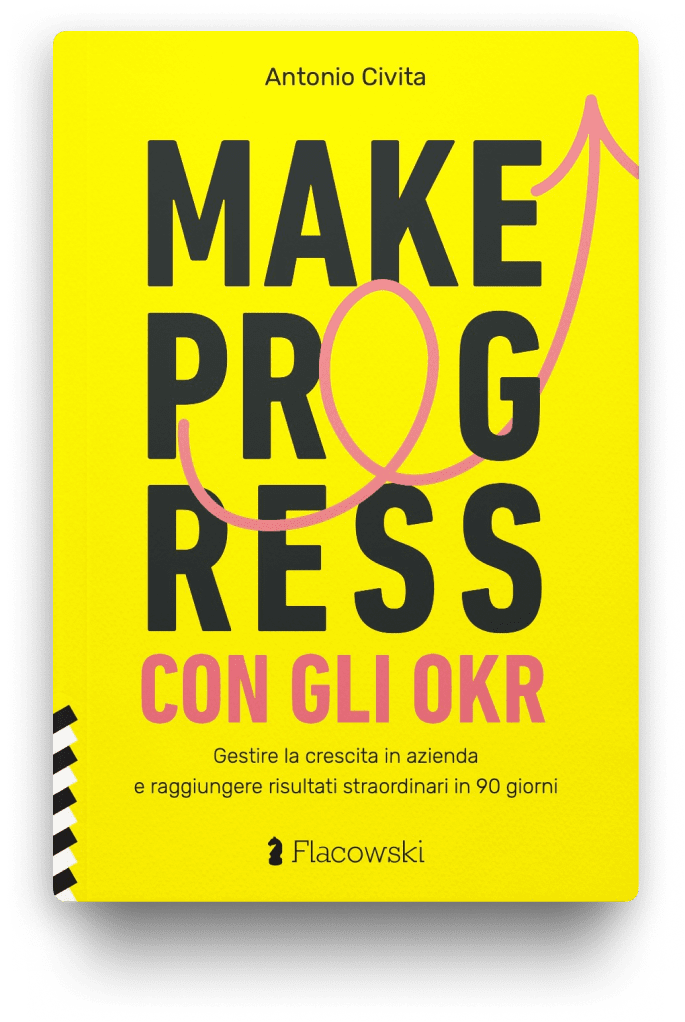
You will not find it within the pages of Make Progress with OKRs because the book is now in print and I no longer have a way to update it, however, you will soon have in your hands the most detailed implementation manual with dozens of examples, tools and templates ready to use.
Reserved only for you. As a reader of this newsletter there is still time to get a 20% discount, and not pay shipping costs. Visit the publisher’s website and enter the code STRTGY20 at check-out.
Organize a book presentation at your company. I would be happy to present the details of the work I produced in a live session. Those who have already done so have found these meetings very useful because they allow them to quickly understand how to adapt the content of the text to their own business model and stage of growth.
It will be a very useful event if:
- Are you considering the adoption of OKRs,
- you are implementing them and you want to solve some obstacles,
- you want to know more about OKRs,
- you are looking for a structured system to manage growth and innovation.
Fill out this form to submit your request and organize the event together, or forward the link to those who might find this opportunity interesting.
Let’s get into the meat of today’s edition.
What is the real Product?
In the early stages of each program I invest sufficient time in reaching agreement among all team members on some basic strategic concepts:
- What is the Vision?
- What is the Mission?
- What is the real Product?
This is only the first of the four levels of alignment to which you must aspire: the other three are alignment on business and sales models (sales driven or product led), alignment on the mechanics of growth, and alignment on executive priorities. Only after unlocking the first one can you access the others.
I will gloss over the Vision and Mission part for this note and focus on the word “true” next to the word Product. This four-letter word profoundly changes the question. I don’t want to know what products the company sells, but what is the product that users buy!
A digital marketing agency, sells dozens of services ranging from SEO to Web Design, graphics to copywriting, but what clients buy is the growth of their business.
A restaurant does not sell dishes on the menu but an experience of entertainment and memories to share.
A designer furniture company does not sell furniture, but a way to express one’s personality in the home.
The list of units sold never indicates what people actually buy. Those are the outputs that the company must give up to achieve the outcome it intends to create. That is a substantial difference!
The first reason this alignment is necessary is because outputs define cost and profit while outcomes define price and positioning. People pay for outcomes and the speed with which they get them, not for the cost of raw materials (unless it is a commodity).
Do not confuse JTBD with Vision and Mission.
One of the most powerful frameworks you could use to precisely define your real product is JTBD.
In 2021 at Product Management Day, I recorded a one-hour lecture that precisely describes how to build a product roadmap by implementing a 4-step analysis process. Click here to watch it.
JTBD and OKR are a very powerful combo for two reasons:
- Both talk about progress,
- both are measurable.
The JTBD provides an understanding of the progress that needs to be sustained in people’s lives so that they continue to create value for the company. OKRs make it possible to measure it.
If JTBD is not measurable,
Is not a good JTBD.
During an OKR coaching session, an executive posed this objection to me, “I think Disney’s JTBD is ‘make people dream,’ how is it possible to measure that?”
The spark that started this note you are reading comes precisely from the fact that JTBD is often confused with vision and mission.
The executive, with “make people dream” made a good summary, but of the wrong concept. Indeed, the official website states that Disney’s mission is “[…] to entertain, inform and inspire people around the world through the power of storytelling, creative minds and innovative technologies to make the company the world’s premier entertainment company.”
So what is the JTBD? To answer this question we would have to ask a more precise one: “what end result are those who buy their products willing to pay for?” While the answer-as you will see from the video I pointed out a few paragraphs ago-requires a good deal of analysis, I can provide my own partial but not far from reality version.
I could define Disney’s JTBD with “the low-cost, always-on, baby sitter.”
This definition-repeat, personal-is also the only reason I was paying for the subscription.
It is possible to measure this JTBD with total watching time.
It is useful for Disney, which thus measures my retention (and the likelihood that I will renew my subscription).
It is useful for me–user–to determine its value based on a comparison of the cost I incurred and the cost I would have incurred if I had adopted a different solution to accomplish the same work (momentarily entertaining my child).
You may note that I used the past tense verb because I have discontinued my subscription now that my son is older, preferring other solutions. Technically Disney has failed over time to sustain our – my son’s and mine – sense of progress. A normal phenomenon that many companies disregard and consequently do nothing to counteract.
This concept opens the door to redefining competition, innovation, optimization and ultimately business growth.
It is around these areas that you should align your strategy and consequently your OKRs. That is why it is a critical question to answer before measuring anything.
Considering the importance of the topic I am thinking of organizing a Masterclass of up to 3 to 5 LIVE sessions to go into detail on JTBD and cover in addition to the basic topics:
- Because the competitive advantage is only temporary,
- How to identify competition by moving from the market concept to the arena concept,
- How to identify pricing,
- How to positively influence B2B sales,
- How to link it to the strategy and OKRs.
Would you like to participate? Click here to express interest, so I can arrange it in the best possible way.
ALWAYS MAKE PROGRESS⤴
– Antonio