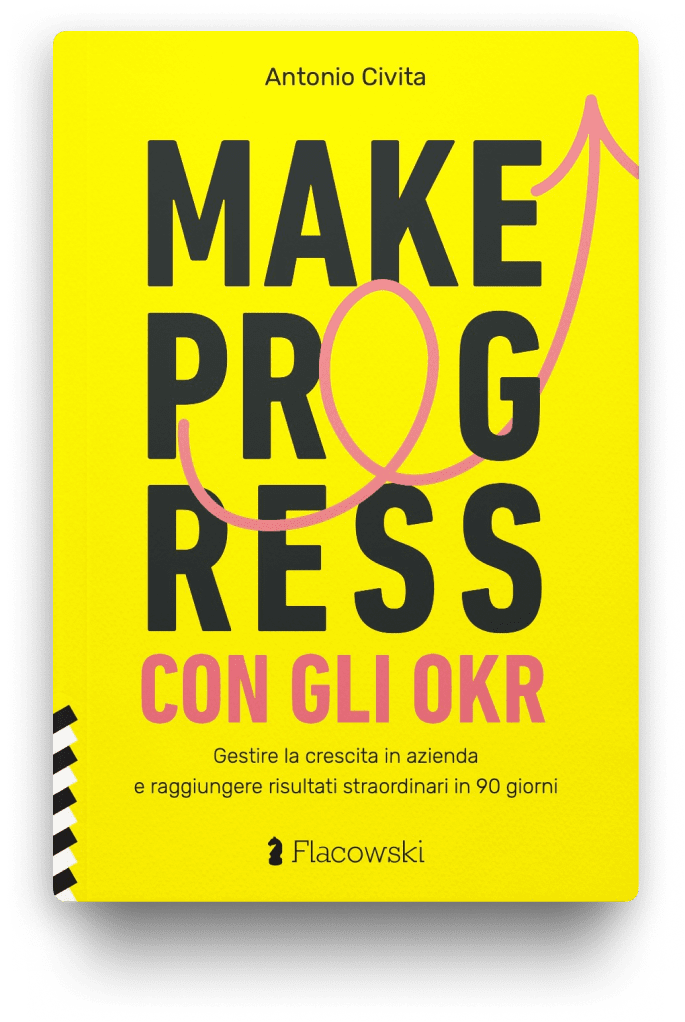
The greatest advantage of having a strategy is to know when it is not working before it is too late.
And those who use MAKE PROGRESS as their growth operating system also have at their disposal the most efficient toolkit to get the ship back on track, quickly.
In this note, I have identified 5 signals that can be read on the Focus One Pager (SFO), the most important tool that is used to document, deploy, measure, and most importantly, frequently update the strategy.
You will find out what block from the canvas to look at, what metrics to look at, and some tips for responding.
Every strategy, after all , is nothing but a call for change, and change is a constant in every system. One should not fear it, on the contrary! One must change perspective and set out in search of change. To inspire you, I have also collected 5 stories paired with each signal.
These stories show how those who have been able to treasure them have made such a spectacular strategic pivot that has determined their success.
For a greater understanding of these concepts I invite you to watch this video training that, through a simple example, shows how the SFO works.
Side note, KPIs are intentionally expressed in a generic way to allow you to adapt the concepts expressed to your business.
Happy reading.
Signal No. 1: Decline in Product Core Metrics.
SFO block to be monitored: Product Core Metrics
Top 3 KPIs:
- Reduced customer acquisition rate
- Decreased user engagement
- Increased churn rate
How to interpret the signal:
A significant decline in key product metrics is a wake-up call that indicates a possible disconnect between current offerings and evolving market needs. This decline can result from a variety of factors, such as the emergence of new, more innovative competitors, changes in customer preferences, technological obsolescence, or reduction in implementation, production, or delivery quality.
Suggestions for responding:
Constantly perform market research, analysis of customer feedback and monitoring of industry trends, not just in times of crisis. Consider innovating your product or service in a systematic and structured way. Also consider exploring new market segments or alternative business models.
The case: Nokia from paper factory to cell phones
Founded in 1865 by Fredrik Idestam as a paper factory in Finland, Nokia expanded throughout the 20th century into various industries, including rubber, electrical cables, and consumer electronics. By the 1980s, the company produced a wide range of electronic products such as televisions, computers, and other household devices. However, during this period, Nokia began to experience a significant decline in product-related metrics. Sales of televisions and computers declined due to increasing international competition and market saturation highlighting a loss of competitiveness in the company’s traditional areas.
Recognizing these troubling signs, new CEO Jorma Ollila, appointed in 1992, decided that a strategic pivot was needed to reverse the negative trend. Ollila carefully analyzed the performance of the various business segments and identified mobile telecommunications as the area with the greatest growth potential. Under his leadership, Nokia sold or closed unprofitable divisions and focused resources on innovation in mobile telecommunications.
By investing heavily in mobile technology research and development, Nokia was able to launch a series of successful cell phones that conquered the global market. By the late 1990s, Nokia had become the world’s leading cell phone manufacturer, turning a potential crisis into an opportunity for market leadership. This move not only lifted the company’s product metrics, but also positioned it as a pioneer in the mobile telecommunications industry.
Unfortunately, management failed to live up to expectations later when it found itself under the same pressure with the launch of the nine models of cell phones such as Blackberry and iPhone.
Signal No. 2: Radical changes in customer preferences
SFO block to be monitored: Ideal Client / Market
Top 3 KPIs:
- Decreased customer satisfaction
- Decline in sales in key segments
- Increased negative feedback or requests for new features
How to interpret the signal:
Customer behaviors are always changing faster than companies can adapt. Cyclically, solutions and products that once satisfied the market are no longer aligned with current needs. This can manifest itself through declining customer satisfaction, declining sales in key segments, and an increase in negative feedback, and it is crucial to understand these signals in a timely manner that, if ignored, could lead to a significant loss of market share and the possibility of competitors filling the void left behind.
Suggestions for responding:
Again, customers prove to be the best advisors. Consider adapting or reinventing your products and services to align with new preferences. Explore opportunities in adjacent or entirely new market segments.
The case: Nintendo (1889) from traditional playing cards to video games
Founded in 1889 by Fusajiro Yamauchi in Kyoto, Nintendo began as a manufacturer of traditional Japanese playing cards called Hanafuda. For nearly a century, the company thrived in this niche industry. In the 1960s, Nintendo faced a decline in sales as consumer preferences shifted to new forms of entertainment.
In 1949, Hiroshi Yamauchi, grandson of the founder, took over the leadership of the company and realized that diversification was necessary to survive. After unsuccessful attempts in areas such as cabs and hotels, Yamauchi recognized the emerging potential of consumer electronics. In the 1970s, Nintendo began developing electronic games and in 1977 launched its first home console, the Color TV-Game.
The real pivot came with the launch of the Nintendo Entertainment System (NES) in 1983. Facing a market in which customer preferences were shifting toward digital entertainment, Nintendo invested heavily in the development of innovative hardware and addictive games. Under the visionary leadership of Hiroshi Yamauchi, the company created iconic franchises such as Super Mario Bros. and The Legend of Zelda, redefining the video game industry.
This strategic pivot not only saved Nintendo from decline but transformed it into a world leader in the video game industry. The company continued to innovate with products such as the Game Boy, Wii, and more recently the Nintendo Switch, always introducing new ways to stay relevant in the lives of its customers.
Signal No. 3: Disruptive technological evolution
SFO block to monitor: Growth Machine Enablers.
Top 3 KPIs:
- Reducing the frequency of purchase
- Increase in Lost Clients due to lack of features
- Reduced ROI on strategic investments
How to interpret the signal:
The emergence of disruptive technologies can quickly make existing business models obsolete. If you notice that new technologies are revolutionizing the industry and your products or services are no longer leading the way, it is a clear sign that your company is in danger of losing relevance. Inertia is the enemy of innovation. It is essential to understand how new technologies can support growth and avoid depending on technology as the only value proposition.
Suggestions for responding:
Conduct a thorough analysis of new and emerging technologies and assess how they may affect your industry. Invest in research and development to integrate these innovations into your products or services. Consider partnerships or acquisitions of technology startups to accelerate the adoption of new skills. Review your business model to incorporate these technologies and create new sources of value for customers. Analyze your processes and bottlenecks-how can you use technology to overcome them?
The case: IBM from hardware to IT services and solutions
Founded in 1911 as the Computing-Tabulating-Recording Company (CTR), IBM began by producing scales, industrial clocks and computing machines. In the 1950s and 1960s, under the leadership of Thomas J. Watson Jr. IBM became a world leader in mainframes and computer hardware. However, in the 1980s, the advent of personal computers and increasing competition in hardware led to a significant decline in sales and profits.
In 1993, IBM appointed Louis V. Gerstner Jr. as CEO, marking the first time an outsider assumed this role. Gerstner recognized that the hardware-centric business model was unsustainable in the new technology landscape. Noting the technological evolution and the shift toward more integrated solutions, he decided to pivot the company toward IT services and solutions.
Under his leadership, IBM reduced its emphasis on hardware, selling some divisions such as personal computers to Lenovo in 2005. Instead, the company invested in consulting services, software and tailored business solutions. Through this transformation, IBM returned to profitability and consolidated its position as a leader in the technology industry. The pivot not only met the challenges posed by technological evolution, but also created new opportunities for sustainable growth. The model is still relevant at the time of writing.
Signal No. 4: Significant regulatory or market changes
SFO block to monitor: Business as Usual
Top 3 KPIs:
- Increased operating costs due to new regulations
- Reduction in demand due to market changes
- Increased sanctions or penalties for noncompliance
How to interpret the signal:
Sometimes it is not only competition but also regulations or external market factors that challenge a company’s business model. These transformations may include new environmental laws, more stringent tax regulations or changes in the competitive dynamics of the industry. Understanding that such changes may make existing processes obsolete and require rapid adaptability is business critical.
Suggestions for responding:
Collaborates with legal experts and industry consultants to fully understand implications and identify hidden opportunities. Consider internal process innovation, adoption of new technologies, or diversification into less regulated sectors. Evaluates the possibility of actively influencing policies through dialogue with institutions.
The case: Piaggio from naval furniture and aircraft to scooters
Founded in 1884 by Rinaldo Piaggio in Genoa, Piaggio initially specialized in the production of naval furniture, rail vehicles, and later aircraft. During World War I and World War II, the company became an important manufacturer of military aircraft for Italy. Everything changed when at the end of World War II, with Italy in ruins and Allied restrictions on aircraft production, Piaggio found itself in deep crisis.
In 1946, Enrico Piaggio, the founder’s son, began a collaboration with aeronautical engineer Corradino D’Ascanio that gave birth to a scooter that was inexpensive, easy to ride, and suitable for the ravaged roads of the postwar period: the Vespa was born. This vehicle responded perfectly to the need for low-cost individual mobility.
The pivot was a direct response to regulatory changes that prevented aircraft production and market demand for affordable means of transportation. The opportunity was to convert production know-how and factories to meet a new market segment. The Vespa quickly became a cultural and commercial icon, exported all over the world.
Signal No. 5: Erosion of sustainable superiority.
SFO block to be monitored: Uniqueness
Top 3 KPIs:
- Reduction of competitive advantage over competitors
- Decrease in perceived quality or innovation of products/services
- Increased market share of competitors
How to interpret the signal:
Erosion of sustainable superiority occurs when the company can no longer maintain the competitive advantage that sets it apart in the marketplace. This can happen if competitors improve their offerings or if the company stops innovating, leading to a decrease in the value perceived by customers. For a business leader, it is crucial to recognize that sustainable superiority is not guaranteed for life; it requires an ongoing commitment to innovation, quality, and adaptation to changing market needs.
Suggestions for responding:
Perform a critical assessment of your product portfolio and compare it with that of your competitors. Identify areas where your competitive advantage has narrowed and invest in research and development to fill these gaps. Consider adopting new technologies, optimizing processes and innovating business models. Engage customers to better understand their needs and expectations, using this information to guide product development strategies.
The case: 3M from mining abrasives to continuous product innovation
Founded in 1902 as the Minnesota Mining and Manufacturing Company, 3M began its operations by mining ores to produce abrasives for industry. However, the poor quality of the mined ores quickly led the company to face serious financial and operational difficulties. The company possessed no competitive advantage.
Recognizing the need for change, 3M management, led by CEO William L. McKnight in the 1920s, decided to pivot strategically. They adopted the concept of sustainable superiority as a guiding principle, understanding that to remain competitive they needed to offer products with measurable benefits that were difficult for competitors to replicate.
The first step was massive investment in research and development, leading to the creation of Wetordry waterproof sandpaper in 1921. This innovative product offered superior performance over competitors, solving practical problems for users and setting a new standard in the abrasive industry. The sustainable superiority of this product stemmed not only from its quality, but also from the difficulty for competitors to replicate its technology.
The push for innovation continued with the invention of Scotch® adhesive tape in 1930, thanks to engineer Richard Drew. This product opened new markets and demonstrated 3M’s ability to create unique solutions that met specific customer needs. Sustainable superiority here was evident in the combination of proprietary technology and attention to market needs.
In the 1970s, the company continued to embody the concept of sustainable superiority with the creation of the Post-it® Notes. Scientist Spencer Silver developed a low tack adhesive. The project was initially considered a failure because low tack glue seemed a mistake rather than a feature. It was fellow scientist Arthur Fry who sensed its potential to create a revolutionary new product… keeping the mark on sheet music without ruining it! Post-it® notes quickly became indispensable in offices and homes around the world because of their uniqueness and usefulness. The difficulty for competitors to effectively imitate this product further consolidated 3M’s dominant position.
At every stage of its evolution, 3M has used the concept of sustainable superiority to guide its strategic pivots. The company did not just respond to market changes, but anticipated future needs by developing innovative products that offered tangible value that was difficult to replicate. Today, 3M is a multinational conglomerate with more than 60,000 products in sectors such as health, industrial, electronics and consumer. Its dedication to sustainable superiority through continuous innovation has been critical to its success and its ability to adapt to market changes.