It’s good to see you again in this Q2 that started almost on the sly during the Easter break.
A busy but news-filled period has begun at STRTGY. Let’s start with these:
1. Hello Turin!

A new BACKSTAGE on April 10 in Turin at 6 p.m. c/o COMBO, in collaboration with Torino Digital Days and admission offered by them. Unlike other backstages, registration is on Eventbrite. Request the pass and you will receive the link. If you want, you can have dinner with us.
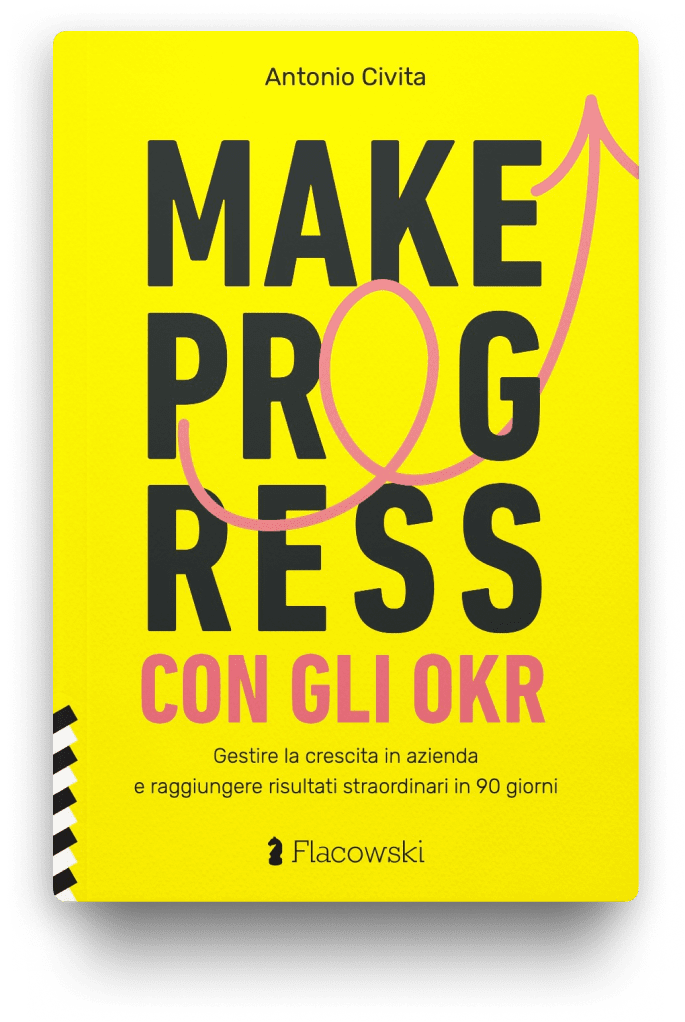
If you are interested in using OKRs in business and learning about case studies from those already using MAKE PROGRESS, this is an opportunity not to be missed. PASS allows you to download the OKR Toolkit to apply the methodology right away and access upcoming workshops.
2. Binge-watching
The STRTGY Meeting recordings can now all be viewed on demand in a convenient playlist. Access the STRATEGY Learning Center via this link to find a playlist with nearly 60 hours of strategy content from key players from recent seasons. Take advantage before it becomes payment 🙊
3. 200+ strategic reports
Q2, it’s time to refresh your annual strategy, and to keep you abreast of the latest trends, I have published a collection of more than 200 strategic reports from the world’s top organizations.
In this collection you will find reports from the World Economic Forum, Accenture, Adobe, Bacardi, Coinbase, and Deliveroo. I have tried to cover all industries to provide you and the entire community with comprehensive analysis on the most authoritative industry trends.
4. Do you know this book?
Have you ever heard of MEASURE WHAT MATTERS by John Doerr? It is the book that opened many people’s eyes to the world of OKRs, prompting them to implement them in their companies. I must confess that it is the book that introduced them to me as well, but at the same time I must admit that it presents OKRs in a way that is not entirely up-to-date, containing some small pitfalls.
In this short video, I show you what these traps are and how to avoid them. Does this sound interesting? I guess so, because you have probably experienced firsthand these very challenges in applying OKRs.
5. The law of two buckets
Have you ever heard of the popcorn experiment, which reveals a lot about human psychology? At the entrance of a movie theater, low-quality popcorn was offered in two different containers, one large and one small. Those who had the larger container ate more of it, although it was not very good. This highlights typical human behavior, where the size of the container affects our perception and ability to consume.
If we apply this to work, our receptacles might be the backlog of activities and goals to be achieved. We can use this tendency to our advantage; in this video I illustrate how.
6. Align OKRs with your own standards
In some recent OKR Coaching sessions, a team was questioning how to properly write a goal and identify the right targets in a context common to many companies, namely measuring some metrics for the first time.
There is no inviolable mathematical rule in these cases, especially for exploratory metrics, of which past baselines and trends are unknown.
My advice in these cases is to identify targets that represent the standard of work to which you aspire.
OKRs are effective in numerically representing a new level of operational quality. When thinking about targets, instead of focusing on a business outcome that is difficult to influence, it might be more effective to represent-with numbers-the standard of work that elicits pride and self-respect.
In the end, it is not the achievement of the goal that is the key element, but the transformation of the organization on its way to the goal. If the first step is to align one’s work with personal standards in order to be satisfied, that will be the best goal to write.
ALWAYS MAKE PROGRESS ⤴
Antonio