Hey, happy Monday,
I’m going straight to the point because if there’s one thing I’ve learned in this week of remote-working, it’s that important to make decisions quickly.
If China had taken action one week earlier today we would have had 66% fewer infections. If it had done it three weeks earlier the cases would have been reduced by 95%.
– Ian Sample, Science Editor, The Guardian Article
The article, however, is not meant to point the finger at those who should have made the decisions and did not but is meant to spur other leaders to act quickly as the virus and best practices spread.
Flattening the curve
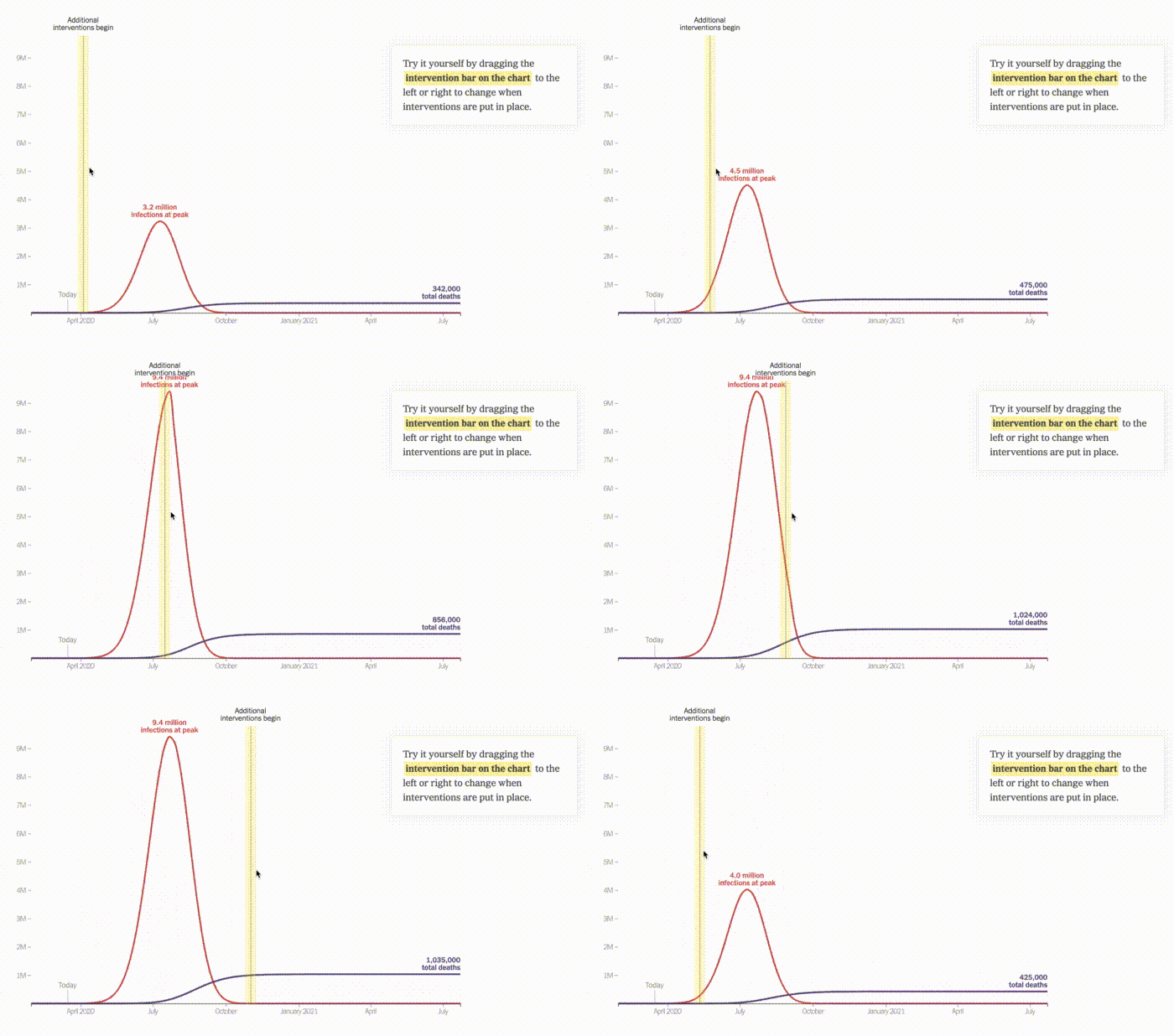
The NYTimes has released an interactive article here where by dragging on the timeline the moment of action you can simulate the positive impact of making the decision as soon as possible. Hard right?
The game is to try to do everything to “flatten the curve,” to make sure that we don’t have the spike in infections that would surely bring down the health care system. But you already know that. The only thing you can do is stay home and follow the rules.
There is another curve that is flattening, if not flexing dangerously, and that is your company’s revenue curve. Here, too, you need to decide quickly.
I have to tell you that you don’t have to be the CEO, or a manager to decide to work differently. No one will hold you back if you decide to work better, faster and with less cost. The good news is that as of one week no one is checking up on you. It’s called smart-working because you have to be the smart one. It’s not enough to just take your computer home.
You have to imagine business as an hourglass. This pandemic didn’t ask for permission when it suddenly turned the cruet, forcing you to play with only the sand you had made time to store.
In the last STRTGY Note, No. 9, I told you about “bring-at-home” brands. That is, all those brands that with their excellent Customer Experience, are bringing home the piece of the world that you cannot have for the moment.
Bring-at-home Office → Slack / Zoom / Google Meet / Miro
Bring-at-home Food → Esselunga over all / Tannico
Bring-at-home Entertainment → Netflix / Spotify / DAZN / Playstation
Bring-at-home Fitness → Peloton (which is not in Italy yet…) / DownDog
Bring-at-home Education → here I may never end…
Their experiences are disruptive because, forced by the momentary context, you are trying services that you had not considered before, you were a non-consumer, and suddenly you have become one. The fact is, there will be no convenience in going back.
The vaccine
I have selected 4 key characteristics that make their business models particularly resilient.
It is on these characteristics that I invite you to reflect and possibly make the decision to adopt all or part of them to bring your curve back on the growth trajectory even at this time.
Recurring Revenue
These brands don’t wait 60 days fm to cash out. These brands already have your credit card. Your relationship with them is light, transparent, recursive and upfront. Their subscription model is a winner especially when you think about Netflix’s over 90 percent retention rate.
Which of the products/services you offer can have a subscription model?
Margins
The profitability of these services is very high and is due to the fact that the marginal cost of a new customer is practically zero. The entire organization shapes its processes by promoting efficiency and differentiation. Margins are the sand you put back into the hourglass.
What activities can you reduce to improve margins and invest in CX to differentiate yourself from competitors?
Product + Service
A product, by its nature, is copyable. Product plus service is not. That is why a Mac is still a Mac even if for the same price you can buy a PC twice as powerful. We could say the same thing about Leica or Nespresso. So of Netflix or Amazon Prime Video: both platforms offer video streaming but it is the quality of their service understood as the ability to produce and aggregate quality content that makes them different. Google and its Partner Network. Oracle and its consulting division…
Ah, I almost forgot, they have a very high NPS!
What product and service can you inextricably pair to give an inimitable experience?
Brand
These brands are always in sync with your life because they have decided to own the relationship with each individual user through the use of data and artificial intelligence. They are computational brands; their experiences adapt and improve as you use them. And so does communication.
How can you gather insights from your customers and incorporate them into the next iteration of your product/service?
Branding by Design (Webinar)
To talk about branding, I invited Giuseppe Mayer to our community. Formerly of Armando Testa Group, Grey/ WPP, Ambito5/Publicis and Isobar/Dentsu.
In his new book, “Branding by Design” (Egea, 24 euros, 192 pp.), he talks about how it is possible, precisely through digital, to build a brand by opening up to people’s contributions in order to be able not only to adapt to the demands of specific targets, but also to become “antifragile” that is, to improve whenever one is subjected to any kind of pressure or change.
The STRTGY Meeting will also adapt to this new lifestyle, and for this we are preparing a Webinar in which Joseph will tell us what are the eight characters of the post-digital brand he has identified. He will not give us the “recipe for success,” rather he will describe the challenges we face by analyzing them at a deeper level to bring out the key concepts and support those of us who need to launch our own action plan.
At the end of the webinar you will be given a code to enable you to purchase the book at a 20 percent discount on the publisher’s website.
Sign up to be notified of the date.