Hey, happy Monday!
Marcus Aurelius recommended stopping every night before going to bed in a quiet corner of the house and thinking back over the day that has just passed. Understand what the most important events were and reflect on the quality of our reactions.
Regardless of whether you like stoicism or not, going through your business-or your life-is really a powerful thing, triggering a very powerful change. Have you ever tried it? It’s not exactly easy. You run the risk of ending up justifying your actions or even defending them, of thinking that it happened that way because it had to happen that way–because we wouldn’t have had any power over events anyway.
I have to say that I do not believe in luck and instead firmly believe that we are the consequence of the choices we make. If you want different things, you have to choose to be different.
For the past few years I have had in my calendar two blocks of time, one after the other of 15 minutes each, to review the day that has just passed and plan for the next. For me it is an important time, a habit that has brought me many benefits, and I am sure that with experience, it will bring me more.
It was not easy; I had to learn how to do it. At first it was painful because every time you see all your flaws in such a clear light that you cannot deny that they exist. That’s why I want to share with you a technique I learned on my own skin.
But what does this have to do with business, with strategy–with all the things you’re used to reading about in this newsletter? Stopping and reflecting on what has been done and how to do better is at the heart of any strategic process. It is not just a personal skill. As a leader it is your responsibility that your team acquire this skill as well.
Video games, running app, OKR
There are no more effective industries in making users addicted to their products by acting on the most effective levers of human psychology. To install a new habit in your life you can copy their techniques.
If you want to get better and better, if you want to push your limits, you have to turn on ghost mode.
You basically have to learn how to compete with the previous version of yourself.
Racing video games-car, motorcycle or other, it is indifferent-have this feature. When you make a record time your trajectory on the track is saved so when you play the next time you will see yourself speeding alongside you. And it’s only by going to correct the mistakes you see in the driver racing transparently against you that you can set a new record.
When I first started running, I was doing it with an app called Runtastic-purchased by Adidas in 2005 for $240M-which I had chosen precisely because it implemented this feature. Every day I would run against my best performance so that I would outperform myself. A voice would alert me in my headphones when I caught up or was outperformed by myself. When that happened I would run harder because I didn’t want to go home without beating myself.
What makes OKRs effective, besides choosing goals and metrics well, are the reflections on the results that trigger change. Every cycle you are called upon to overcome the previous version of your organization, and if you do not do something to change it surely the situation will not improve.
The Ghost Review
Back to business. Every 30-90 days you need to realign the way you work to the strategy. It is not enough to talk about it once at the beginning of the year to be sure to execute it. Not everyone has that iron discipline that allows them to sail without straying from the original course. Rather, the company looks more like a ship where even the captain is in the engine room!
Some of it boredom, some of it motivation, some of it the thoughts of life, you naturally end up losing focus and taking shortcuts on processes, thus deteriorating results. It may also happen that new needs have actually emerged to which one must react.
Stopping to reflect and realigning team roles to the new situation becomes critical. When the team does not have a rhythm, the time when this happens is generally a time when anxiety is generated. Especially when the leader is the one calling the “fateful” meeting.
So here the idea is to go into ghost mode and examine the work done by the ghost of ourselves. Not ourselves.
Because basically we are always better at giving the advice to others. A kind of counselor syndrome who are good at giving advice to clients rather than solving their own, identical, problems.
In the next OKR check-in with your team, or when you reflect on your day look at that information as if it were from a stranger.
As if they belonged to one of your clients and you were actually paid to do it.
Basically, it tries to remove the emotional and subjective component from the matter.
Behave like a professional.
With your team.
With yourself.
ALWAYS MAKE PROGRESS ⤴
– Antonio
UPDATE: JTBD Progress Revealed
I was really impressed by the preparedness of the people who participated in last Wednesday’s live show. Here is some feedback from a participant:
“I’ve been using JTBD for a long time but this is the first time in Italy that I’ve seen it applied so deeply, I’ve learned so much!”
If you want to delve deeper into these concepts and apply them immediately to your product, marketing, or sales, consider joining the cohort leaving in March.
I will choose up to 20 professionals for a mini course in which we will delve :
1/ Discovering Progress
2/ Defining Progress
3/ Building for Progress
4/ Managing for Progress (OKRs)
4 DAYS
● 50-minute hands-on sessions
● All records
● All templates
● 3 months of private support
A big bonus!
If you participate with your team (minimum 3 people) I will personally interview 4 of your clients and produce your JTBD Roadmap + OKR with you.
Find out all the details to candidates with your team here
strtgy.design/JTBD-join
Wednesday, March 1 12:00 p.m.
Write the most important page for your team
The Strategy Focus Onepager (SFO) is the most flexible canvas for collecting and distributing all strategic decisions among the members of an organization.
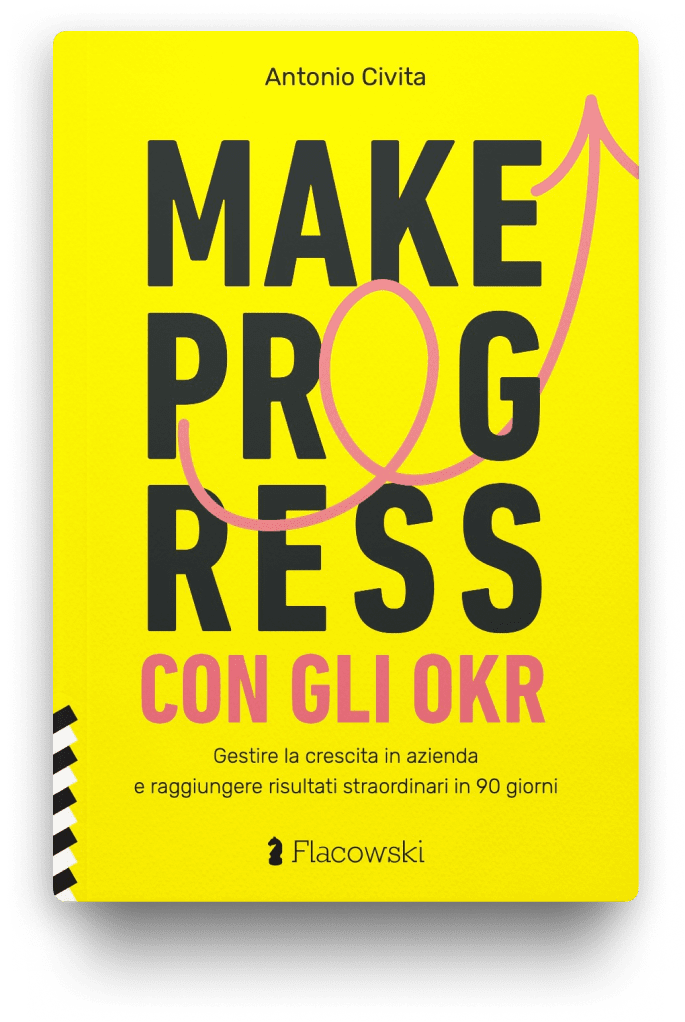
Of all the tools in the book MAKE PROGRESS with OKRs, this is the main one as well as the one on which the most creative and strategic energy is invested.
Filling it out correctly-and executing it-can change the fortunes of the company.
In the live session I will explain how to do it, block by block.
This masterclass is not just for those who want to adopt or improve their adoption of OKRs. But it is for anyone who is looking for a practical tool to make strategy distributed, clear and understood at all levels thus enabling alignment of activities around tangible results.
ONE MORE OCCASION NOT TO MISS: At the end of the live show I will announce a new entry-level product dedicated to founders and small teams who want to launch OKRs in the next 90 days. You’ll be able to be among the first to log in!
● Wednesday, March 1, 12:00 noon – Register here
strtgy.design/event/okr-sfo-live/