If you are a CEO, manager, or executive in a consulting firm and are looking for examples of OKRs that your colleagues are implementing within their companies, you are in the right place.
But if your goal is to select a consulting firm that can help you implement OKRs in your company, you are still in the right place, but in that case I encourage you to read this article in which I explain how to distinguish good consultants from less knowledgeable ones and how to select a quality OKR consulting firm.
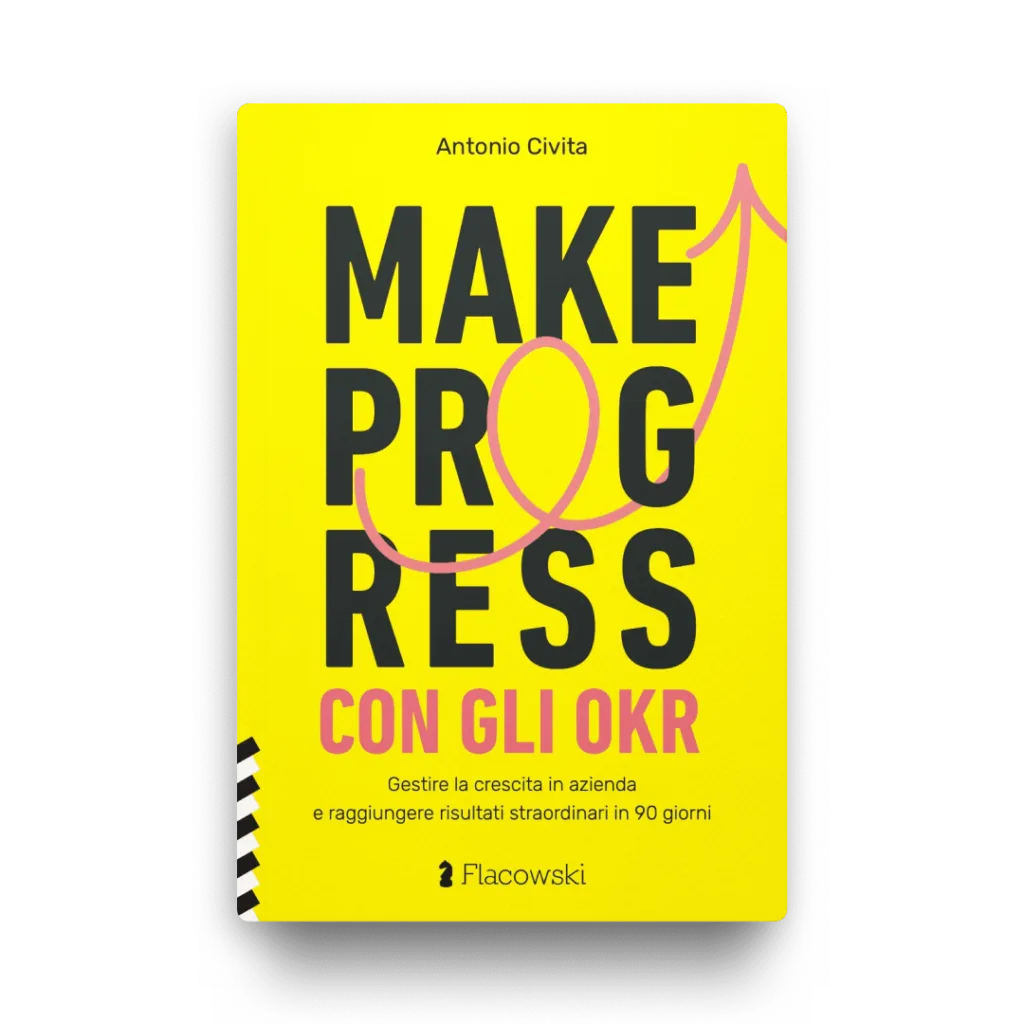
At STRTGY, we have guided many consulting companies toward the adoption of OKR with remarkable results. We have worked with teams of various sizes: from the typical Italian consulting firm of 5-10 people to large organizations. Thanks to our “Make Progress” method, OKRs have proven to be extremely effective in every context.
In the next few paragraphs, I will show you exactly which strategies have made a difference and how you can apply them in your reality. And it doesn’t end there: I’ll show you examples of OKRs that have made a difference and that, as far as we know, remain mainstays of periodic check-ins.
Understand the business model and business strategy
Understanding the business model and strategy is key to any OKR program, especially for a consulting firm. There are consulting firms of all sizes. Some, small with 5-10 employees, attract clients through digital campaigns such as Google AdWords or Facebook Ads, or simply through the entrepreneur’s network. In these companies, clients arrive, receive service and stay as long as they are satisfied.
On the other hand, there are larger consulting firms with sophisticated customer acquisition strategies such as account-based marketing, trade shows, podcasts, live streaming, and production of proprietary magazines. They work with large organizations, and customer acquisition can be time-consuming. In these companies, clients are very profitable and often require additional services, making cross-selling optimization critical.
But one thing is clear: regardless of size or business model, without a well-defined strategy, communicated and understood by employees, it is impossible to establish quality OKRs.
If you are in this planning stage, I suggest you use “Strategy Focus Onepare.” It is a canvas that gives you a clear view of your business strategy in one sheet, making it accessible, shareable and easy to update.
At this link you can access the entire OKR Toolkit at STRTGY and exclusive trainings.
Understanding the growth pattern
If you want to establish effective OKRs, you must first understand how your company grows. Imagine asking your employees what they should do to increase growth. Would you receive consistent answers or a myriad of different opinions? If the answers vary, there is an obvious mismatch. OKRs can help you bridge this gap, but first you must address the root of the problem.
I propose one approach: the The Growth Machine workshop we developed at STRTGY. This exercise aims to clearly illustrate how the organization intends to grow. When each individual employee has clarity about how he or she contributes to growth, his or her commitment and direction become evident. Without this awareness, you may end up with overly vague OKRs that lack real impact. An example? Assigning salespeople simple sales quotas as OKRs. Isn’t that what they already do every day?
For OKR that truly supports growth and to make sure every person is aligned, it is essential that everyone has a clear understanding of the mechanics of the company’s growth.
Understanding the organizational model
In your consulting firm, not every team or function needs to have an OKR assigned to it. It is critical to identify who among team leaders, managers, and individual employees have a direct impact on business results. These people should have well-defined OKRs. The others? They could focus on specific KPIs to monitor the progress of their activities.
This approach guarantees you what OKRs promise: focus and simplicity. Imagine if every single individual had an OKR: You would end up overwhelmed with a multitude of goals, making it difficult to identify true priorities. OKRs, in that case, would lose their meaning.
But how to understand the organization of work in your company? There are two main methods. The first is to analyze the organizational chart. The second, and often more revealing, is to understand how value flows within the company. This is because work does not always follow the lines of the organization chart; mapping the value chain (value chain) can offer valuable insights.
After outlining the organization, you need to determine which areas deserve priority. If you are aiming for customer expansion, sales and marketing teams will be the focus. If, on the other hand, the goal is to optimize costs, the focus will shift to Operation and Finance. It is critical to understand how each team interprets the strategy.
To help you with this, tools from STRTGY can be invaluable. One of the most effective tools in the OKR toolkit at STRTGY is “Now and Next.” I suggest you access it and, if necessary, seek support from a coach at STRTGY to make the most of it.
Examples of OKRs by business function
These examples are elaborations on the basis of past experiences in launching OKR pilots in consulting companies in Italy and abroad. They are shown with the purpose of representing the quality of realistic implementation of the program MAKE PROGRESS with OKRs.
Sales Manager’s OKR.
Micro Strategy
Increase penetration in the target market by improving the quality of proposals and tailoring the sales approach to the specific needs of potential customers.
OKR
| Objective | Steadily accelerate customer acquisition in Big profile by Q4 |
| Why | Big profiles are sporadic acquisitions unlike Medium and Small whose channels are established. The new platform being adopted allows for faster customizations. |
| Why now | In Q4, the most important purchasing window for this category opens. |
| KR 1 | # new customers Big Q4 > (20) 33 |
| KR 2 | % conversion rate of proposals to contracts > (8) 13 |
| KR 3 | € cost per signed contract < (2,500) 1,350 |
KPI
| KPI 1 | € global turnover |
| KPI 2 | # net new logos |
| KPI 3 | % retention rate |
Task
- Training on new offerings: Hold training sessions for the sales team on new consulting offerings and distinctive strengths.
- Proposal review and optimization: Work with the team to review and improve standard proposals, making sure they are customized and meet the specific needs of potential clients.
- Implementation of a post-sales feedback system: Create or improve a system for collecting feedback from customers after a contract is completed to better understand areas of strength and potential areas for improvement.
OKR of the Consulting Manager
Micro Strategy
Optimize the delivery of consulting projects by ensuring excellence in quality, timeliness, and adaptation to specific client needs while further developing the team’s expertise.
OKR
| Objective | Improve the efficiency and effectiveness of consulting projects by Q4 |
| Why | We can learn from successful cases. |
| Why now | Resources need to be freed up to support sales teams in accelerating |
| KR 1 | gg average project delivery time < (180) 85 |
| KR 2 | % projects completed with marginality 35% > (10) 17 |
| KR 3 | # p.ti customer satisfaction at project closure > (58) 97 |
KPI
| KPI 1 | # of projects completed on-time |
| KPI 2 | # of projects completed on-budget |
| KPI 3 | % average marginality per project |
Task
- Project process review: Analyze and optimize current project management processes to identify areas for improvement and implement best practices.
- Ongoing team training: Organize regular training sessions for the consulting team on new methodologies, tools or industry skills.
- Implementation of a post-project feedback system: Create or improve a system for collecting feedback from clients after a project is completed to better understand areas of strength and potential areas for improvement.
OKR of the CTO (chief technology officer).
Micro Strategy
Drive technological innovation within the company, ensuring that the tools, platforms, and methodologies used are state-of-the-art and aligned with customer needs and market trends.
OKR
| Objective | Increase operational efficiency on XYZ service by Q4 |
| Why | The new platform has also been available since June for A, B, C employees. |
| Why now | We can deliver on the promise of personalization of current campaign services without undermining marginality, timing, and quality. |
| KR 1 | % internal adoption of XYZ platform > (25) 100 |
| KR 2 | gg average new customer instance setup time < (32) 23 |
| KR 3 | # monthly bug support tickets < (58) 30 |
KPI
| KPI 1 | # tot of tickets processed |
| KPI 2 | gg average setup time of new customer instance |
| KPI 3 | € total infrastructure cost x |
Task
- Ticket Monitoring and Analysis: Implement a tool or dashboard that monitors the total number of tickets processed in real time, providing insights into types of problems, resolution times, and areas for improvement.
- Periodic Review of the Setup Process: Organize monthly or quarterly reviews of the setup process to ensure that it remains efficient and to identify areas for continued improvement.
- IT Infrastructure Audit: Conducting a regular audit of the IT infrastructure to identify areas where savings or optimizations can be made, with the goal of reducing the total cost of the infrastructure.
HR Manager’s OKR.
Micro Strategy
Develop and maintain a highly skilled and motivated workforce by fostering a positive corporate culture, ensuring ongoing training, and effectively managing human resources.
OKR
| Objective | Strengthen and optimize human resource management to support business growth and innovation. |
| Why | The new onboading process and knowledge base now enable faster onboarding and training. |
| Why now | There is a need to sustain the demand for people to support new projects arising from the current Big campaign. |
| KR 1 | % employee retention > (50) 75 |
| KR 2 | gg average recruitment time < (35) 15 |
| KR 3 | # tot employee referrals < (85) 142 |
KPI
| KPI 1 | % of participation in the “Talent Development” program. |
| KPI 2 | € cost per single hire level x |
| KPI 3 | € total cost of training programs |
Task
- Onboarding Program: Create or review an onboarding program for new employees, ensuring that they are properly trained and integrated into the company culture.
- Continuing Education Initiatives: Identify the training needs of employees and organize courses, workshops or training sessions to fill any gaps in skills.
- Feedback and Evaluation: Implement or improve an ongoing performance appraisal and feedback system, enabling employees to receive regular and constructive feedback on their work.
OKR of the CFO (chief financial officer)
Micro Strategy
Lead financial planning and management, ensuring the company’s financial sustainability, resource optimization, and compliance with financial regulations.
OKR
| Objective | Optimize spending to end the year with record financials |
| Why | After the acquisition of X, it is necessary to restore liquidity levels. |
| Why now | The push on product X allows cashflow to be optimized through the new pricing model. |
| KR 1 | €M total operating costs < (1) 0.75 |
| KR 2 | €K burn rate Q4 > (123) 92 |
| KR 3 | m total runway > (1) 4 |
KPI
| KPI 1 | % Budget Variance |
| KPI 2 | % Payment Error Rate |
| KPI 3 | % Debt-to-Equity |
Task
- Cost Review: Conducting a thorough review of all operating costs to identify areas of potential savings or efficiency.
- Strategic Financial Planning: Development and implementation of strategic financial planning that takes into account sales forecasts, projected costs, and future investments.
- Audit and Compliance: Organize regular financial audits and ensure that all processes and transactions comply with local and international financial regulations.
OKR of the CMO (chief marketing officer).
Micro Strategy
Enhance the company’s visibility and brand perception in the target market by driving effective marketing campaigns, optimizing digital presence, and building strong relationships with customers and partners.
OKR
| Objective | Accelerating contact acquisition through low-cost channels and nurturing |
| Why | The ABM playbook is bearing fruit and entering the optimization phase, we can focus on strengthening the positioning. |
| Why now | The rollout of the new site allows you to leverage organic and gated content |
| KR 1 | # total organic visits > (45,000) 75,000 |
| KR 2 | # average ROI on XXX’s campaigns > (2) 2.8 |
| KR 3 | # newsletter subscribers (12,000) 20,000 |
KPI
| KPI 1 | € Marketing Spend |
| KPI 2 | # Keyword on the first page |
| KPI 3 | € Cost per visit |
Task
- SEO and SEM Optimization: Working with a team of experts to optimize a company’s online presence through search engine optimization (SEO) techniques and search engine marketing (SEM) campaigns.
- Audience Analysis and Segmentation: Conducting market research to identify and segment target audiences, enabling more targeted and effective marketing campaigns.
- Collaboration with Influencers and Partners: Identify and establish collaborations with industry influencers and other strategic partners to expand the reach and impact of marketing initiatives.