Bill, we can’t get anything done!
Bill Anderson is the CEO of Bayer, a pharmaceutical giant famous for Aspirin. Over the past year, it has experienced a sharp decline in its share value (more than 50 percent). The company also faces considerable debt of about 34 billion euros.
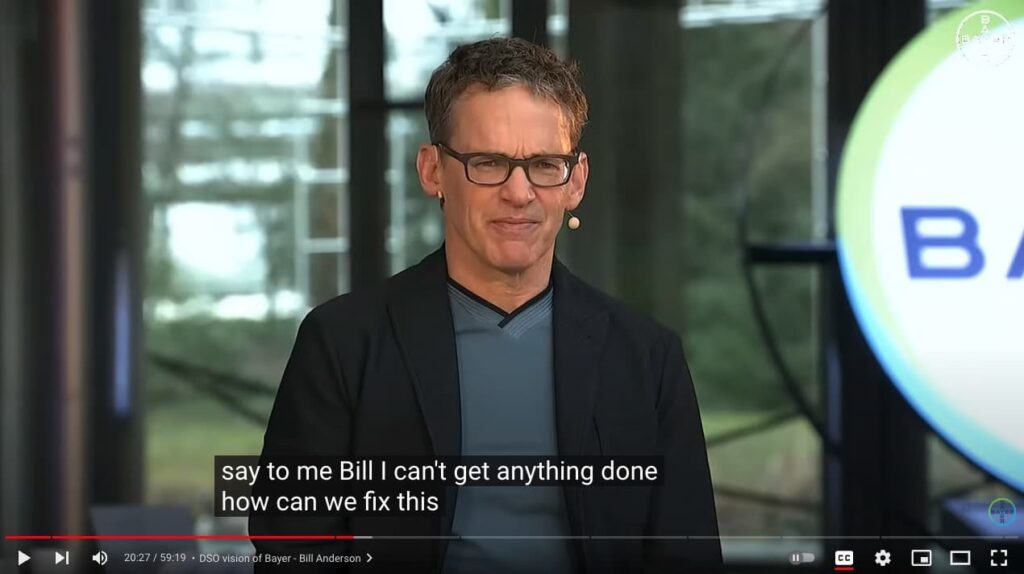
When Bill Anderson took over the role as CEO , he interviewed his employees to understand what was going on.
“People love the company, they love the kind of culture, science and commitment to patients, but they also said, We can’t get anything done. It’s too hard to get ideas approved or you have to consult with so many people to accomplish anything!”
I have also heard these words dozens, if not hundreds, of times in my career.
Re-design is the norm
No company has existed in the same form since it was founded. Just as any form of life has remained unchanged since it appeared on the face of the Earth.
Constantly reinventing oneself to adapt to new habitats is not a project that needs approval, it is a matter of survival.
“We are redesigning Bayer from management to Mission, from alignment to action, from CEO to customers ” – Bill Anderson

Skipping straight to the point
02:04 Gary Hamel talks about Humanocracy, explains why we need to dismantle traditional bureaucracy and how to reorganize to create more resilient companies. Innovation is at the heart of this. Also Gary Hamel shows the negative impact of bureaucracy on productivity and shows examples of companies that are adopting more agile and decentralized operating models.
19:19 Bill Anderson talks about DSO, Dynamic Shared Ownership, Bayer’s new organizational model. He explains how it all started, the path and what the expected impacts are. Interesting storytelling!
26:53 Michael Lurie, Chief Catalyst (new strategic role, will understand more later) explains how the roll-out of this strategy will work. Creating a network of cross-functional and entrepreneurial-minded teams, increased emphasis on technical product development roles with focus on customer needs. Creation of expert communities instead of intermediate approval committees.
34:35 Sebastian Guth, President of Bayer Pharmaceutical, talks about how they will reduce organizational hierarchy by forming autonomous, cross-functional agile teams of up to 15-20 people, who will make decisions faster (going from 3-6 months to real-time decisions) due to the sharp reduction in approval levels. All teams will be dynamically formed through the use of an internal marketplace to connect priorities with talent that can execute them. They will work in 90-day cycles. This should break down silos by shifting work from functional teams to project teams organized on-the-fly with specific outcomes and distributed decision making: did you say OKR?
Interestingly, at the beginning of the segment, Sebastian talks about metrics such as “spend-on-control,” which he changes the term to give it a meaning that fits better with the new strategy: “spend on-coaching.”
45:30 Heinke Prinz, Chief Talent Officer, talks about how performance management will change to rely increasingly on peer accountability and processes designed in co-creation mode by internal design teams. His exact words, “You can fool your boss, but you can’t fool your colleagues!” How true! It changes the role of leaders, which he anticipates, there will be fewer and fewer of. They will not have to manage the teams’ work, but set the direction, architect the system, and support the team in executing the strategy. The new leaders will be visionaries, architects, catalysts and coaches.
Heinke then points out the hard truth: an organization that needs fewer people.
51:16 Kevin Nolan, CEO of GE Appliance, brings testimony of how applying these principles has led them to become the market leader. Reorientation of the organization around market-focused microenterprises. Development of a business culture that incentivizes risk-taking and market leadership. The original model is called RenDanHeyi and you can find the simple simple explanation here along with a STRTGY Meeting with Haier’s Head Of Design.