Hey this Monday is full of strategy!
Today we talk about JTBD through the analysis of some Instagram stories and how you can apply these concepts to your business.
At 6:30 p.m. we’ll meet live with Matteo Carini of Prontopro to talk about OKRs and all the mistakes that inevitably happen during their implementation. Of course, we’ll also – and most importantly – talk about how to prevent them from happening to you.
Tonight a friend of mine is starting a free strategic bootcamp on Web3, dedicated to freelance creators and in-house teams. Click on the link to find out the details.
Without delay!
⤴⤴⤴
It seems that this thing of seeing JTBD in action in everyday life appealed to many readers of the newsletter, so I asked myself, why not continue?
I think it may be useful considering the fact that I have not found much material around that explains the theory of JTBD in such a simple and practical way, either in English or in Italian, so I try to make my contribution.
This time the inspiration comes from the stories of a friend of mine whom I asked for her willingness to be analyzed under this lens: that of JTBD. Meet V.
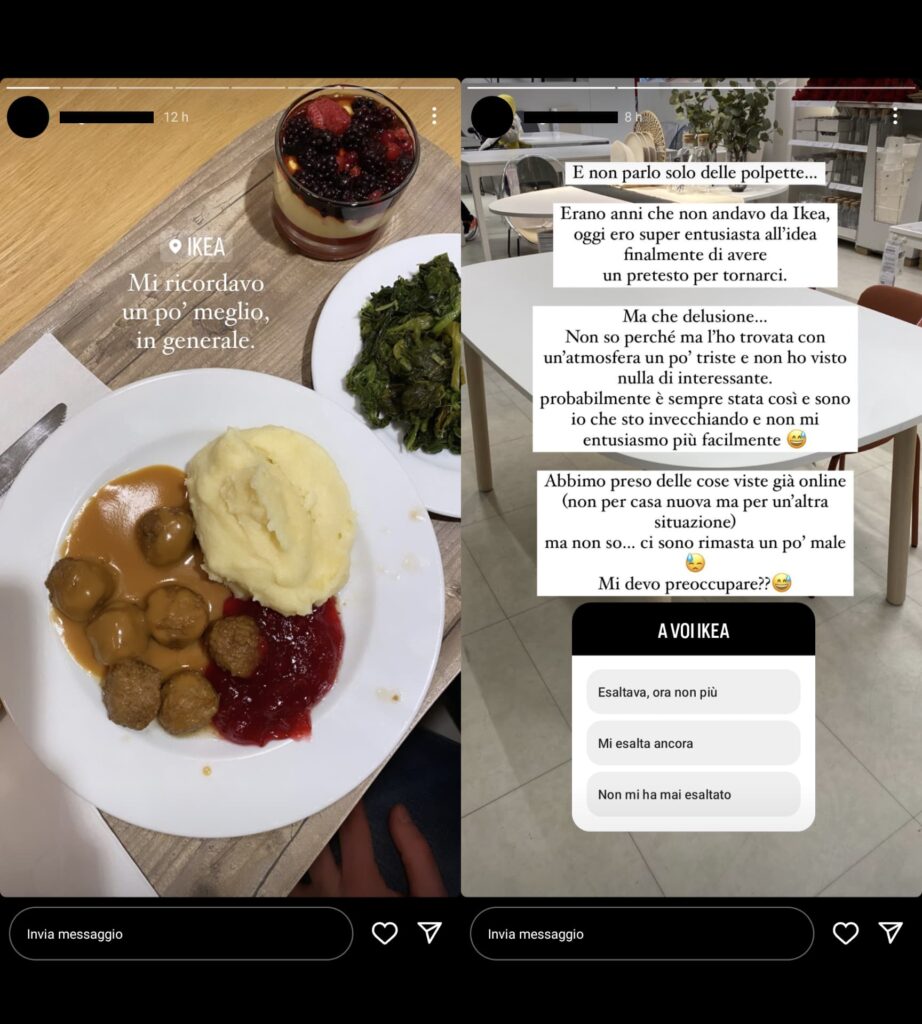
It went like this. On Monday I see a story showing a plate of meatballs, mashed potatoes, and raspberry sauce, the geotag of IKEA, and on the overlay the words “I remembered a little better, in general.”
A few hours later here is another story. This time with more text. I’ll leave you the screenshots and try to interpret.
The switch interview
What I am about to show you is called a switch interview, which is an interview structure that you can do to two categories of people: current customers and former customers, the only requirement being that both must have known the product.
I make this premise because, this technique, is very useful for understanding how customer habits develop and for mapping competition rather than for doing discovery in the early stages of any business idea or product feature.
In this case I could only look at the stories without asking questions so I will just interpret the images as if they were answers; forgive any inaccuracies.
A little piece of theory: you know that people are loyal to a solution as long as it continues to satisfy the desired feeling of progress. When this does not happen people switch i.e., they choose a solution that competes to solve the same JTBD as long as it performs better. The switch interview serves precisely to map the triggers that bring people into the arms of the competition (which, if it, too, knows the JTBD, has only to wait with open arms-it is called demand generation). Of course, all of this has implications for the concept of competition itself.
PS: I am preparing a live masterclass on this topic, let me know if you are interested by dedicating less than 30 sec for some questions at this link.
But back to us. The first story with the words “I remembered a little better, in general.” really signals that something has broken down. My friend’s idea of IKEA no longer corresponds to reality. And this is normal, time always improves memories….
But later stories clarify, “And I’m not just talking about the meatballs…” of course “I hadn’t been to Ikea in years, today I was super excited about finally having an excuse to go back.”
Here is the trigger that changes the context: follow me closely.
“But what a disappointment… I don’t know why but I found her sad. It’s probably always been like that and it’s me getting older and not getting excited anymore.” This thing is called self betterment and is the innate ability humans have to visualize a better version of themselves as they progress with the current solution (I also talk about this in Make Progress with OKRs).
And I saw myself in this a little bit, too. When I was a student and was on a budget, IKEA was the only place to buy nice furniture. When the house is not yours, you don’t feel like investing in expensive furniture. On the contrary when I bought my house I decided to invest in more important and durable pieces of furniture. As we said last time, context always guides our choices.
I know that V. and her partner have renovated their home with great taste, and I am sure they have chosen their furnishings carefully. They must have flipped through hundreds of magazines, catalogs, and scrolled through miles of Pinterest and Instagram to save inspirations–it’s inevitable that this process has naturally evolved their tastes.
Trigger + Context + Motivation = Switch
In fact, the text goes on to say, “We got some things seen online. Not for new house but for another situation.” Case in point.
V. was a satisfied IKEA customer until the context – she decided to renovate a house of her own and move in permanently – and the motivation – to build a house with quality furniture and style – changed. So she made switch by switching to alternative solutions.
But customers are neither lost nor won because they are not gambles. If they were, building a business would be incredibly risky, more so than it might seem.
Nowadays, in any market, demand far exceeds supply, so people momentarily meet their needs by constantly evaluating competitive solutions.
A few hours later a new story clarifies IKEA’s JTBD. “If you don’t want to spend a lot and want basic things IKEA is still a ‘zero slam’ solution (apart from assembly).”

When context and motivation reallianate people again make switches, reverting to choices that have proven to work in the past, thus less risky.
Why is it important to understand JTBD?
JTBD is a complex and fascinating theory that allows us to understand the dynamics that govern a market as long as we look at the market as the set of decisions that people make.
While not complete-I should have explained many other things, and I will not spare myself for those who decide to join the live masterclass-I have used this device to show you how it is rooted in everyday life.
The forces that influence our decisions are the same ones that intervene in the supermarket as they are in enterprise environments where we are talking about products in the tens of thousands. Understanding people unlocks innovation and growth. Always.
What is the most important lesson we take back to the office today from this newsletter?
One should fear not competition but irrelevance.
IKEA did not lose V. forever as a Chilean, only momentarily, until he became relevant again for his choices.
Companies do not go out-of-business because of competition, but because of choices that simply disappoint some customers to support others.
Therefore, it becomes important to understand how consumption evolves and how to adapt the product accordingly and support people’s progress for as long as possible. Who is responsible for this in your company? Is it you? Write to me I want to meet you!
We can bring this concept into the software world and thus explain how dangerous it is when sales teams disproportionately influence product roadmaps because they have sniffed out a big deal and ask teams to develop a new feature that was not planned and only useful to that potential customer. And because “stuff done doesn’t get thrown away,” this new feature starts appearing for all users.
One rip-off after another the core JTBD becomes diluted and we find ourselves going from being the best solution for someone to becoming the perfect solution for no one.
And you know what? When it happens it ‘s the numbers that say it.
ALWAYS MAKE PROGRESS ⤴
– Antonio