This newsletter is sent to more than 700 professionals who are rethinking how Design, Business and Technology will work together in the near future. Pass it around by inviting registration at strtgy.design.
Hey, happy Easter Monday!
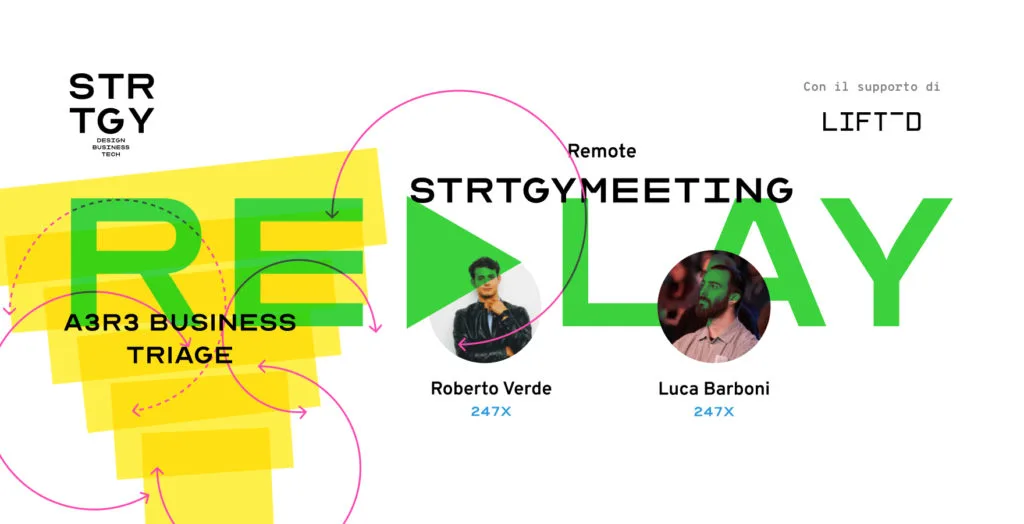
Although I took care of the organization in great detail, I could not attend the last STRTGY Meeting, the one with Roberto Verde and Luca Barboni.
John Lennon is so right “Life is what happens to you while you are busy making other plans.”
Having received 200 entries in 3 days I felt a certain responsibility….
Therefore, rather than cancel the event at the last minute, I asked Roberto and Luca if they felt up to doing it on their own.
I wrote them a didactic email from my cell phone explaining the situation.
They replied, “Sure, go ahead, give us instructions.”
I sent Zoom accesses and went back to my family who needed me at that time.
The rest you may have experienced live, otherwise you can access the Facebook group STRTGY Community and watch the recording(direct link to post)
I learned two things:
The first
Roberto and Luca are two great professionals. Real professionals.
At the end of a few notes ago, in No. 7 to be precise, I was stealing and expanding on the description of what makes a professional — a true professional in fact. This checklist they tick it all off. Read it!
With great humility, professionalism, and accuracy they conducted one of the finest webinars on growth hacking I have ever had the pleasure of seeing.
They also did the honors by explaining what STRTGY was better than I could have done.
They even stayed an extra hour to answer all questions.
They are in debt.
The second
The importance of having structure and processes.
Having to fit time into the days to devote to the growth of this community every single activity is geared toward maximum efficiency.
I carve out blocks of time to prepare content in advance and document procedures so I can re-do them faster and without mistakes or I can delegate them.
This is an immense advantage because everything can work even when you are not physically there. This gives freedom to you and agility to your business.
You can ask my colleagues how much I stress them to document what they do. Not to control them, but to build the conditions for growth. Although it may seem too “expensive” in the short run, the long-term benefits are undeniable.
If you can delegate a task, properly documented, to a less expensive resource, you can devote your best efforts to more complex tasks where you can make full use of your skills.
When you fall into the trap of “I’ll do it first,” that’s where you are not only creating inefficiency but laying the groundwork for your own frustration.
Also, if you have a structured process you can improve it. In fact you have to allow everyone on your team to do it. It is a subtle difference between “procedure” and “default.”
Procedure is bureaucracy. It is something that cannot be changed. It is the scar that organizations create when someone makes a mistake. The next day someone else higher up in the hierarchy decides not to give trust. No second chances for anyone.
The “default” mode means you can follow those steps, but you don’t have to. If you find a more efficient way, you can modify the sequence and share it with your colleagues.
This is the fork in the road between becoming incrementally better or steadily getting stiffer and stiffer.
But this is not like other Mondays.
Idleness is fatal only to the mediocre.
– Albert Camus
So enjoy it today!
(or watch the webiner recording on Growth Hacking in the STRTGY Community😉
Make yourself heard.