Hey, happy Monday.
A great week of online events and crazy content has just passed.
I was a guest speaker atItaly’s Growth Talent and sponsor of the first Italian Notion meetup.
I also want to give back to you reading these notes the same quality of content that I shared with those who participated-you deserve it.
I have decided to make public the framework that is only implemented in expensive strategic acceleration programs held behind closed doors. So save this note and share it with your team and most importantly, if you implement it, keep me updated on your progress.
ALWAYS MAKE PROGRESS ⤴
If what you read will ignite a spark
Give your team back time to work on a great strategy
Adopt the only OKR-based business growth system with STRTGY
Applications are open to work with me and a small number of executives, on the adoption of the Make Progress Method in the October cohort.
Align strategy and execution, accurately identify priorities, and prepare to achieve extraordinary results. Choose a time from my calendar to calculate the project ROI based on your baseline situation and discover the work schedule.
OKR and Growth Hacking, 4 principles for building your, personal, Growth Playbook
Writing OKRs (Objectives and Key Results) is only the first step to a sustainable growth strategy. The magic happens when daily activities are perfectly aligned with the important numbers.
How to filter the fog through the endless activities a growth team can launch?
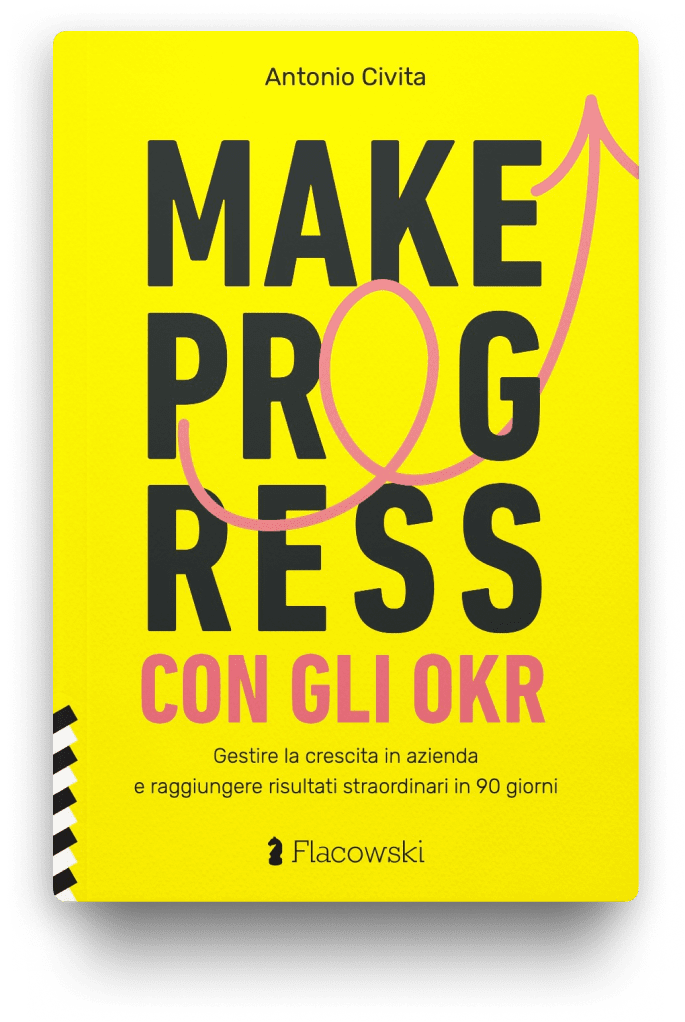
In the next few lines I will show you how to use some of the tools in the book Make Progress with OKRs to map the impact of metrics in building results, connect initiatives to goals, free up time for new experiments, and stay focused on what matters.
Principle # 1: All objectives must support the mechanics of growth

Alignment is a term that often causes confusion. What exactly does it mean?
Teams are aligned when everyone actively contributes to business growth. implies that every activity aims to improve the “mechanics of growth,” a key concept for any organization.
The mechanics of growth are illustrated by a tool called the Growth Machine. This model represents how the company creates value through a series of interconnected gears. Each gear positively affects the next, generating a composite effect over time. This dynamic allows the company to scale, freeing itself from the constraints of linear growth and maximizing resources and investment.
The Growth Machine represents how the driving force is generated that enables all levels of the organization to contribute to growth. And when there is alignment, results follow an upward trajectory, often described as a “field hockey stick curve,” rather than a linear one.
After outlining the mechanics of growth, the next step is to establish the OKRs (Objectives and Key Results). These represent the priorities that teams have decided to pursue for a given period. But it is not enough simply to define the OKRs; it is crucial to map the relationship between each OKR and the corresponding cog in the mechanics of growth.
Imagine having quantifiable goals that give you an accurate measure of the team’s success in achieving strategic results. This numerical focus eliminates ambiguity and aligns everyone toward a common goal. In contrast, when OKRs are not connected to the mechanics of growth, energy and resources are wasted.
Every OKR must be directly linked to the mechanics of growth. It will not only increase the effectiveness of teams, but also the likelihood of long-term success of the entire organization.
Principle # 2: If NSM does not improve there is a problem with the strategy

The North Star Metric (NSM) is the most important number in any work group for one simple reason: it allows you to predict success.
Yet NSM is a lagging metric that unfortunately cannot be influenced directly by the direct effect of our work, just like financial metrics. This means that by the time we are measuring them, it is no longer possible to intervene.
Understanding how to influence the NSM is critical. One must trace the flow of until backlog actions have direct influence on the numbers.
In this note, using the example of Spotify-a business model we are all familiar with-I show how to make NSM actionable.
But it is also important for teams working on growth to understand how their experiments, especially the winning ones, bring real impact and are not simply corporate folklore. Look at the blue boxes in the diagram.
To change leading metrics, teams perform two categories of activities:
- Business as Usual: core business activities
- Experiments: tactical explorations to understand how to achieve higher performance
What is the smartest thing to do when an experiment works? Replicate it on a larger scale!
I used the word experiment on purpose because, what separates growth professionals from marketing amateurs is the fact that they can replicate the activity and get consistent results.
Winning ways are described and integrated into the standard operating model as the growth team prepares for new challenges.
What if NSM does not change?
It is a problem of strategy.
- The strategy may be wrong: the numbers that do not change are proof that the decisions made are not the right ones.
- Strategy is not executed: although written, documented and represented by OKRs, it is very common for teams to fail to spend time on strategic activities because they are forced to work in survival mode (more on the last principle).
Principle # 3: No processes, no numbers

If you feel that finding the numbers is difficult the reason is that there is probably no repeatable process for getting a particular result.
For each cog in your growth machine, identify the key processes and try to understand how the numbers move in your systems each time a step is executed.
I Make Progress with OKRs there is an exercise that everyone finds enlightening, it is called the KPI Chain. And all the metrics identified are organized in the KPI Book so that they become visible and measured consistently.
“I try to explain God by numbers” – Pythagoras
Likewise, I invite you to explain business by numbers.
Principle # 4: Enter the Progress loop

There is a direct relationship between the volume of experiments performed and the growth of the company, so it becomes important to build an environment in which teams can stay in execution mode for as long as possible because that is where the magic happens!
I elaborate on this concept in footnote 151, which I invite you to re-read because I show how, by adopting OKRs, and Make Progress tools, teams enter the progress loop, disproportionately extending execution time and increasing the effectiveness of learning, idea generation and planning.
- Learning Mode: they learn from previous results
- Generative Mode: generate new ideas
- Planning Mode: prioritize resources based on expected impact
- Execution Mode: they execute to the best of their ability
When teams have no way to learn and plan, new ideas collide with emergencies, and teams delude themselves about efficiency by working in reactive mode.
When even having new ideas is a luxury, teams remain segregated in survival mode.
Nothing good is generated in these two dysfunctional modes. In the best case scenario, the business grows because the market also grows, but the talent will wear thin and, when they leave, they will not have enriched the organization with replicable successes making it fragile.
The playbook in brief
- Principle # 1: All goals must support the mechanics of growth
- Principle # 2: If NSM does not improve there is a problem with the strategy
- Principle # 3: No processes, no numbers
- Principle # 4: Enter the Progress loop