Hey happy Monday!
In the previous note, I put in black and white the key differences-which no one ever talks about-of the two main growth models: Sales Driven and Product Led. If you haven’t read it, retrieve it here.
I care a lot because being clear about whether one’s company is SD or PL radically changes for the better the quality of decisions that are made every day.
How do you measure the quality of decisions?
From the results they bring.
Deciding is only half the story
A decision is always good as long as it is made in time to influence outcomes. Not making decisions is also a decision but it is definitely among the most costly and dangerous options.
[Flashback] In this 2020 memo there is an interactive graph demonstrating how having anticipated decisions during the pandemic would have flattened the contagion curve. History teaches.
But any decision must contain parameters to understand, unequivocally, whether it was a right or wrong decision.
That’s why if I had to explain OKRs to someone unfamiliar with them I would avoid the classic tasteless answer taken from Wikipedia “it’s a goal-setting methodology used by individuals, teams and organizations to set measurable goals” but answer on what I think is their essence:
“OKRs are the most powerful tool for making effective decisions, with the right timing and at any level of the organization.”
I want you to understand that what matters in OKR methodology is not the goal.
It is the decision of how the company will transform when it has achieved that goal!
It will be the numbers-KPIs and KRs-that will tell us whether it was a right or wrong decision and, very importantly, whether it was executed or not.
High-value conversations
“We have often talked internally about how the adoption and use of OKRs results in more valuable executive conversations. How can this value be measured? What KRs could be used to quantify it?”
This is one of the questions that, as a founding member, I have answered within Quantive’s international Dreams with Deadlines community.
I think a high-value conversation is a decision-dense conversation.
By density I mean that the number of decisions per talk hour.
When you have that unpleasant feeling of having wasted time in a meeting, it is because you used the time without making decisions.
Some meetings are meant to update participants on a given situation, and these could easily be replaced by an email, voice message, or small video shared with the team.
In others, however, they mimic mandatory attendance workshops, that is, they wait for the meeting to work together only then without any preparation, and this is the least efficient way to get the most out of everyone’s time.
The most useful meetings, on the other hand, are those in which everyone leaves the room with the precise knowledge of what to do next.
For teams evolving their way of working with STRTGY we provide structured agendas such as the Daily Check-in, one of OKR Drumbeat’s core meetings. Here is a video where I explain how to conduct the one daily meeting that will save you hours of unnecessary meetings throughout the day and have a team focused on priorities.
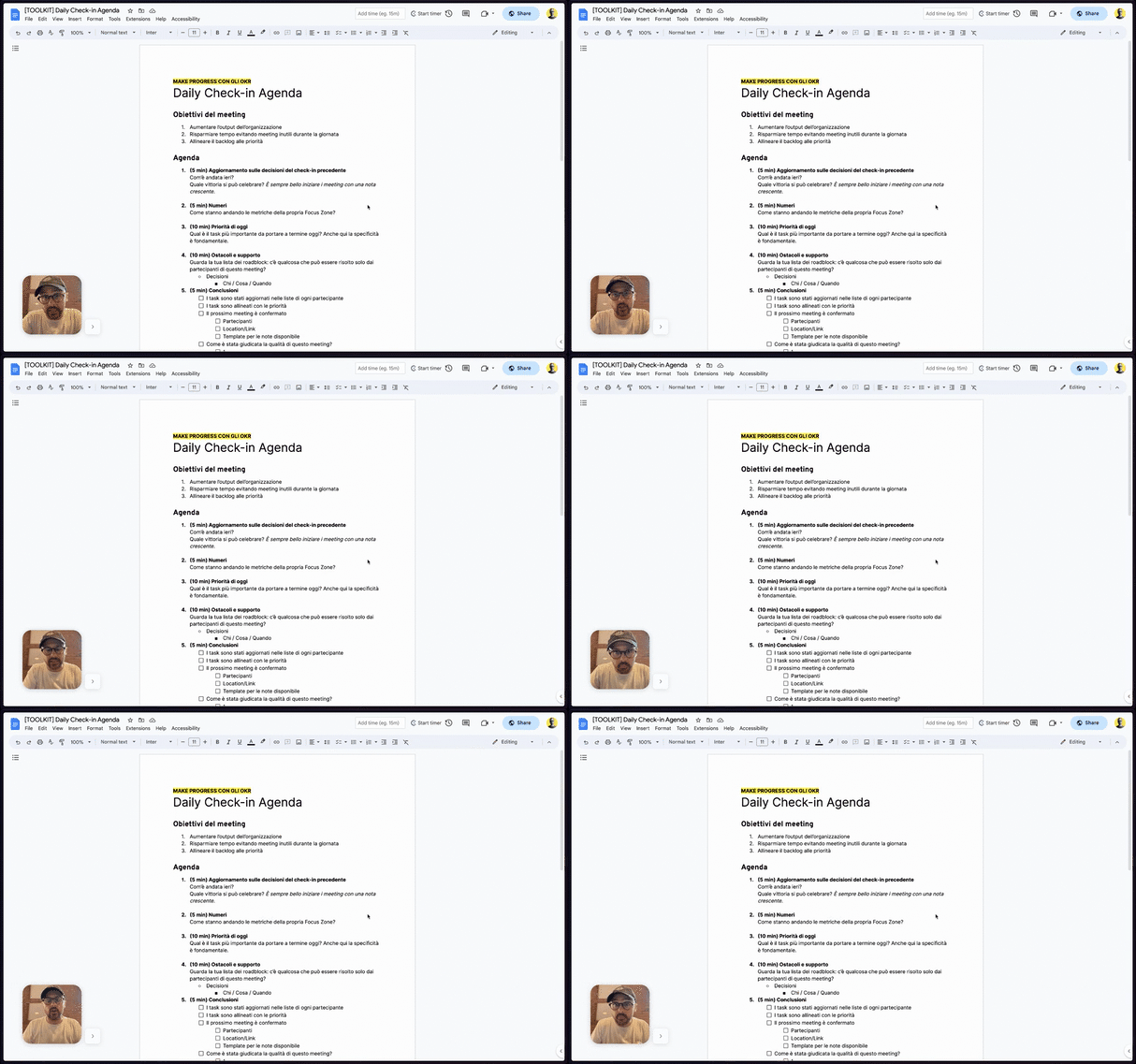
Decisions made at the meeting can be recorded in the Progress OS News section I discuss in the book and distributed to the teams a few minutes after the meeting itself.
Too cumbersome? Let the AI help you. I can recommend these two tools that I have personally tested and they work very well even in Italian: Grain or tl;dv. The first retrieves the recording of the meeting, transcribes it and creates an always searchable and indexed library. The second enters as a guest in the conversations, records and finds for all participants the key moments of the meeting, then sends an email to all participants.
But, this is important, do not leave the meeting without first providing quantitative (1 to 10) and qualitative feedback on how it was conducted. Obviously not all meetings, but at least those that include OKRs as conversation starters.
Over time, this habit has proven to be the best way to measure intangible but important results while improving the quality of conversations, which too often are a hindrance to the quality of the work itself.
Let me know if this lit a spark….
Have a great week,
ALWAYS MAKE PROGRESS ⤴
-Antonio
How to get the most out of STRTGY
1 / Adopt the only OKR-based business growth system with STRTGY. Work with me and my team to implement the Make Progress Method in 12 weeks (or less). Here I show you how, step-by-step.
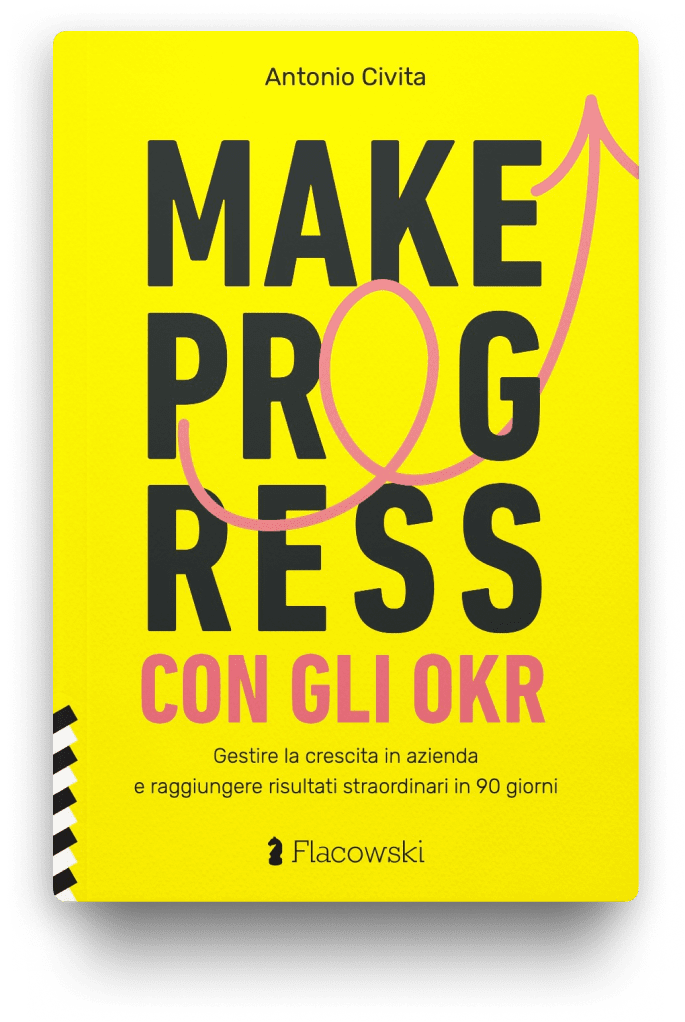
2 / Buy Make Progress with OKRs. The most pragmatic book ever written on management by objectives technique. Includes the effective 12-week implementation program and all immediately usable templates. Click here.
3 / Download the OKR Toolkit. If you know OKRs well and just want to speed up their implementation, or solve specific problems with more effective tools, then get hold of all the templates. Click here
4 / Leave a review on Amazon. Wherever you purchased MAKE PROGRESS with OKRs, know that if you spent at least $50 with your Amazon account, you can leave a review. Click here to rate the book, and allow other leaders like you to discover it.