“Before a strategy can influence a competitor, it has to survive your system.”
Andrew Marshall, strategist and director of the Office of Net Assessment
●↑
I’ve prepared four prompts to help you and your team compare your stated strategy with the one you’re actually executing.
One after another, they bring three things to light: where you’re spreading resources too thin, which competitive advantage you’re overlooking, and which concrete decision can change the next 30 days.
The exercise can be a little painful, but that’s exactly the point: if everyone sees a different company, you can discover where you’re wasting valuable energy.
“How was your summer?”
Since I got back, every call has started with the same question. My answer is always the same: it was a really intense summer, full of change and learning. Maybe I haven’t experienced anything like it since my high school graduation exams.
That’s exactly how it feels: in the first part of the year, you learned a lot and realized you were ready to start another one. In September, you return to the same office, reopen the same tools, and meet the same people. But unless you spent two months completely disconnected, you find a radically different landscape from the one you left at the end of June.
If you think you’ve been teleported, you’re not far off…
Two months in “ludicrous mode”—here’s (a small part of) what happened
Everything happened so quickly that some of the news I’d saved for this newsletter was already old by the time I started writing it.
In July, OpenAI introduced GPT-5.6 and ChatGPT Work. Grok 4.5 and Claude Opus 5 arrived. Google released new Gemini models designed for faster, less expensive agents.
Then the price war began.
In August, OpenAI cut the price of some models by up to 80%.
DeepSeek finished training V4 Pro and, even though it raised its prices, it remains one of the models with the best price-to-performance ratio available today.
On August 12, Grok 4.6 was released, presented as a model for coding, knowledge work, and agents capable of handling long-running tasks. The day before, SpaceXAI had introduced Grok Bot.
Two days later, SpaceX completed its acquisition of Cursor, which said access to SpaceX’s computing capacity would help it build more powerful, less expensive models, distributed directly through its code editor.
Then, on August 17, Cursor launched Origin, an alternative to GitHub for hosting repositories, managing pull requests, and bringing code and agents together in one place. Cursor describes it as infrastructure designed for the scale of agents: more generated code means more commits, more pull requests, and more runs of verification systems—a workload that puts pressure on tools built before this wave.
Timing is everything in strategy. Origin launched on the same day that GitHub experienced a 7-hour-and-47-minute outage, affecting the site, authentication, GitHub Actions, APIs, pull requests, issues, and Copilot. GitHub explained that the incident began when a critical component failed to handle a new traffic spike. That’s not enough to attribute the outage to agents, but it shows how strategic software infrastructure has become in a world producing code at an ever-increasing pace.
Cursor’s change of ownership also prompted an immediate response from OpenAI. On August 28, it notified SpaceX of its intention to terminate the contract that brings its models into Cursor, and decided not to provide any more models in the future, saying, “Based on our experience with Elon Musk’s companies violating contracts, we cannot be certain that SpaceX will use our technology in accordance with our terms of service.” My interpretation is that this decision also serves to protect Codex. In my experiments over the past few months, it has become the tool I get the best results with when working with AI. That’s a personal assessment, not a systematic comparison of all the products available.
Grok Bot deserves a few more lines, though. It has an interface reminiscent of Slack, and in addition to your colleagues, you can invite or “hire”—that is, create—agents. Each one has its own computer and can learn to carry out even complex tasks on real websites and platforms. I’ve only recently started trying it because it’s included in my Cursor subscription. It’s one of the first times the idea of delegating ongoing work to a group of agents has felt so tangible to me. If you don’t know where to start, you can hire your next agentic colleague on this site.
Meanwhile, being good Italians, we didn’t miss out on a few new rules. On August 2, the transparency obligations of the AI Act became applicable.
Then came a plot twist: on September 3, NVIDIA reached an agreement to acquire Hugging Face for around $12.93 billion. No one saw it coming, but then again, as I always say, “strategy is the art of surprising the enemy.”
On the same day, OpenAI introduced GPT-6 Astra, perhaps the first real model “leap” after Sol, Terra, and Luna, toward AGI. Salvatore Sanfilippo made a video about it.
When I compare what I can do today with what I was doing in July, 90% of what I considered settled in the spring deserves to be seriously reconsidered.
The role of strategy
I had the opportunity to travel a lot, which led me to reconsider my work habits. No more long, distraction-free sessions, but short sessions where I could open my computer and devote some highly focused time to the important things, getting ready for September.
But how do you distinguish what’s important from what’s exciting?
The Strategy Focus Onepager was the first document I opened at the start of a new session.
If you’re not familiar with it yet, it’s the tool that brings together on one page the long-term direction, the numbers to protect, STRTGY’s growth system, and the priorities for the current cycle.
For me, it’s the most important document of all: a map to keep you from getting lost, because it can make the next steps visible to everyone in the company. Humans and robots.
I didn’t have to choose the project that seemed most interesting at that moment. I could identify a specific piece of our growth system and work on that.
The general slowdown helped me. Clients, companies, and collaborators had slowed down; I was able to step away from operations and look at my own work from the outside.
That’s why I don’t consider summer time wasted. The work of the previous months had already protected our priorities and created the financial and organizational space to slow down. Every time I reopened the Onepager, I found my direction again.
That’s one of strategy’s roles: to keep pointing to the next step while you do something else.
Dogfooding: using what we build ourselves
One of STRTGY’s principles is to use the tools we make public ourselves first. I want to see where they work, where they don’t, and what’s missing before asking someone else to change the way they work.
This summer, my deepest reflection was about the maturity of MAKE PROGRESS®.
I started building MAKE PROGRESS® with a few community pioneers before artificial intelligence was something we could rely on consistently.
Imagine that the first version of the book was written without AI. Today it makes me smile to see that em dashes have become a kind of telltale sign of its involvement. I’ve always liked using them—in fact, maybe I learned to use them around that time—because in books they’re an elegant way to weave thoughts into a sentence. But that’s another story…
MAKE PROGRESS® began as a series of precise, efficient tools designed to work together. Pieces of a puzzle, but made of carbon—light and strong.
MAKE PROGRESS® helps leaders describe their strategy, choose objectives, measure progress, and use what they learn to update the next cycle.
The implementation program follows a precise sequence: first, the strategy is clarified; then, leadership and teams define objectives; finally, numbers, obstacles, and decisions are reviewed through a cadence of meetings—daily, weekly, monthly, and every four months—that we call the Drumbeat.
Users can access dozens of canvases on Miro and spreadsheets for every kind of project. But in recent months, I’ve noticed how difficult it is to ask people to stop and learn instead of pasting in a prompt. We’ve all changed.
And so MAKE PROGRESS® has evolved too. Now you can rely on prompts and agents to help fill in the canvases. They’ve reduced some of the effort and sped up execution, but they haven’t solved the problem of day-to-day execution.
Since June, some companies have been testing STRTGY’s first software products.
The most important one at this stage is the KPI Book. It’s not just a tracking system, but a space where all the organization’s metrics are catalogued uniquely and connected to the strategy.
The KPI Book lets you track numbers across different company systems and reconstruct the strategy, check-in by check-in. It preserves the history of how metrics have changed, what people have done, and what obstacles they’ve encountered.
In the KPI Book’s internal data, we recorded 529 check-ins and activity from 174 unique teams in July. Friday was the day with the most check-ins; Monday had the most one-on-one meetings. Volumes were lower in August. September will tell us whether these behaviors are becoming a stable habit.
With the KPI Book, strategy becomes part of everyday work: people check in, update their team on their progress, report the obstacles they’ve encountered, suggest ways to solve them, and receive feedback from colleagues. It’s a window into execution mechanisms and a kind of company feed that shows the state of the strategy in real time.
Things that are impossible in a spreadsheet.
All of this is already available. During a call, I can show you how to give yourself and your team access to the KPI Book. Choose a time using this link: book a call with me.
STRTGY’s lab
Real-world work is also changing the way I’m building STRTGY, which is based on three fundamental components.
The first component is the method and its tools: the book, canvases, spreadsheets, software, prompts, and agents.
The second is support: my personal involvement and that of the qualified coaches who apply the method every day in hundreds of organizations, large and small, across very different sectors.
The third is the community. We meet every Thursday during Office Hours to review implementations, help each other, and unblock the points where someone has gotten stuck.
There are already more than 60 Office Hours recordings accessible through our MCP. Not everyone knows that this connector gives you access to STRTGY’s knowledge directly through your own AI. The model can then read the company’s work alongside our methodology and produce more precise answers than it would without context.
Many new tools have grown out of recurring problems raised during these meetings.
I believe we’re building a particularly pragmatic corporate strategy lab: it keeps improving through the problems, tests, and results observed every week in the participating organizations. If you want to be part of it, this is a good time.
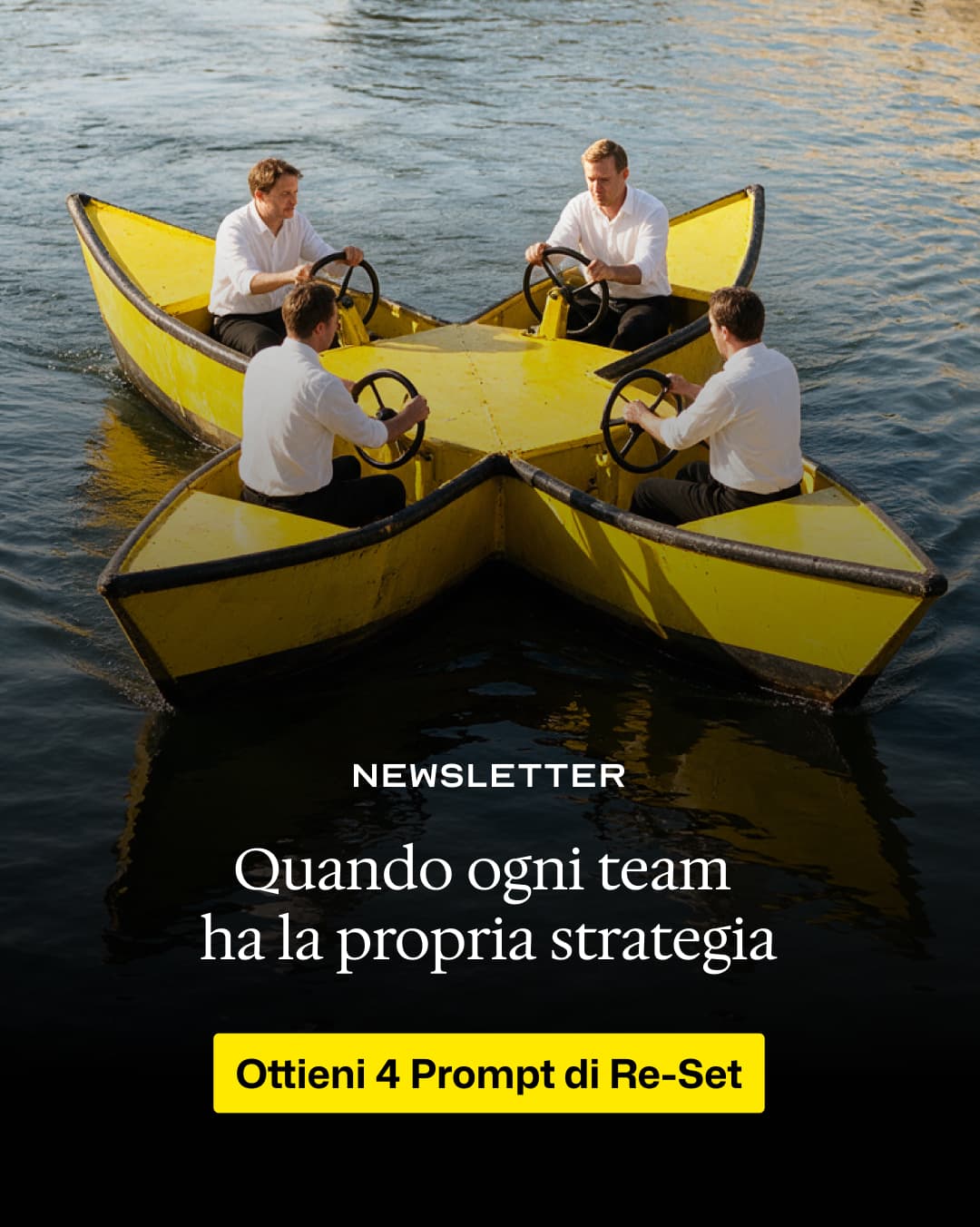
How many different strategies coexist in your company?
Probably at least two… multiplied by the number of people who work with you.
The first is the stated strategy. It lives in the presentation prepared in January, the annual plan, the OKRs, and the words used during kickoff.
The second is the strategy being executed. It lives in the decisions made afterward, the customers served, the projects opened, the tasks completed, the problems postponed, and the priorities that actually received time and money.
When they coincide, everyday work keeps pushing the company in the chosen direction. When they diverge, you can achieve plenty of results without building the company you wanted.
The real strategy is the one the work shows has been executed, and today there’s a new place to look for traces of it: the history of conversations with ChatGPT, Claude, Grok, and the other systems we use.
A model can write a long, well-organized strategy full of detail in a few minutes. If it doesn’t know your company, it will draw on what it knows about others and produce an average strategy, so well-written that it becomes difficult to challenge.
Your account history, on the other hand, contains the questions you asked, the alternatives you considered, and some of the decisions you made. It doesn’t know everything that happened in the company, but it knows the work you did there.
You can use it to compare what you wanted to build with what you actually worked on.
Four prompts for a September Re-Set
Here’s how you can get a taste of our tools in your work right away. You can do it today, as soon as you finish reading this newsletter. Don’t put it off: all you have to do is copy and paste four prompts. The answers could change what you work on between now and December—and beyond. By the end, you’ll have a pragmatic plan for the next 30 days.
Send these prompts one at a time. Move on to the next only after you’ve read and evaluated the previous response.
Use the best model available in your account and the highest level of reasoning you have access to.
Prompt 1
Analizza tutto ciò su cui abbiamo lavorato insieme negli ultimi 9 mesi: estrai o deduci gli obiettivi, le decisioni, i prodotti, i clienti, i progetti, le conversazioni e le priorità disponibili nel mio account.

Crea un ritratto strategico dell'identità aziendale che emerge dai fatti e spiegami in cosa differisce da quella che sto cercando di costruire.
Prompt 2
Quale comportamento ricorrente noti nel mio lavoro e in quello del mio team che sta assorbendo risorse senza produrre un vantaggio cumulativo?

Quale vantaggio competitivo non stiamo sviluppando a causa di questo comportamento?
Prompt 3
Se io e il mio team smettessimo oggi di alimentare quel comportamento e concentrassimo le risorse dell'azienda su quel vantaggio competitivo, rendendolo il più asimmetrico possibile rispetto alla concorrenza, quali sarebbero gli scenari più plausibili tra uno, cinque e dieci anni?Prompt 4
Quale decisione pratica, difficile da invertire e misurabile posso prendere oggi per costringere l'organizzazione, nel suo interesse, a iniziare subito quella traiettoria?

Crea un piano sintetico di 30 giorni.
You can do a second round.
Ask the people who work with you on strategy to run the same sequence in their own accounts, without agreeing on the answers beforehand. Put the results side by side.
You might discover that there isn’t just one company within your organization. There are ten, fifty, or a hundred—one for every direction people believe they should be following.
This is the Reflect: looking at what happened through facts and decisions.
Then comes the Re-Set. You don’t have to erase the previous cycle and write a new strategy from scratch. Use what you’ve learned to update the priorities, projects, numbers, and objectives for the next cycle.
How much longer can you afford to have a hundred different strategies in the same company? If you’d like to share what came up and find out how MAKE PROGRESS® can help, book a call with me.
Discover Augmented Leadership™
Try the four prompts now.
If the answers reveal that your company lacks a system for connecting strategy with weekly work, watch the recording of the Augmented Leadership™ webinar.
I explain how to use artificial intelligence to increase your ability to execute strategy, instead of relying on workarounds that produce more emails, documents, and activity without improving results.
With the recording, you’ll also receive early-access rights to ProgressOS, the strategic priorities assessment, the first chapter of MAKE PROGRESS® on OKRs, and discounts on the acceleration programs.
The seventh cohort of the strategic acceleration program starts in September. I’m collecting registrations these days, and there are 10 places available. Consider joining us.
Watch Augmented Leadership™ and claim the bonuses
If you’re already familiar with MAKE PROGRESS® and want to find out whether the program is right for your organization, you can book a call with me from the same page.
In the coming emails, I’ll also invite you to a live session dedicated to the developments at STRTGY that I worked on over the summer. Mark these emails as important so you don’t miss them.
ALWAYS MAKE PROGRESS ●↑
Antonio