“AI won’t replace people. But other people—the ones augmented by AI tools—will become increasingly competitive.”
Logan Kilpatrick, Google DeepMind, formerly OpenAI
●↑
At last Wednesday’s webinar, I asked the attendees, “Who’s using AI for their strategy, not for writing emails or code?”
Almost nobody raised a hand.
And yet, that’s exactly why they were all there.
The exocortex question
I don’t know if we’ve realized it yet, but we are—or will be very soon—the first humans to have an exocortex.
You read that right: an exocortex, meaning an external cognitive capability you can use as if it were your own. Not a tool that executes tasks, but an extra brain that reasons, synthesizes, and makes suggestions. In business, it’s the difference between a calculator and a partner.
The fact is, you’re no longer competing with people who know more. AI has unlocked access to knowledge, just as the internet did some time ago. You’re competing with those who make better use of this exocortex, which—unlike the one inside our skulls—can be enhanced and, above all, shared.
How autonomous is AI in business already? Two real-world examples

In March 2023, just after GPT-4 launched, designer Jackson Greathouse Fall started an experiment called HustleGPT: he gave AI one hundred dollars and a single instruction—make as much money as possible, without doing anything illegal. He simply followed its instructions.
The AI chose a name, designed the brand, built the website, and set the advertising strategy, acting like a CEO. But the business never took off: actual revenue remained at just a few hundred dollars. The point wasn’t the profit; it was seeing a machine make operational decisions autonomously.
And it’s not an isolated case.
People are already talking about companies of one—tiny businesses generating enormous numbers. One example cited is a business generating $1.8 billion in revenue, managed with AI.
In 2022, Chinese company NetDragon Websoft even appointed an AI, Tang Yu, as CEO of a subsidiary. In the months that followed, Business Insider reports, the stock outperformed the Hang Seng Index. Extreme cases, admittedly, but that’s the direction things are heading.
How are you using it?
Most people in business use AI like a very fast automatic typewriter. Ask for what you need and you get a huge amount of text that very often nobody reads.
And that’s a big problem, because an exocortex isn’t there to help you do what you already do, only faster. It’s there to help you think of things you wouldn’t have thought of on your own.
There is, however, a catch—and it’s why so many people are disappointed: an exocortex is only as good as the context you give it.
Without a strategy that’s shared and accessible to everyone, AI works blindly and gives you generic answers.
But if your strategy is written down, with objectives, metrics, targets, and priorities clearly laid out, then this second brain has something to work with and becomes truly useful.
To use AI for business strategy, you don’t start by buying yet another subscription. You start by codifying your strategy so that everyone—humans and agents alike—can read it.

The age of augmented leadership doesn’t reward those who know the most
It rewards those who put an external capability to work in service of a clear strategy. Individual talent still matters, but on its own, it’s no longer enough to keep pace with the market.
The good news is that the advantage is no longer just technical; it’s strategic—and will become increasingly so.
Unlike models, you’re in control of your strategy.
In the Augmented Leadership webinar, I covered all this in detail, with examples, tools, and a live demo. The full recording is online, with the bonuses included.
- 90-minute recording
- Assessment with a personalized report (3 min)
- Strategic debt calculator
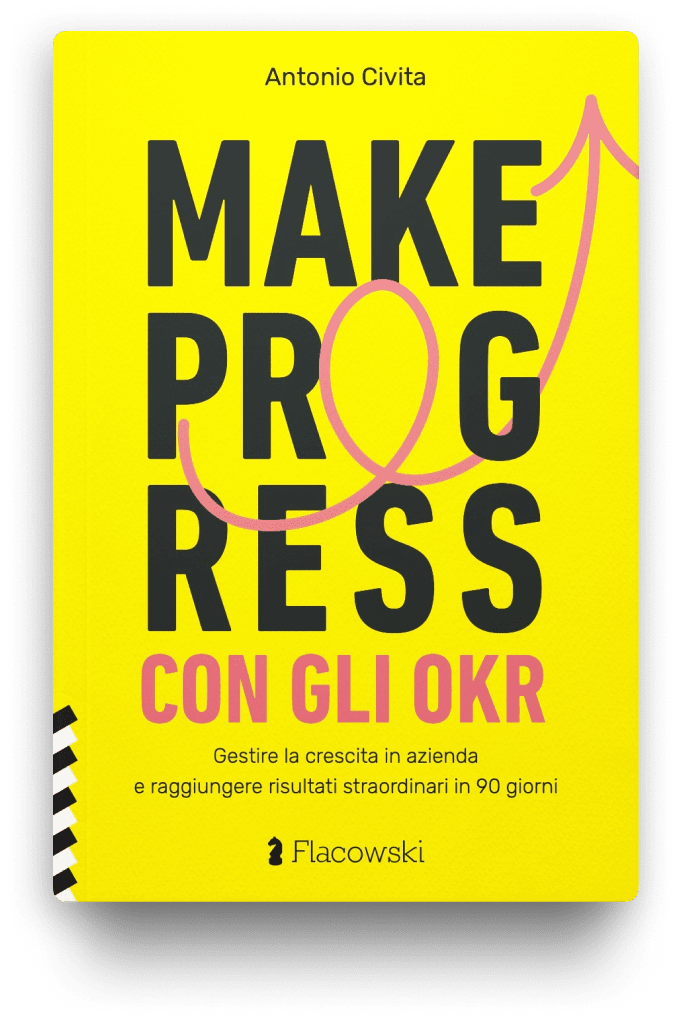
- First chapter of MAKE PROGRESS with OKRs
And if you’d like to put all this into practice with your team, you can
- apply to the September cohort
- meet with me to see if it’s right for you
Access the Recording and Bonuses
ALWAYS MAKE PROGRESS ●↑
Antonio Civita is the founder of STRTGY and author of MAKE PROGRESS® with OKRs. He helps founders and teams turn strategy into execution using the MAKE PROGRESS® method. To get in touch, reply directly to any email you receive from STRTGY.