| 🏖️ TOO HOT TO READ? LISTEN TO THIS 1. Augmented Leadership Webinar. The recording is ready, log in, claim the bonuses, and listen to it like a podcast. 2. Will AI replace managers? The episode of the Pionieri del Tech podcast, watch on YouTube or listen in your favorite app. |

“Productivity is for robots. What we want to optimize are opportunities, choices, possibilities, innovation, novelty. None of that is very efficient.”
Kevin Kelly, co-founder of Wired
●↑
Prediction: 80% of work over the next 24 months will be AI-to-AI.
It probably already is. Think about it… how many times have you received an email that was obviously written by AI, then asked another AI to reply in a “polite and professional” way, and the other person does the same… And since every agent has this absurd enthusiasm for collaboration, you find yourself replying so you don’t leave the conversation hanging.
Are we becoming AI relays?
Work that isn’t work
An increasing share of operational work is already AI-to-AI, with humans in the middle acting as relays. We write prompts, copy outputs, and hit send.
We feel productive because the message has been sent, the inbox is empty, something has moved forward.
But what, exactly, has moved forward?
Emails that generate more emails. Documents that generate more documents. Alignment meetings that generate more meetings, which produce more emails and documents. The loop keeps running, but it doesn’t produce anything that didn’t already exist—just faster and in greater quantities.
If you don’t stop to chart your direction, you risk moving very fast down a road that leads nowhere.
You’re starting to see that the problem isn’t AI, but where, how, and when you use it.
Which problems deserve AI?
Using AI on a trivial problem won’t make it any less trivial. No LLM is so bold as to tell you it’s bored of handling the problems you’re giving it.
I built a matrix to understand where most companies fall. Two axes: process volume and complexity. Try to find your bearings in these four quadrants.

Quadrant A: AI helps you
Here, you have simple processes, low volumes, and straightforward decisions. It’s you, perhaps a small team, and a workflow that fits comfortably in one person’s head. The return on AI here is close to zero, because these problems are solved with a well-designed workflow, not intelligence. Keep a low-cost account to ask ChatGPT or Claude to fix the occasional bug when one comes up. Nothing more. Investing beyond that isn’t innovation—it’s waste disguised as modernity.
Quadrant B: AI accelerates you
Here, you have simple processes but high volumes: customer service, data entry, content generated from structured data. The same task, repeated dozens or hundreds of times a day, where the result must always be the same. This is the quadrant of immediate, measurable ROI: hours reclaimed, fewer errors, lower cost per operation. But be careful: AI shouldn’t “do” the work here; it should help you design, monitor, fix, and evolve workflows—yes, exactly, workflows. At most, use a few minimal agents with open-source, stable, precise, inexpensive LLMs. Left to their own devices, LLMs overengineer every solution. Your job is to protect simplicity.
Quadrant C: You need AI to compete
Here, you have complex processes and a high number of interactions. AI is nothing new for you: you probably already use platforms, applications, and algorithms without which it would be impossible to work. The return here isn’t measured in hours saved but in market share: those who orchestrate data, models, and processes better win; the others become suppliers to the winners. Your job isn’t to add tools: it’s to build a proprietary advantage—your data, your context, processes your competitors can’t copy in a quarter.
Quadrant D: AI makes you the best
Here, you have few processes, but they’re highly complex: the bets you win here will determine the next few years. Low volume isn’t a limitation; it’s your opportunity: you can afford to dig deeper than any competitor chasing volume. The return on AI here is discovery: you run benchmarks, cross-reference data no one has ever brought together, generate multiple solutions, and test them quickly, reaching places you never thought you’d reach. Your job here is to protect your focus.
Where most Italian companies fall
In Quadrant A, convinced they’re in C. It’s the pattern I see most often when working with founders and teams in the community.
They use AI for emails. For presentations. To reply to social media comments. These are Quadrant A activities with low complexity, low volume, and returns close to zero. But because the tools are new and the demos are impressive, they feel like they’re innovating.
Meanwhile, Quadrant D problems—the ones that require difficult decisions, structure, and strategic clarity—remain exactly where they were.
Start here
Don’t install a new tool. Don’t spend your days looking at model benchmarks.
Find your bearings on the map: which quadrant are you in?
That answer tells you everything about how to use AI, what to automate, where to invest your time, and, above all, where you can get the most meaningful returns.
In the Augmented Leadership webinar, I showed how to map a company’s real problems, how to build the strategic context that makes AI genuinely useful, and why most attempts fail not because of the models, but because of an organization that has never asked itself the right question.
The recording is online. Ninety minutes. With real examples, tools, and a live demo.
It also includes:
- Assessment with personalized report (3 minutes)
- Strategic debt calculator
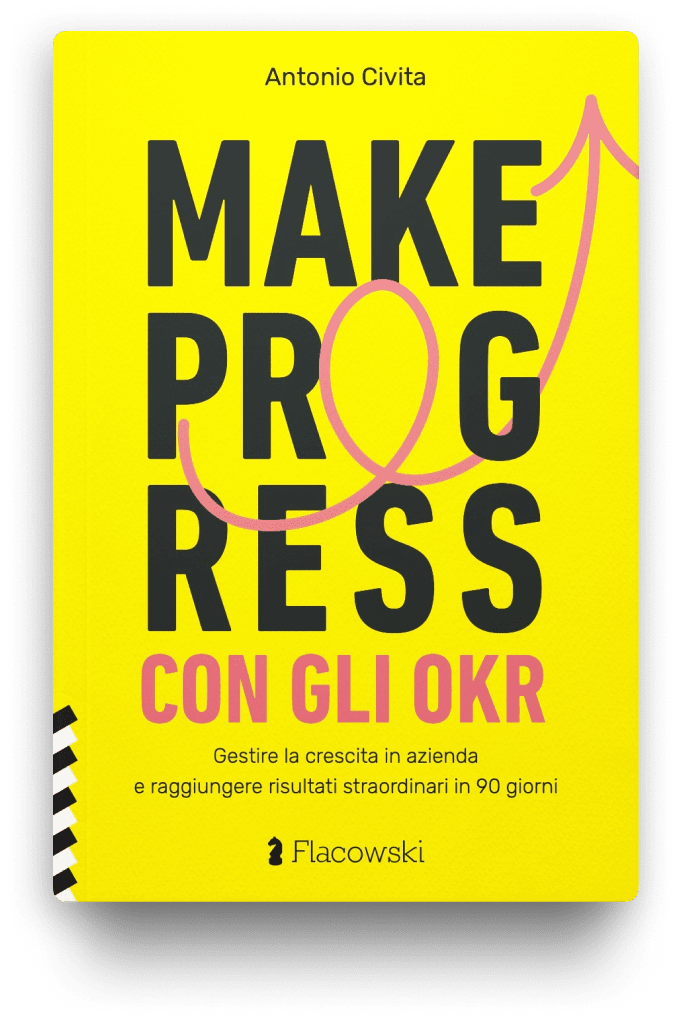
- First chapter of MAKE PROGRESS with OKRs
Access the recording and bonuses
ALWAYS MAKE PROGRESS ●↑
Antonio Civita is the founder of STRTGY and the author of MAKE PROGRESS® with OKRs. He helps founders and teams turn strategy into execution. To write to me, reply directly to any email.