In brief:
- Micro-budget: break down the budget into financial, talent and time to have immediate control over resources and plan accurately for 2025.
- Decision-making framework: adopts the “Me, You, We” method to simplify decisions and distribute responsibilities clearly and effectively.
- Real-time metrics: implements tools such as the KPI Book to monitor progress and replace vague expectations with concrete, accessible data.
- Priority protection: reserve time for strategic goals, avoiding sacrificing the long term for daily urgencies.
- Process automation: identify repetitive tasks, create SOPs, and use tools like MAKE.com to free up time and focus on business priorities.
The year 2025 has just begun, and I know you wished you had the whole 2025 strategy ready so you could start right away on that new way of working that you so longed for as you dragged in the last year-end calls.
The good news is that you still have time. In truth you are always in time to start. This thing that a guillotine falls on 12/31 separating the old year from the new has to stop. But it is also true that the sooner you start, the sooner you will see the positive effects of change.
One of the points of the Coaches’ Manifesto at STRTGY is, “Enjoy the feeling of having already done it.” Instead of procrastinating, immediately imagine the feeling of pleasure and energy that comes from finishing the task, and do everything to get it done!
I wanted to put off writing this Note. I thought how useful it would be to you.
Don’t want to go for a run? Think about how good you felt the last time you came back from your run.
Don’t you want to call that client? Think of the satisfaction of closing that contract.
Are you putting off work on the Strategy? Think about how you felt the last time you were able to see so clearly the direction….
I have collected here 10 principles that are guiding my strategic work and that of dozens of coaches and companies that have decided to use our tools. This note is in two parts.
Part 1, note #198:
- Micro-Budget
- Proxy
- Measurement
- Zero compromise
- Automations
Part 2, #199 (due out 20/1/25) :
- Subtraction
- Competition
- Personal energy
- Network
- Extended Board
Read them carefully-even several times if necessary-and give yourself time between notes to implement what you need.
Share these notes with those who are facing strategic challenges with you.
Use them to design a path in which you can move with speed and frictionlessness toward your best year ever.
And keep me updated on your progress, I care.
ALWAYS MAKE PROGRESS ⤴
Antonio
—
1 – Introduce 3 types of micro-budgets.
I am not a big fan of budgeting (I have already talked about it here, here, here and here). But – if done well – I cannot deny its usefulness.
The biggest problem with budgeting is that it is so complicated and time-consuming to implement that it risks reinforcing all the bad habits instead of activating critical thinking about how to improve resource use.
My advice is to spend as little time on it as possible, accept its impermanence, but revise it frequently.
In addition, the budget everyone thinks about is the financial one, but stopping to look at the company from that one perspective, while important, is limiting as well as dangerous.
I invite you for this reason to make 3 types of budgets, smaller, but no less effective. We will call them micro-budgets.
Micro-Budget Financial
Use it to understand the company’s most basic financial needs and set minimum targets accordingly.
- Divide the sheet into twelve columns one for each month.
- Separate the rows into two major groups: costs and revenues.
- In costs, based on the expenses of the year just ended, include what you can already anticipate such as those of personnel, rent and software.
- In revenues, calculate how much you need, month by month, not only to cover costs, but also to sustain the growth-and marginality-you desire.
That alone is enough, believe me. But if you want more precision, you now have the information to figure out how many renewals and how many new customers you need to reach these volumes, and you can finally ask yourself the queen question of strategy: am I building what I need to create the impact I aspire to?
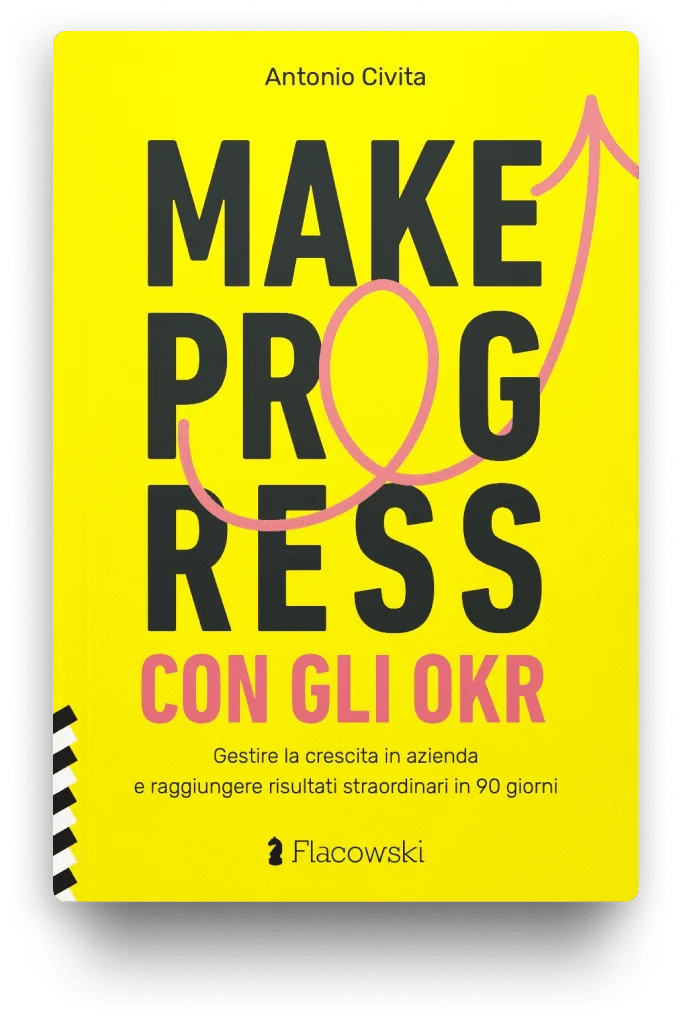
Leave aside for a moment all the stories about challenging goals (we’re not talking about OKR!) and make the budget highlight which growth dimensions you can count on 90% confidence in achieving them. In MAKE PROGRESS it is called Committed Growth (you can elaborate on this on page 128 of our handbook)
Talent Micro-Budget
Many strategies are unexecutable because there is not yet the expertise in the company to do what was envisioned. While it is very easy to estimate costs, it is much more complicated to estimate a talent budget. Yet it would be a much more useful form of budget, wouldn’t it?
Review your strategic projects and see if the people accountable for each project have the skills to do so.
In the financial budget, depending on your availability devote a percentage to training, coaching or specialized consulting to acquire the skills you need.
Assign those financial resources to the accountable people and-as you will see in Step 2-don’t add additional levels of authorization. If they are strategic projects, make sure everyone has the resources to do them to the best of their ability.
Make managers autonomous in these four activities:
- Hiring: deciding whether and who to hire (full-time, part-time, external)
- Firing: deciding whether and who to fire
- Upskilling: deciding who and how to evolve
- Re-skilling: deciding who and how who to make change
Micro-Budget Time
Everyone says that time is the scarcest resource and yet it is the least designed. How come?
One of the most positive impact activities we do at STRTGY and with our clients is to design the ideal week.
In Google Calendar, create a new calendar by clicking on + in the left column next to “Other Calendars.”
Build a calendar of appointments that define the rhythm of delivery. Mark at least these three important areas:
- No-meeting zone: the space of the day where meetings, including internal meetings, are prohibited
- TOP3: The space of the day (usually included in the no-meeting zone) dedicated to working without distraction on the 3 most important tasks connected business priorities. This is the time to work on OKRs (if you were wondering!).
- Team check-in: schedule team synchronization times in advance so that everyone can organize their agendas accordingly. Enter only the minimum necessary such as those to measure progress on OKRs.
This time budget does not indicate what to do, but when to do the important things. People will then choose what to do at those times.
If you don’t plan time for priorities, you won’t be able to call them priorities.
Once completed, share this calendar with the entire team and ask them to adjust their schedules to those blocks of time. This is the first step in acquiring a new organizational rhythm.
2 – Optimizes delegation and decision-making
One of the major bottlenecks in business is decision-making. There are those who centralize them all on themselves. On the other hand, there are those who-believing they are creating the flatter hierarchy that is so fashionable-leave everyone in uncertainty but are ready to either scold if things don’t work out or take credit when they do. Either way is not good. Here’s a simple framework you can follow with your team to solve this dysfunction-it’s called Me, You, We.
Me, You, We
When there is a need to analyze people’s behavior there is little use in locking yourself in a room with snacks to do a workshop because the results will be biased and likely influenced by the facilitator (especially if internal). Rather follow this good practice:
- Create a sheet in any system you prefer divided into 3 columns: me, you, we
- Each time a decision is made each person must add the decision to the column indicating the level
- Set a short monthly meeting to review this list.
Here is an example:
- Decision Me: personal level.
Ex: You must purchase a ticket for a $100 training event or activate a $12/month trial
These are decisions that anyone can make on their own without the need for approval. You can set a principle that all expenses within a certain monthly amount do not have to be authorized. It’s kind of like when parents give pocket money, sometimes I’m surprised at how even this minimal level of trust is lacking.
- Decision You: higher level
Ex: you have to allocate budget, decide whether to collaborate with a partner or hire a new colleague
These decisions require a higher level of seniority or are decisions you make as a manager after assessing the situation. Probably the people in contact with the client or partner see the need to make the decision and need to know the process for getting resources approved.
- Decision We: level together
Ex: launching a new product or opening a new market.
These decisions have important consequences and require confrontation and cooperation. Treating decisions at this level as Me decisions is often why many choices that have the label “strategic” are perceived as being dropped from above. It must be clear when and what is the right time to talk about it as well as how to participate.
This simple exercise, conducted over a sufficiently long period of time, allows you to map at no cost the types of decisions that are made in the company and redistribute power appropriately.
3 – Make progress (or lack thereof) visible
If you have been here for a while, or have started following STRTGY recently you will have realized how important numbers are. What we want to solve here is to move from a style of leadership that I call “management by expectation” to one that calls “management by real time numbers”
Managing by Expectation
Managing by “expecting the best” means having high expectations without clearly communicating them to those who have to realize them. It is like starting a journey without a map: it is assumed that the guide knows where to go, but no one has explained the destination or route. Delegating without clarity often leads to disappointing results, and blame is placed on others instead of recognizing that the problem is the lack of precise instructions.
Managing by Real-Time Numbers™
This approach relies on up-to-date data to provide clarity and transparency. By defining accurate and accessible metrics, progress can be monitored in real time. People no longer live by expectations, but make decisions based on hard numbers. In this way, the team works with autonomy and motivation, knowing exactly what to do and what results to achieve.
A key tool for this approach is the KPI Book, which helps organize and monitor each team’s KPIs, assigning clear responsibilities. It also supports the construction of more effective dashboards, overcoming common difficulties in visualizing and managing metrics. Integrated into the MAKE PROGRESS method, the KPI Book provides focus and structure to remove ambiguity from conversations, drive continuous improvement and achieve strategic goals.
4 – Priorities without compromise
When OKRs fail, it happens not, surprisingly, because of the difficulty of defining or executing them, but because of the fact that, once set up, teams continue to be overwhelmed by an avalanche of unforeseen activities that contribute nothing to strategic goals.
The truth is that people want to stay focused on what is important to them, without interruption. Yet, in many organizations, the culture of urgency overrides that of priority, and any distraction is treated as inevitable.
Many of these activities are not really urgent, but just distracting noise. And the more we agree to give in to these interruptions, the more we teach others that our time is flexible and available for everything but what really matters.
My invitation is: do not compromise on the quality of your work. Protect the time devoted to strategic priorities. It is not only a good practice, it is an act of leadership. Whenever you allow an unplanned task to invade your focus, you are choosing to sacrifice your long-term impact for an immediate and often irrelevant result.
On the back cover of MAKE PROGRESS is a sentence that embodies this principle: “If OKRs are about setting priorities, then they are a priority themselves.” Treat them with the same respect and discipline you would reserve for your most critical personal projects.
People want to feel free to focus on what really matters. Giving them this opportunity is not only an organizational improvement, but a gesture of respect toward their talents and potential. Not everything can be urgent, but every strategic goal deserves to be protected.
5 – Automate the repeatable
In any business, repetitive activities represent a black hole that sucks up time and motivation. By automating these tasks, you are not only improving efficiency, but giving your team back the ability to focus on what really matters, both for their professional growth and for the strategic value of the company.
A resilient business does not rely on people, but on stable, well-documented processes that can be replicated and optimized over time. The cost of maintaining active automations is infinitely lower than employing a full-time resource to do the same manual work. Tools such as MAKE.com enable you to build workflows that run seamlessly, ensuring efficiency and reliability.
A key element in maximizing the benefits is to build libraries of SOPs (Standard Operating Procedures) that can be further enriched with AI-specific prompts, speeding up the execution of dynamic tasks such as custom reports, analysis, or communications. They not only reduce operational load, but also increase the quality and consistency of tasks.
Automating means creating a system that works in the background, allowing people to shift their focus to higher goals, such as innovating, growing, and building lasting impact. It’s not just about technology; it’s about building an organization where processes support progress and people can devote themselves to what makes their careers meaningful.
Here is a simple process you can activate as early as today:
- Observe and write down: as for step 2 – devote a week to observing the repetitive activities you do regularly. Whenever you realize you are doing the same thing twice, take notes and write down the main steps.
- Assess repetitiveness: when you find that you are following the same procedure at least 10 times without changing it, it is time to seriously consider automation.
- Document the process: turn the steps into a clear and easy-to-follow SOP, and use it each time you perform the same operation by updating it until it is comprehensive. .
- Choose the right tool: explore platforms such as MAKE.com to build automation that performs the procedure consistently and without error.
- Monitor and improve: Once automation is enabled, periodically check the process to make sure it is working properly and make any optimizations.
6 to 10
Has it been helpful to you so far? Write to me simply by responding to any email you have received from STRTGY.
Don’t miss the next note to complete the list.
ALWAYS MAKE PROGRESS ⤴