Hey, happy Monday!
I want to be sure that nothing can stand in the way of your participation today, April 11, 2022, in the STRTGY Meeting with Irene Cassarino.
Irene is the CEO of The Doers (Digital Magics group, one of Italy’s leading business incubators, BIT:DM), and with her team she has developed an investigative approach that steals FBI tools and puts them in the hands of those of us who need to innovate by intercepting, effectively, new markets.
Here’s how it will work! At 6:00 p.m. you will receive the link to get advance access to the room on Zoom in which we will meet. Find a quiet corner to follow the meeting with webcam and microphone on (this is not a webinar!) and have pen and paper with you to take notes. The event will begin as always at 6:30 pm sharp.
📅 Add the event to your calendar
Google Calendar / Apple Cal / Outlook
🟢 Invite your team with a simple message on Whatsapp. Innovation is a team sport! Invite via Whatsapp
Those who attended the previous STRTGY Meetings were thrilled!
“Enthusiastic.”-Andrea, HR Innovation
“Innovative and highly educational.”-Massimo, Sales Manager
“Interesting, right timing, attention that stays high the whole time.”-Claudio, Startup Founder
“The topics are of high quality and are examined in every detail.”-Michele, Designer
“Absorb as much as you can.”-Fiorella, Trainer & Coach
In this note, in addition to the service information I just gave you, I also want to pass along my notes on an incredibly important and underrated aspect of growth: Retention, even (and especially) in B2B.
Many of us work in companies that have (apparently) already found Product Market Fit(here how to calculate it, №90) and thus generate revenue, more or less permanently, from their products and services.
But when there is a need to grow it is not enough just to increase budgets on marketing and continue to acquire customers, it is also important that customers continue to find value in what you offer.
Our clients evolve over time moo-very quickly.
Do our products do that too?
ALWAYS MAKE PROGRESS
-Antonio
● PRODUCTS / Retention
The hidden ROI of innovation
Although everything seemingly looks the same, it is not. The company you lead today is different from the one you led just a few weeks ago in terms of Customer Experience.
Over time, it’s natural for your customers to access different versions of your business: new people joining the team, new messages in marketing, new ways of offering things, new tools…
Every experience is different, and this affects the value you will be able to extract from relationships.
As the company grows, the number of former customers (of customers who no longer find value in our products) increases while the number of new customers interested in the product decreases.
In this situation, investing in marketing is like adding water to a bucket full of holes!
To be sure that the innovations you introduce are sustaining growth, it is important to measure that new customers are generating more value than those who started with you in an earlier version of your business.
The best business models focus yes on acquisition but more importantly on continuing to create value for the customers they have already acquired because that is where the greatest profits are. It is not sustainable to keep “buying” customers!
Here innovation plays an important role and, at this point, can even be measured more effectively (which also means projects that go faster and are supported by more resources)!
When we think of innovation we immediately think of launching a new product that will attract new customers, but there is a risk of neglecting existing customers who will gradually see their support for their own development dwindle, snuffing out like candles with an increasingly short wick.
Many organizations fail to consider the Network Effect, the fact that business increases in value as customers increase by focusing on the success of current customers who will consequently attract new ones.
In fact, the opposite happens more frequently, a kind of Negative Network Effect, very common in service companies, where as the number of customers increases, the attention devoted to customers decreases.
Innovating does not mean “creating new things” but “creating new value”!
How to measure. Demographic or behavioral segmentation is not enough; temporal segmentation by grouping customers into cohorts is also important.
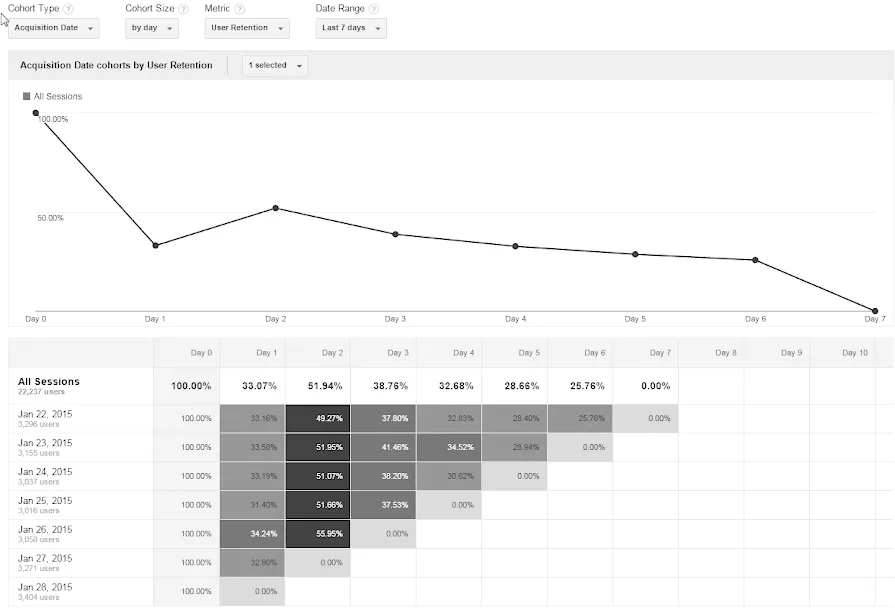
That is, putting together the numbers of those who started working with you in a particular period (e.g., Q1-21) to compare with the numbers of those who entered your business in a different period (e.g., Q1-21 vs Q1-22, what changed?).
What to measure. Profit is the measure of all strategies so start with that.
Good metrics should always be comparable and easy to calculate. Profit per unit is a number that exists in every business (profit per project, profit per customer, profit per item sold, profit per table, profit per night, you go on…). Start with that.
One number alone is not enough to draw a straight line.
The leading profit metric is the Number of Active Clients per Month (NMAC Net Monthly Active Clients) or Number of Active Users per Month for SaaS (NMAU Net Monthly Active Users) and you can calculate it like this:
NMAC = New Acquired Clients - Client Lost + Reengaged Clients
How to move this issue. Cooperation and conversation.
This issue is so powerful! Because it acts on three different teams: new customers are the responsibility of Marketing and Sales, lost customers are the responsibility of the Product team, recovered customers again of Marketing and Sales, and if everyone looks at this number, a good part of the organization will make decisions that will support growth!
Use this number to generate frequent and meaningful conversations. Use OKRs to quickly change leadership style from Managing by Expectation, where you are dissatisfied with responses, to Managing by Real time Numbers™ where you can finally be proud of progress.
Today you can preview the tools I have developed to implement a Growth Management System, based on OKRs, quickly and without making common mistakes.
Choose the best time to meet with me at a meeting strtgy.design/your-next-cycle/