Hey, happy Monday!
Judging by the Out-of-office I get every time I send out the newsletter, it must be the beginning of the vacation and “let’s talk again in September” period. Wherever you are, the only urgent thing right now is for you to be happy!
I must confess that time flew by and I didn’t realize I had teleported to mid-July! Between the editing of the book and the physical events in which I participated, time seems to have accelerated dramatically.
Registration is still open for the last STRTGY Meeting of the season to be held on Monday, July 18 at 6:30 pm. We will meet Federico Ferretti, Head Of Design at Haier, one of the world’s most innovative global organizations. Among the brands you are sure to know are Hoover and Candy.
Watch STRTGY Meeting with Federico Ferretti and access more than 60 hours of exclusive live coverage. Go through this link
We will discover with Federico that Haier not only makes great use of Design Thinking in the design of its products but also adopts one of the most progressive management methodologies currently in use: the RenDanHeyi, which could be literally translated as “customer-company integration.”
While preparing for the event, I discovered a principle that struck me deeply and that is that of Zero Distance.
RenDanHeyi expresses the Taoist insight that we live in a zero-distance world, in which everything is connected to everything and no part of a system can thrive unless all parts of the system thrive. Zero distance stands to symbolize a kind of quantum entanglement, thus indissoluble, between the inside and the outside of the enterprise. In this case, RenDanHeyi means that the employees (Ren) of a company, indeed the company itself, cannot prosper and enjoy the value created if its customers/users (Dan) do not also enjoy this value (are aligned with, Heyi) through the use of their products and services.
The model to which it is contrasted is that of the companies we are familiar with, which is called Taylorian, that is, where the company creates value as if the various departments were working on an assembly line.
While in recent years, traditionally managed Taylorian companies have experienced 1.1 percent annual growth. Since fully implementing RenDanHeyi in 2012, Haier has experienced 23 percent annual growth. And while, with the exception of the large e-commerce companies, almost all of the world’s large retail companies have suffered severe losses and contractions as a result of the Covid-19 crisis, the unique features of its RenDanHeyi model have seen Haier return to full production in mid-February 2020.
How did they do it?
Newtonian/Taylorian-style companies, which treat the employee as a tool or resource of management, who must do its bidding, deprive employees of autonomy and potential. This thwarts the possibility of employees finding meaning, joy or a sense of purpose in their work and denies companies any lost potential, including motivational potential, resulting in decreased innovation and productivity.
The entire structure of RenDanHeyi is designed to put into practice a broader philosophical vision as well as a deep respect for human dignity, the autonomy of the individual, and the belief that everyone is unique and everyone has the potential to create his or her own distinctive value if given the freedom to do so.
In the implementation of the model by Haier, which invented it-and other examples I have been able to find on the Web, especially in Asia, while in Italy the first experiments seem to be conducted by Intesa Sanpaolo and Gummy Industries-the company is organized not hierarchically but in a network of micro companies-with their own budgets and rules-where employees are also entrepreneurs. Hence the great agility that has supported the growth I mentioned earlier.
In this scenario we have two practices that become crucial: good design and good management. The first to create products that intersect, in a sustainable and improving way, in people’s lives. The second to align strategic goals.
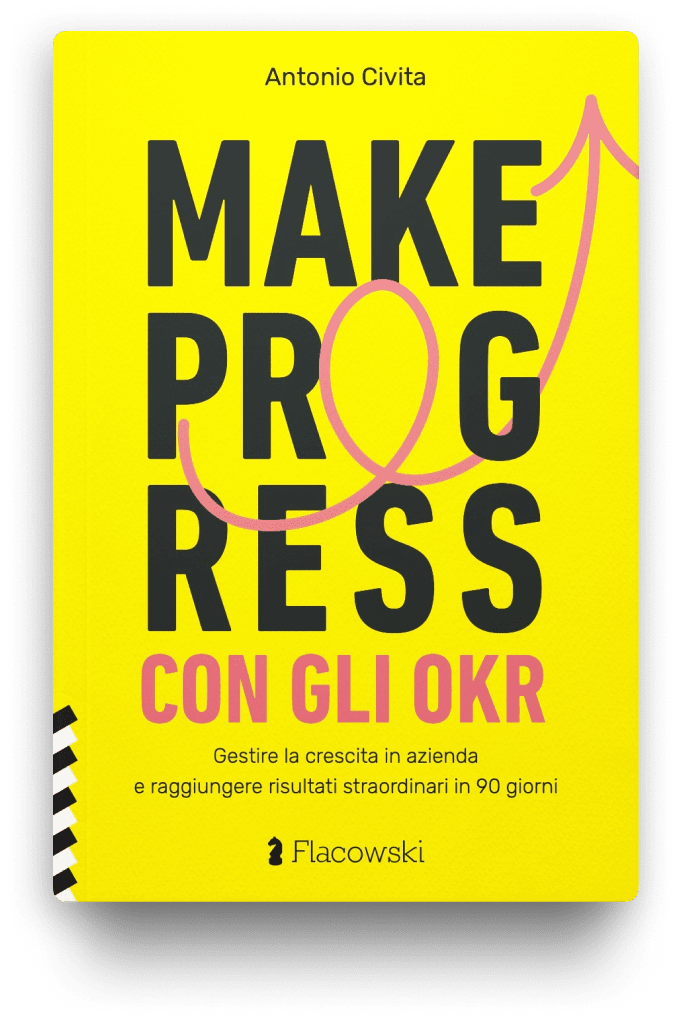
Around this time I’ve been circulating among a small circle of friends a few chapters from the book MAKE PROGRESS with OKRs and I wanted to share with you an acknowledgement, which among others, Luca Barboni, Founder & VP of Growth at 247X, left with me, that highlights this very aspect:
“I believe OKRs are the best possible tool for getting all members of a complex organization to behave as if they were the founders of the organization.”
I look forward to meeting you in the room. Enrollments are already flooding in, remember to reserve your spot to guarantee your entry into the room on Zoom.
ALWAYS MAKE PROGRESS⤴
Antonio