“Practice isn’t what you do once you’ve become good.
It’s what you do that makes you good.”
Malcolm Gladwell, author of Outliers
—
Every strategy begins with a choice, draws strength from consistency, and becomes real only when it is translated into action.
In the first chapter of this email series, we saw that choosing means having the courage to give things up, accepting that every clear direction also means leaving something out.
In the second, we discovered that consistency is what holds everything together: a logical thread that aligns decisions, behaviors, and systems.
Now we’re moving into the most demanding part: the discipline of doing.
Because it’s not enough to understand what’s right to do: you have to do it, every day, in the same way.
Many strategies don’t fail because they were good strategies, but because no one ever executed them.
Execution isn’t a second phase of strategy; it’s its daily test: where decisions change behaviors, budgets and priorities move in sync, and culture reveals what you truly believe.
In this chapter, we’ll talk about how strategic decisions become visible in the world, how resources tell the truth about the direction taken, and how the rhythm of action determines the strength of progress.
We’ll also see why measuring effort isn’t enough, and why instead we need to learn to measure change.
This is where direction meets discipline.
Where thought becomes movement and strategy takes shape in behavior.
In previous episodes
Over the past few months, I’ve collected the most common challenges faced by members of the community: priorities that change every week, confusion between KPIs and KRs, fluid roles, working in crisis mode, and never having enough time.
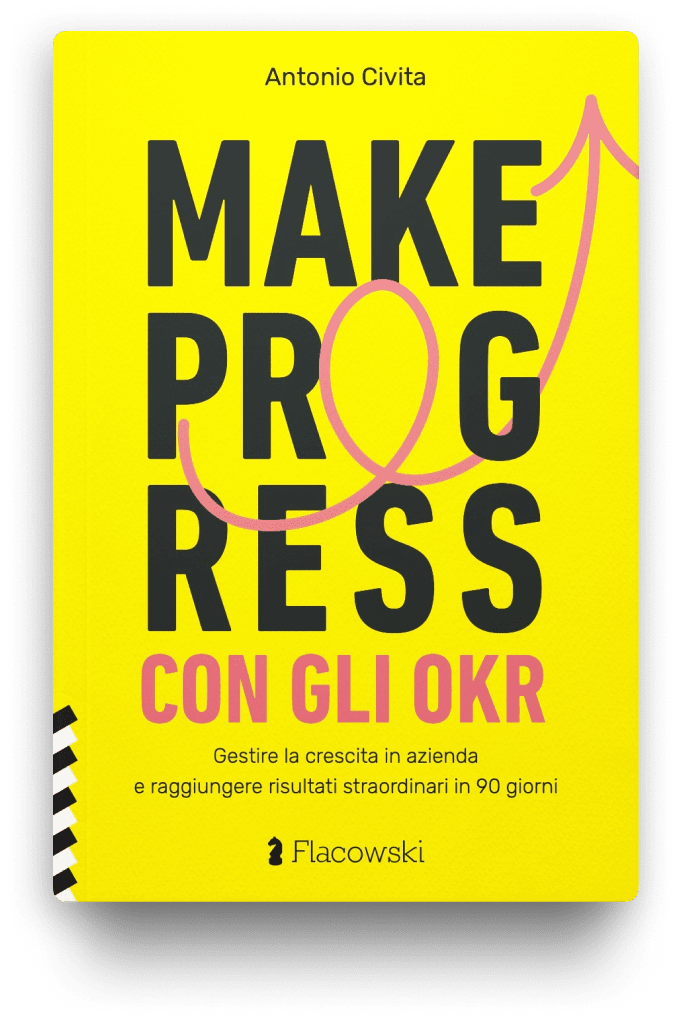
I decided to write a five-chapter series bringing together twenty-five fundamental principles that guide my work and that of hundreds of teams who today use MAKE PROGRESS® as an objectives-based strategy execution system.
These are strategic laws that no company I know has ever been able to ignore.
Each law is a lens for seeing more clearly, for distinguishing what truly matters from what distracts us.
Chapter I – The Nature of Strategic Choice
Published Monday, October 20 at 7:00 a.m., read here.
Every strategy begins with giving something up. Understanding what “winning” really means and where it’s worth playing is where everything starts.
Chapter II – Internal Consistency
Published Monday, October 27 at 7:00 a.m., read here.
An isolated choice isn’t enough. Value comes from the connections between capabilities, metrics, incentives, and collective behavior.
Chapter III – The Discipline of Action
Published Monday, November 3 at 7:00 a.m., in this post.
Chapter IV – Learning Over Time.
Published Monday, November 10 at 7:00 a.m., read here.
Strategies don’t work forever. The ability to learn faster than your competitors is the only defense.
Chapter V – NO SPOILERS
Monday, November 17 at 7:00 a.m.
Chapter III. The Discipline of Action.
Execution isn’t a second phase of strategy: it’s its proving ground. Priorities, budgets, and decision-making rhythms are the strategy itself.
Law 11
A decision is strategic only if it divides.
In strategy, words don’t matter: what matters are the decisions that change the course of events.
A good decision is a dividing line: it separates “before” from “after.”
It can’t be both right and left, forward and backward, or include everything.
A strategic decision is only a decision if it rules out something equally valid, not something stupid. Otherwise, it isn’t a decision; it’s just common sense.
Roger Martin suggests that every decision must pass a kind of stupidity test: if someone has chosen the opposite and is still making money, then that’s a real decision.
“We want to be customer-centric,” but the opposite—ignoring customers—isn’t a decision; it’s suicide.
“We want to create an inclusive, people-focused workplace,” but the opposite would be “we want to be toxic and discriminatory.” Although, sadly, many end up that way (but that’s another story), we can’t call it a decision; it’s an ethical choice.
“We want to innovate constantly to offer customers better solutions,” but no one would choose the opposite of “avoid improving products at all costs.”
Deciding isn’t just choosing; it’s making the choice visible: in behavior, priorities, and exclusions.
Every decision without an observable effect is just a thought with the annoying pretense of being concrete.
Every consistent decision, on the other hand, is a signal, a public act of commitment to the chosen direction.
Every strategic decision requires a transfer of resources. This brings us to the next law.
Law 12
Resources define the truth of strategy.
In strategy, where you put money and talent reveals your true direction.
Every organization tells many stories about what matters.
But priorities aren’t revealed by speeches; they’re revealed by budgets, tasks, and calendars.
Resources tell the real story.
Resource allocation is the most tangible expression of consistency.
Every euro, every hour, and every talent assigned to an activity communicates a strategic preference.
And it’s the sum of these preferences that defines an organization’s competitive DNA.
Inconsistent companies are easy to spot: they talk about the future but keep funding the past.
Strategy isn’t read in documents, but in the flow of resources.
Changing direction means shifting energy, not just words.
It means taking resources away from one area to strengthen another, giving up what isn’t working (and sometimes even what works well but will soon become irrelevant) to build what will be needed tomorrow. This is where a leader’s courage is put to the test, because every reallocation is a political act as well as an economic one.
The rest is just corporate storytelling.
Law 13
Priorities are the temporal form of strategy.
Every organization has a thousand things to do, but only a few truly matter.
Setting the order of actions is what distinguishes having a strategy from simply being lucky.
People who work with strategy don’t ask, “What can we do now?” but “What do we need to do first to make all the other choices possible?”
Priorities aren’t there to fill time, but to orchestrate the sequence in which an advantage is built.
When everything is urgent, nothing is strategic.
Urgency leads to reactivity; priority creates direction.
Knowing how to say “not yet” is just as important as saying “no longer.”
A good priority isn’t measured by its importance in isolation, but by its systemic effect: if an action reinforces several strategic choices at once, it comes first.
If it’s brilliant but unrelated, it can wait.
The organizations that grow fastest don’t do more: they do things in the right order.
There can be no strategic consistency without a deliberate hierarchy of what comes first, next, and never.
Law 14
The rhythm of execution is part of the strategy.
The cadence of decisions influences effectiveness as much as their content.
The effectiveness of strategy execution is directly correlated with the pace at which you put it into action.
Too slow, and the effect evaporates. Too fast, and the organization implodes.
Rhythm is what turns a plan into a sustainable flow of action and learning.
Every company has its own natural heartbeat: the rate at which it can absorb change, make decisions, and learn from results.
The leaders guiding it need to know how to pace things according to the system’s capacity, not market expectations or their own egos.
A company that accelerates without coordination creates chaos; one that slows down for fear of making mistakes misses opportunities.
The optimal rhythm isn’t constant: it fluctuates between periods of intense effort and periods of consolidation. Just as an athlete alternates training and recovery, an organization must learn to breathe.
The cadence of decisions is a leadership choice: leaders set the pace and determine when to learn, when to act, and when to pause. Nothing happens by chance.
Speed without synchrony is noise.
Strategy isn’t just what to do, but when to do it.
Law 15
Measure change, not effort.
Too many organizations confuse movement with progress.
Meetings, projects, to-do lists: everything moves, but little really changes.
Strategy execution isn’t about doing more, but about doing things differently.
The true indicator of execution is behavior.
A strategy has succeeded only when people act in new ways that are consistent with the choices made.
As long as old patterns remain intact, implementation cannot be considered complete.
Completing a project isn’t enough: you need to observe how the way people make decisions, collaborate, and communicate changes. A transformation is real only when it becomes a shared habit.
Measuring strategy by the increase in completed tasks creates the illusion of progress.
Measuring it through changes in behavior helps us understand how the organization works as a whole, and how to improve it.
Don’t celebrate what’s finished, but what has changed.
Effective execution is a process of organizational learning, not a race to deliver.
Every consistent decision, repeated over time, becomes culture.
And culture, not projects, is where strategy becomes permanent.
Putting it into practice
1. Make decisions visible.
A strategic decision that can’t be seen doesn’t exist. Every choice must leave a concrete trace: a project launched, an initiative stopped, a priority shifted.
In MAKE PROGRESS®, this work starts with the Strategy Focus Onepager (SFO): a single page that forces you to clarify your direction and stay on track.
Continue with the Now & Next exercise, which helps teams make explicit the transition between “how we work today” and “how we’ll work tomorrow.” That’s where strategy truly takes shape: in behavior and language.
You’ll find everything in our Standalone Toolkit
2. Allocate resources, not intentions.
Resources tell the truth that words conceal.
In MAKE PROGRESS®, the first step to realigning strategy is to connect OKRs to budgets and the time actually invested. When a priority receives no resources, it isn’t a priority.
Use Enablers to identify where to focus capital, people, and skills and, during planning sessions, select “To Kill” projects to eliminate anything that no longer supports the chosen direction.
Bonus: here’s a guide to conducting project performance reviews using an analysis system that requires just three extremely simple KPIs but makes every Project Manager (who should already know how to do this) pale in comparison.
3. Put actions in order.
There is no strategy without sequence. Priority isn’t what matters most, but what comes first.
In MAKE PROGRESS®, the Time Horizons system (Vision, Annual, Four-Month) helps you build the operational sequence that turns direction into progress.
Use the Gap Score to understand where to intervene first, and the Focus Zone to protect weekly time dedicated to real impact.
Repeat the Now & Next exercise every four months to make sure the sequence stays aligned with growth.
Download our templates to get started now.
4. Set the rhythm of your execution.
A living company has a heartbeat you can feel. In MAKE PROGRESS®, this rhythm is called the Drumbeat: the sequence of meetings that keeps the system in sync.
The Daily Check-ins clear minor roadblocks, the Weekly Check-ins strengthen alignment, and the quarterly Strategy Refresh reconnects objectives, metrics, and priorities.
In the MAKE PROGRESS® Coach Manual, you’ll find an entire chapter on how to design your ideal Drumbeat.
5. Measure change, not effort.
Completing tasks doesn’t mean making progress if you haven’t learned anything along the way.
During check-ins, use MAKE PROGRESS®’s What, So What, Now What technique to shift the conversation from activities to the behaviors that generated the results.
Make the Roadblock List part of your routine: every problem solved should become a new SOP, a system that prevents the mistake from happening again.
In the Standalone Toolkit, you’ll find ready-to-customize agendas for your weekly behavior and results reviews.
Action is the test of strategy
Every decision, every priority, and every metric only makes sense when it becomes visible behavior.
Strategy doesn’t exist (only) in documents, but in the way people make decisions, communicate, and act every day.
Many companies think they have an execution problem, but in reality they have a problem with discipline: too much movement, too little transformation, and even fewer results.
Execution isn’t about doing more, but about acting with intention.
It’s through changing behavior that strategy stops being a motivational speech and becomes culture.
In the next chapter, we’ll explore the most delicate point of all: the systems and metrics that make consistency measurable and action sustainable.
See you next Monday,
ALWAYS MAKE PROGRESS ●↑
Antonio