Hey, happy Monday!
It was exciting to meet, albeit virtually, outside this newsletter. Did you make it to participate?
The STRTGY Meetings are key moments for our community.
Not only are they the time where we manifest ourselves in the flesh and can interact, but they are, above all, extremely valuable learning opportunities.
In any case, I can assure you that they are not finished; on the contrary. Get ready the best is yet to come. Check our emails throughout the week, we will be announcing the next guest on Wednesday, and I’m sure you won’t want to miss it.
In the meantime, if you want to go over some of the steps or if you simply didn’t get a chance to attend live, know that starting today you can access Replays of all STRTGY Meetings. Free and on-demand.
You can visit the archive of events and choose from the “on-demand recordings” section the one you want to cover.
Would you like to suggest a guest or give us feedback?
Go ahead and respond to this email. I always read, respond as soon as I can, but most importantly I really use all the feedback to improve your experience.
I share with you some reflections after these first two meetings dense with information you could not have found elsewhere.
Reading signals from the future
What do an Influencer Marketing agency and one of the most important Advertising agencies we have in Italy have in common?
They help their clients build the future.
Michele Pagani, Head of Media Strategy at Gummy Industries and Founder of Flatmates, told us about how Brands use Creators to be able to achieve essentially two goals: to reach an audience that is not currently paying attention, thus reaching non-customers by definition, and to simultaneously fill a language gap that makes them credible in the eyes of that same audience.
Marcello Ascani, a 600k sub on Youtube alone, was very clear: Creators need freedom, madness and respect for their followers in order to create high-engagement content.
On the concept of freedom we come back to toward the end, let’s stay for a second on respect for one’s audience.
I was impressed with Marcello’s ability to understand so well what people like about his content consumption. I’m sure this is not just a trait of his but of all Content Creators who constantly have to satisfy their viewers…and make money.
They do this by looking at the data, understanding the algorithms and using them to their advantage.
They are consistent in what works, with a systematic and precise content production pipeline, but they are brave enough to experiment with new things (in a story on Instagram for example, Marcello talked about the results of a long video shot completely vertically, something he had never done before).
How many companies, including our own, can we say have these characteristics?
- Relying on data
- Understanding and protecting your relationship with your customers
- Focus on what works
- Constantly experimenting
We find the same pattern with Giuseppe Stigliano, CEO of Wunderman Thompson Italy, who offered his perspective gained from working with prestigious Brands and multinational teams.
On the role of agencies he is so clear as to suggest at one point that a new remuneration model may be needed to incentivize it (go to min 25:40)
Agencies are tasked with accelerating a very important transformation: the constant alignment between products and people’s changing expectations and desires.
His teams use Big and Small data to read these signals, interpret them, and pass insight from the real world to the creative team.
Again, as you see, data is important as is the freedom to be able to experiment and learn in order to … acquire new data.
Data gives us freedom! But how much?
And here we are talking about freedom but in the meantime let’s clarify: free from what?
First, freedom from chaos. Those who don’t have the data clearly don’t know where they are going and how fast they are getting lost.
Second, freedom from Business as Usual. Being able to measure impact with different numbers from the rest of the organization is critical to driving innovation projects.
For example, we cannot measure innovation (only) by EBIDTA, otherwise it is not innovation and we should call it by the right name of optimization…
Third, the freedom to learn. When there is failure we sweep the dust under the rug and forget about the project. Instead, it should be possible to celebrate it by sharing the learning.
All this leads to the freedom to experiment and thus, as the most likely effect, to fail.
But how do we measure it?
A useful model was developed by the Future Strategy Group and reported in Rita McGrath’s latest book “Seeing Around Corners: How to Spot Inflection Points in Business Before They Happen.” which I recommend, and relates the strength of the signals an organization puts itself in a position to listen for and the creative freedom to respond.
Here is a graph illustrating the pattern.
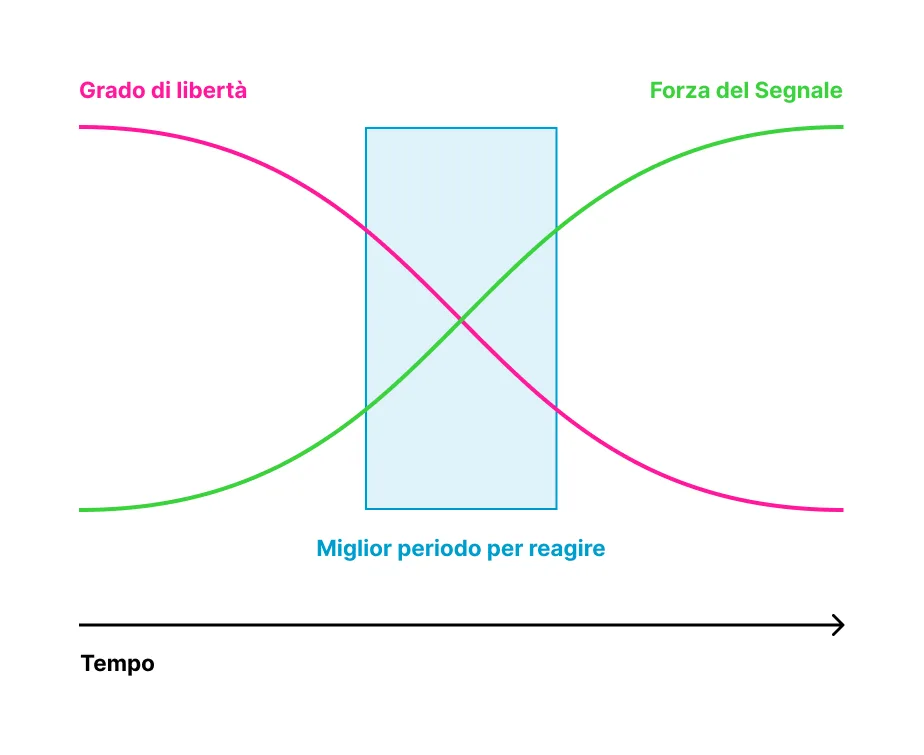
The signs of change that will inevitably impact one’s business model are already present in many organizations. Often they are simply not taken into account. Teams could do anything, which is why they do nothing.
When the signal for change becomes strong it is because we are listening to it so closely that it is extremely dangerous. Right now it is too late and we have no options, we have precisely no freedom to be able to choose an alternative solution.
Instead, there is a time when the signals from the outside world are strong and credible enough to make the impact of the innovation initiatives we might lead realistic. That is the best time to respond!
So the question becomes: how can we identify this ideal time to innovate in time?
The answer lies in two key skills that any organization can acquire.
The first is the ability to make sense of the data.
It is not only the company’s numbers but also qualitative and quantitative data describing the evolution of customer and competitor behavior.
The second is to be “ambidextrous.” Giuseppe Stigliano discusses this at min 54:56 while HBR talks about it in this article from 2004, still relevant.
Being ambidextrous consists of the ability to play two games simultaneously, that of the Exploitationthat is, of exploitation and optimization of the current business model, and of the Exploration, that is, of the ability to organize and support innovative projects with independent but integrated structures and the same management.
And you, what game are you playing?
Good work!
Make yourself heard.