Hey, happy Monday!
I like the idea of starting the year off with a bang.
I want to invite you to the first STRTGY Meeting in 2023.
We will meet Dario De Liberis, Lead Product Manager of Qonto.
Monday, January 23, 2023 at 6:30 pm.
Qonto is a new, fully digital bank specifically designed for SMEs and professionals.
We are not going to talk about finance and how a checking account works or the features they have invented. We’ll leave that for other podcasts and webinars.
We are going to talk about something deeper and more underrated.We are going to talk about the operating system that allows you to lead one of the fastest growing scaleups in Europe.
Steve Anavi, Co-Founder of the company, before launching the product with which his customers interact was concerned about building the product that enables his team to be systematically successful, intercept new opportunities and reduce errors: The Qonto Way.
Do not copy & paste
From Netflix to McDonald’s, from Spotify to Starbucks, these teams have a dual system; on the one hand they are concerned with the success of the company, and on the other they are concerned with the success of the customers.
While it is true what James Clear says, “Goals are good for setting a direction, but systems are better for making progress,” it is also true that to follow someone else’s manual is to set oneself on the road that leads to mediocrity.
This is why making copy and paste of others’ organizational models rarely works. Michele Zanini, co-author of Humanocracy, also confirmed this to us at the last STRTGY Meeting – About Replay.
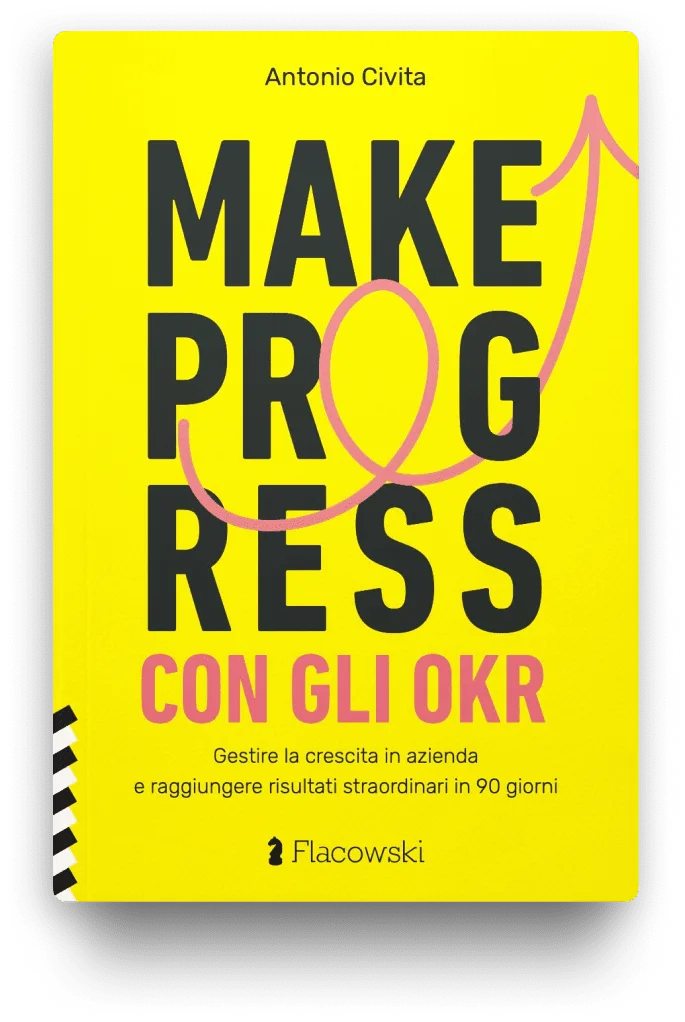
I have worked extensively on this fundamental concept to unlock the growth of any organization. Large or small. In Make Progress with OKRs there is an entire chapter devoted to how to implement your own Progress OS that distills the principles that will help build the one best suited to your, unique, operating model.
Want to anticipate your questions to Dario and me? Use this link.
I’ll wait for you in the room,
ALWAYS MAKE PROGRESS ⤴
THE OMTM
The only metric that matters
When you can measure something, the to-do becomes incredibly clear, but as the importance increases, so does the difficulty in finding the right metric.
If you want a hand in increasing the data literacy of your teams, use this link and share it with those who might find it useful. Each week I will select a challenge to make measurable.
How to measure team engagement?
This request comes from the Instagram channel of STRTGY. Perhaps one of the most frequently asked questions in the recent period.
I can say that the majority of teams that have launched OKRs with STRTGY have among their KRs theEmployee Turnover Rate calculated in this way:
ETR = # dipendenti che hanno lasciato l’azienda / ((# dipendenti all’inizio del periodo + # di dipendenti alla fine del periodo)/2)
This metric includes employees who leave by choice and those who are laid off, retire or otherwise. But leaving the company is not necessarily a negative sign of engagement. On this I think I will devote a special in-depth study. I am convinced that ETR is not the correct metric for this purpose. Neither are the surveys that HR in structured companies often submit to their employees with questions like, “How happy are you working here from one to ten?” They don’t work.
In my opinion, there is no precise metric that describes an employee’s degree of engagement. Rather, what we need to ask is what is the effect of increased engagement, and measure that.
Greater engagement of an administrative team leads to reduced errors. That of a design team to more creative solutions and more frequent and faster interactions. That of a sales team to the generation of more prospects.
It is also important to ask yourself in which area you need to measure engagement. With the corporate brand, with projects, with colleagues? Engagement is a dangerous word that often confuses motivation, competencies and strategic alignment.
Engaged teams solve more problems than bored teams. So rather than calculating engagement, try to understand what holds teams back from giving their best and measure the end result.
Tell me if this column has helped you and, if you like, write to me — even in chat — to let me know your thoughts. I’ll share the most interesting responses.